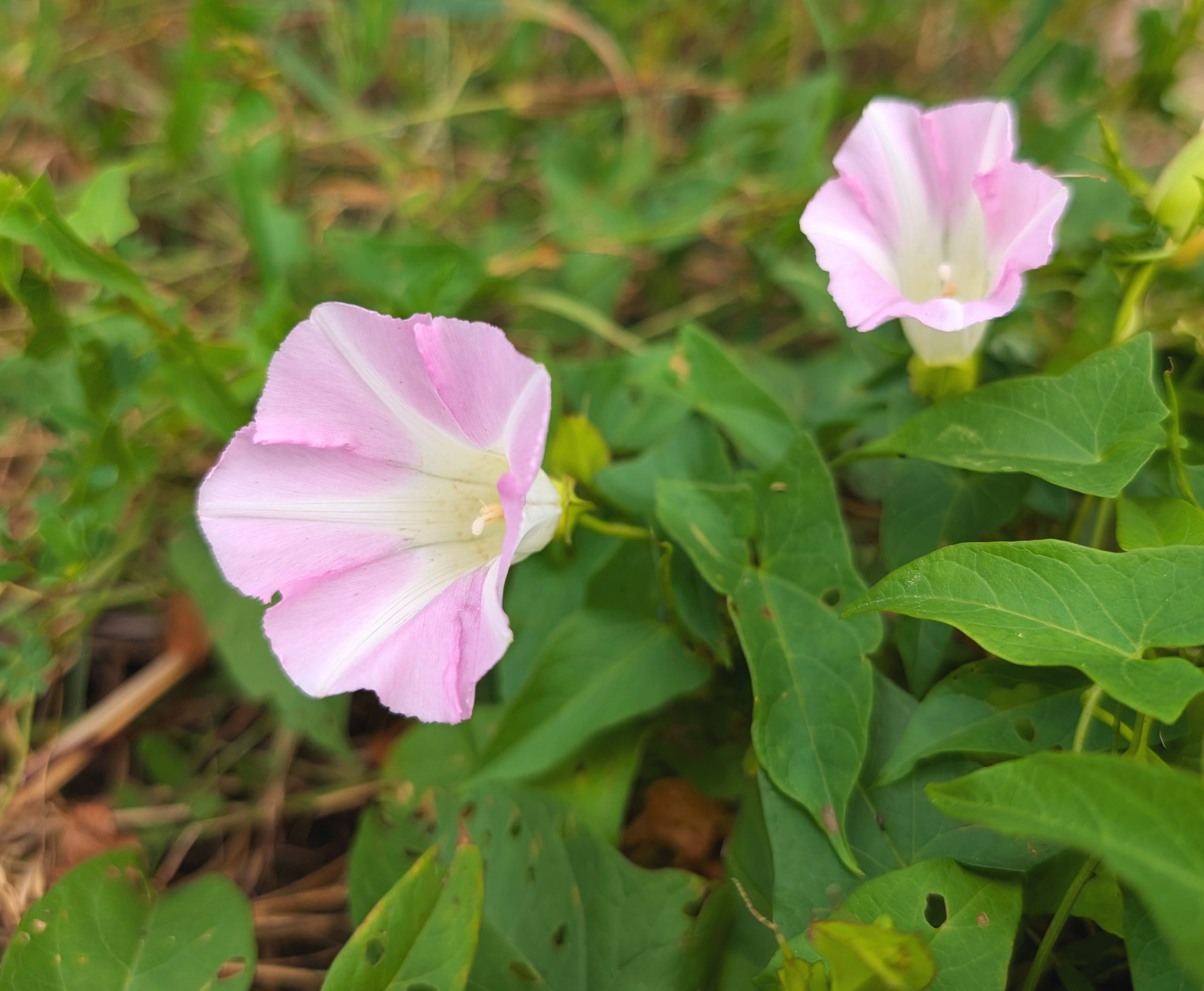
Calystegia sepium
Taxonomy
Domain: Eukaryota
Kingdom: Plantae
Subkingdom: Tracheobionta
Superdivision: Spermatophyta
Division: Magnoliophyta
Class: Magnoliopsida
Clade: Eudicots
Clade: Asterids
Order: Solanales
Family: Convolvulaceae
Genus: Calystegia
Species: Calystegia sepium
Common Names by Region
- United States / Canada: Hedge bindweed, wild morning glory, bugle vine, hedge false bindweed, Rutland beauty
- United Kingdom / Ireland: Hedge bindweed, bellbine, granny-pop-out-of-bed
- A note on “creeping Jenny”: in parts of North America and Britain this name is applied colloquially to bindweed, but it belongs properly to Lysimachia nummularia — an unrelated creeping groundcover in the primrose family with round, coin-shaped leaves and yellow flowers. If someone says “creeping Jenny,” ask which plant they mean.
Description
Quick ID
- Growth form: Vigorous herbaceous perennial vine, twining counterclockwise up anything within reach — fences, shrubs, tall grass — and sprawling across open ground where there’s nothing to climb. Runs 3–10 feet in a season.
- Flowers: Large, showy, funnel- or trumpet-shaped, roughly 2–3 inches across. White to pink, often with five darker pink stripes running up the folds, as here. Each bloom lasts about a day.
- Bracts — the diagnostic feature: Two large, green, leafy bracts sit directly at the flower base, wrapping and hiding the sepals. Visible on both flowers in this photo.
- Leaves: Arrowhead-shaped (sagittate), alternate, with distinct pointed basal lobes and a long stalk. Smooth-margined, medium green, 2–4 inches long.
- Roots: Deep, brittle, spreading rhizomes — the reason this plant is nearly impossible to remove once established.
Blooming
- Early summer into fall. Flowers open in morning light and close by afternoon or in overcast weather — the morning glory habit.
Look-alikes
- Field bindweed (Convolvulus arvensis): The main confusion, and a separate species. Its flowers are much smaller — roughly 1 inch — and its bracts are small and set well down the stem, away from the flower. Leaves are smaller with rounder basal lobes. A federally recognized noxious weed in many states and the more aggressive agricultural pest of the two.
- Common morning glory (Ipomoea purpurea): An annual with heart-shaped (not arrowhead) leaves and blue-to-purple flowers; dies with frost rather than returning from root.
- Low false bindweed (Calystegia spithamaea): A native, non-twining, low-growing relative of dry open ground.
Known Range
- Native status is genuinely mixed. Calystegia sepium has both native North American and introduced Eurasian forms, and they hybridize freely. The pink-flowered plants of eastern North America are often the native subspecies (C. sepium subsp. americana).
- Found throughout most of North America, Europe, and temperate Asia. Common across Pennsylvania on roadsides, field edges, fencerows, thickets, stream banks, and disturbed ground — including the reclaimed-industrial and river-corridor habitat around Johnstown.
Care / Habitat
Light
- Full sun to part shade. Flowers heaviest in the open but persists happily in partial shade.
Soil
- Indifferent. Tolerates poor, compacted, wet, or dry ground; thrives in disturbed and fertile soil alike.
Water
- Moderate to low. Drought-tolerant once the rhizome system is down.
Typical Habitat
- Hedgerows, fencerows, thickets, roadsides, ditches, stream banks, waste ground, gardens, and field margins — anywhere with something to climb and a bit of disturbance.
Propagation / Reproduction
- Rhizomes (the main engine): Spreads aggressively by deep, brittle underground stems. Any fragment left behind will resprout — which is why tilling and hand-pulling typically multiply the problem rather than solve it.
- Seed: Also produced in quantity, and famously long-lived — bindweed seed can remain viable in soil for decades.
- Twines counterclockwise; a single plant can smother a shrub or fence panel in a season.
Pests / Diseases / Threats
- Almost nothing troubles it. Tough, persistent, and largely pest-free.
- The plant itself is the threat in most contexts: it competes hard with crops and ornamentals, smothers young plantings, and is exceptionally difficult to eradicate once established.
- Bindweeds are among the most stubborn perennial weeds in temperate agriculture — the deep rhizome network defeats most mechanical control.
- Mildly toxic if eaten in quantity; the plant contains compounds that can cause digestive upset in livestock.
Additional Notes
Ecology & Use
- A real pollinator plant despite its reputation. Bees and hoverflies work the open trumpets in the morning hours, and the flowers are a nectar source for various moths — including hawkmoths at dusk on the ones still open.
- It’s the larval host for several moth species, including the convolvulus hawk-moth in parts of its range.
- The English folk name “granny-pop-out-of-bed” comes from a children’s trick: squeeze the base of the flower and the whole corolla pops free of the green bracts.
- The genus name Calystegia comes from Greek roots meaning “cup” and “cover” — a direct reference to those enclosing bracts that make the ID.
Management
- Want it gone? Accept that it takes persistence. Repeated cutting to exhaust the root reserves works over seasons; digging usually spreads it. Smothering with heavy mulch or landscape fabric over a full growing season is more effective than pulling.
- Want it? You almost certainly already have it. On a fence line where nothing else will grow and nothing valuable is at stake, it’s a handsome and generous flowering vine.
All Cernunnos Foundation materials are free to use for any educational purpose.
Views: 219