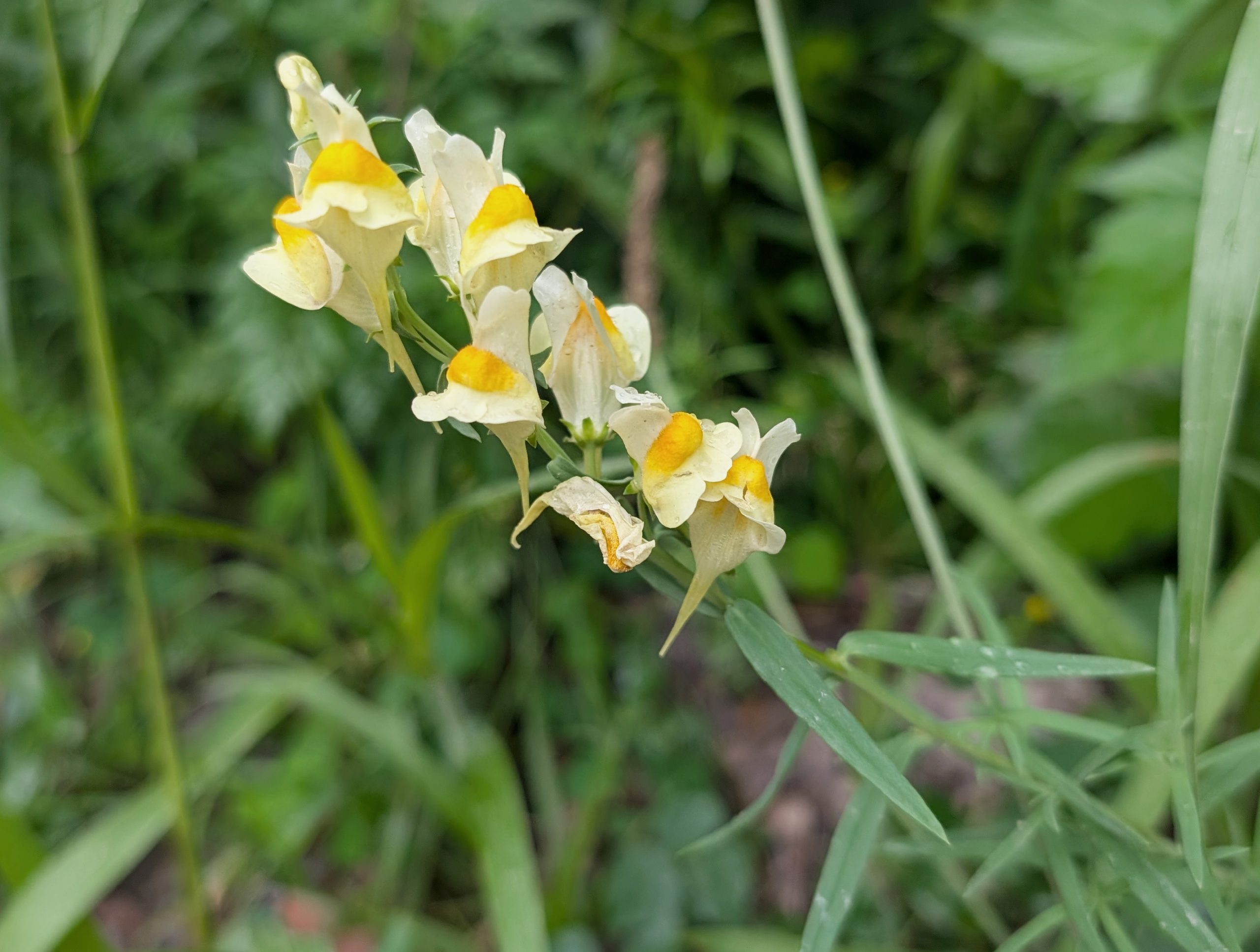
Linaria vulgaris
Taxonomy
Domain: Eukaryota
Kingdom: Plantae
Subkingdom: Tracheobionta
Superdivision: Spermatophyta
Division: Magnoliophyta
Class: Magnoliopsida
Clade: Eudicots
Clade: Asterids
Order: Lamiales
Family: Plantaginaceae
Genus: Linaria
Species: Linaria vulgaris
Common Names by Region
- United States / Canada: Butter-and-eggs, common toadflax, yellow toadflax, wild snapdragon, brideweed
- United Kingdom / Ireland: Common toadflax
- Continental Europe (native range): Local-language equivalents — e.g., German Gewöhnliches Leinkraut, referencing the flax-like (“Lein”) leaves
Description
Quick ID
- Growth form: Slender, upright perennial, roughly 1–3 feet tall, spreading into patches by creeping roots. Reads as an airy, wiry roadside plant.
- Flowers: Pale butter-yellow, snapdragon-shaped (two-lipped, closed-mouthed), roughly ¾–1 inch, borne in a crowded terminal spike. Each flower carries a long, straight spur pointing backward off the base.
- Center details: The clincher — a raised, hairy, deep orange-yellow palate bulging on the lower lip and closing the flower’s throat. The pale petals and orange bump are the literal “butter and eggs.”
- Leaves: Very narrow, linear, grass- or flax-like, blue-green, crowded and alternate up the stem — the “Linaria” (flax-like) trait.
- Pollination note: The closed mouth means only strong insects (mostly bumblebees) can force it open to reach the nectar in the spur — a selective, bee-keyed flower.
Blooming
- Midsummer into fall. This photo dates to July 31, right in the window, with fresh flowers up top and a spent bloom lower on the spike.
Look-alikes
- Garden snapdragon (Antirrhinum majus): Similar two-lipped mouth but larger, broader-leaved, many-colored, and spurless — no backward spur.
- Dalmatian toadflax (Linaria dalmatica): A related invasive with broad, heart-shaped, clasping gray-green leaves rather than the narrow linear leaves here.
- “Peloria” forms: Linaria vulgaris famously throws a rare mutant with five spurs and radial symmetry — a historic curiosity in the study of flower development, worth knowing if you ever find an odd star-shaped one.
Known Range
- Native: Europe and temperate Asia.
- Introduced / naturalized: Widely established across North America — most of the United States and Canada. In Pennsylvania it’s a common sight on roadsides, field edges, railway ballast, and disturbed ground, including the reclaimed-industrial and river-corridor habitat around Johnstown.
Care / Habitat
Light
- Full sun. Flowers best in the open; tolerates light shade.
Soil
- Well-drained, lean ground. Thrives in gravel, sand, and poor rocky soil — the tougher and more disturbed, the better.
Water
- Drought-tolerant. Once the root system is established it asks for nothing.
Typical Habitat (when naturalized)
- Disturbed and pioneer ground: roadsides, fields, waste places, quarry edges, railway lines, and fresh fill — sun plus sharp drainage.
Propagation / Reproduction
- Two ways, which is what makes it tenacious: by seed (prolific, wind- and gravity-dispersed) and by creeping horizontal roots that send up new shoots, forming spreading clonal patches.
- A single plant becomes a colony; root fragments left in the soil resprout, which is why pulling often makes it worse.
- To contain it: dig thoroughly to remove the root system, or cut before seed set — but expect persistence.
Pests / Diseases / Threats
- Tough and largely trouble-free.
- Noxious-weed status: listed as a noxious or regulated weed in several U.S. states and Canadian provinces, mainly a concern on rangeland and pasture, where the creeping roots let it crowd out forage.
- Biological control agents (a stem-mining weevil and a seed-capsule weevil) have been deployed against it in the West.
Additional Notes
Ecology & Use
- A genuine bumblebee plant — the spurred, closed flower is built for them, and they’re its main pollinator. Long-tongued bees and the occasional hawkmoth work it too.
- Folk medicine and dye: historically used as a diuretic and skin wash in European herbalism, and the flowers yield a yellow dye. Now valued more as a wildflower than a remedy.
- Developmental-biology fame: the peloria (five-spurred, radially symmetric) mutant of this species was described by Linnaeus and remains a textbook case in the study of floral symmetry and epigenetics — a rare instance where a roadside weed sits at the center of a scientific story.
- Earns its complicated place in a field guide: pretty, bee-friendly, and honest about being an aggressive naturalized spreader.
Management
- Want it? It needs no help — sun and poor soil are enough.
- Want it held? Dig out the full root system and cut spikes before seed drop; expect to repeat.
All Cernunnos Foundation materials are free to use for any educational purpose.
Views: 242