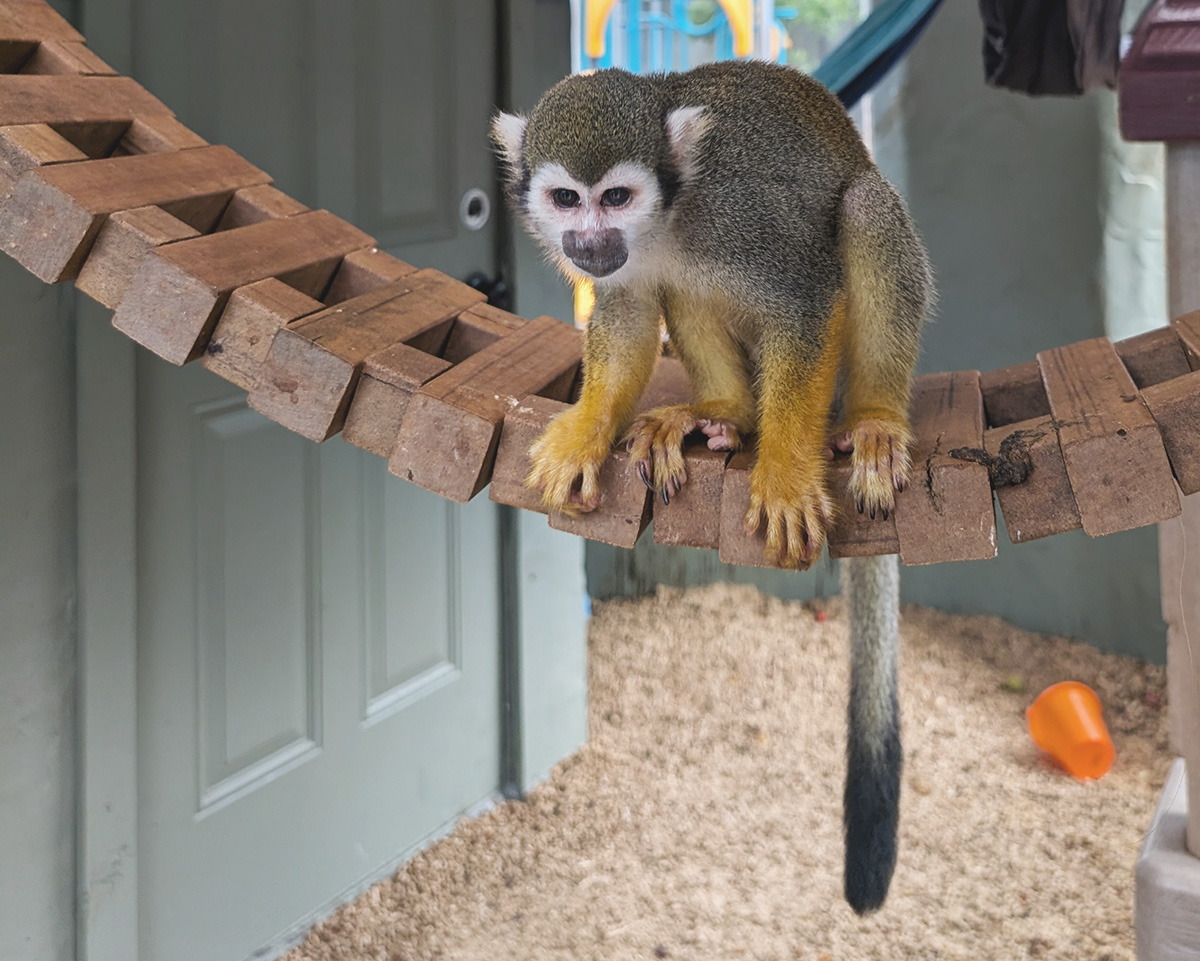
Saimiri sciureus
Taxonomy
- Domain: Eukaryota
- Kingdom: Animalia
- Phylum: Chordata
- Class: Mammalia
- Order: Primates
- Suborder: Haplorhini
- Infraorder: Simiiformes
- Family: Cebidae
- Subfamily: Saimiriinae
- Genus: Saimiri
- Species: Saimiri sciureus (common squirrel monkey; part of a debated species complex)
Common Names by Region
- United States / exhibit & rescue trade: Common squirrel monkey, South American squirrel monkey
- South America (native range): Mono ardilla, saimirí (Spanish); macaco-de-cheiro — “smell monkey,” for its scent-marking — (Portuguese)
- General: Squirrel monkey
Description
Quick ID
- Face: White mask around the eyes with a dark crown and a black muzzle — the “Gothic arch” facial pattern that marks the sciureus group.
- Body: Small and slender, olive-to-gray back and shoulders, with bright yellow-orange forearms, hands, and legs — the “golden” limbs visible here.
- Tail: Long, slender, dark-tipped, and not strongly prehensile — used mainly for balance, not grasping. In this photo it hangs straight down as a counterweight.
- Size: One of the smaller monkeys: head-and-body roughly 10–14 inches, the tail as long again; adults weigh only about 1.5–2.5 pounds.
- Hands: Fine, dexterous fingers with claw-like nails, gripping the bridge slats here.
Range
- Native to the tropical forests of northern and central South America — the Amazon and Orinoco basins across Brazil, the Guianas, Venezuela, Colombia, and neighboring countries.
Habitat & Behavior
- A rainforest canopy and mid-story animal, favoring riverine and secondary forest with dense cover.
- Intensely social — wild troops can number from a couple dozen into the hundreds, among the largest groups of any New World monkey.
- Diurnal and constantly active, foraging acrobatically through the branches. Agile leapers and climbers; the enrichment ropes, bridges, and hammocks in this enclosure substitute for that vertical canopy life.
- Scent communication is central: they mark by rubbing urine on hands and feet (“urine washing”), spreading individual and troop scent as they travel.
Diet
- Omnivorous, leaning heavily on insects and fruit, with flowers, nectar, seeds, small vertebrates, and eggs rounding it out.
- An active insect-hunter — much of the day is spent gleaning arthropods from foliage, which makes them agents of both seed dispersal and insect control in their forests.
Reproduction
- Breeding is seasonal, timed so births fall in the wet season when food peaks.
- Single infant typical, carried on the mother’s back; other females may help tend young.
- Males “fatten” seasonally under hormonal shifts ahead of the breeding season — a distinctive squirrel-monkey trait.
- Long-lived for their size, commonly into their late teens or twenties in managed care.
Threats / Conservation / Notes
- Wild populations face habitat loss and capture for the pet and research trade.
- Historically taken in large numbers for biomedical research and the pet trade — a major past pressure on wild stocks.
- The pet trade remains the reason so many of these animals end up needing rescue (see field note).
Additional Notes
Ecology & Significance
- Squirrel monkeys are a textbook example of mixed-species association — in the wild they routinely travel with capuchin monkeys, exploiting the larger species’ foraging and extra vigilance against predators.
- Their large brain-to-body ratio is among the highest of any primate, an outsized brain on a tiny frame.
- The taxonomy is a live scientific debate: forms once lumped as Saimiri sciureus are variously split into separate species, so any single captive animal’s precise identity often can’t be settled without knowing its origin.
Field Note — Why This One Is Here
- This animal was photographed at a rescue facility, and that is the honest heart of the squirrel monkey story. These are among the primates most often surrendered to rescues and zoos, and the reason is the pet trade. People buy them as babies — small, clinging, undeniably charming — and discover too late what they’ve taken on.
- The cruel arithmetic is in that big brain. A squirrel monkey is just smart enough to make a terrible pet. It is intelligent, intensely social, and wired for a troop of dozens and a canopy of miles — and none of that can be met in a house. As it matures it scent-marks by washing itself in its own urine, it bites, it grows anxious and destructive, and it needs company and movement no family can supply. What began as an adorable infant becomes an animal no home can hold and no owner can rehome. The result is heartache twice over: for the family that couldn’t have known, and for the animal, which pays the larger price — surrendered, or worse, and never able to be returned to a wild it never knew. The kindest thing a person can do for a squirrel monkey is to never make one a pet in the first place.
- A note on this individual: captive squirrel monkeys are very often of mixed or uncertain origin, and this one is likely a hybrid rather than a clean example of any one form. The animals sold into the American pet trade over the decades were drawn from across the Saimiri complex and bred without regard to type, so a given rescue animal may carry the blood of several. Beyond the common squirrel monkey (S. sciureus) proper, forms now recognized as separate species — the black-capped or Bolivian squirrel monkey (Saimiri boliviensis), the Ecuadorian/western Amazonian Saimiri macrodon, and the Humboldt’s Saimiri cassiquiarensis — are all plausible contributors to an animal like this one. Its exact ancestry can’t be read from a photograph, and for most rescue monkeys it simply isn’t knowable.
All Cernunnos Foundation materials are free to use for any educational purpose.
Views: 257