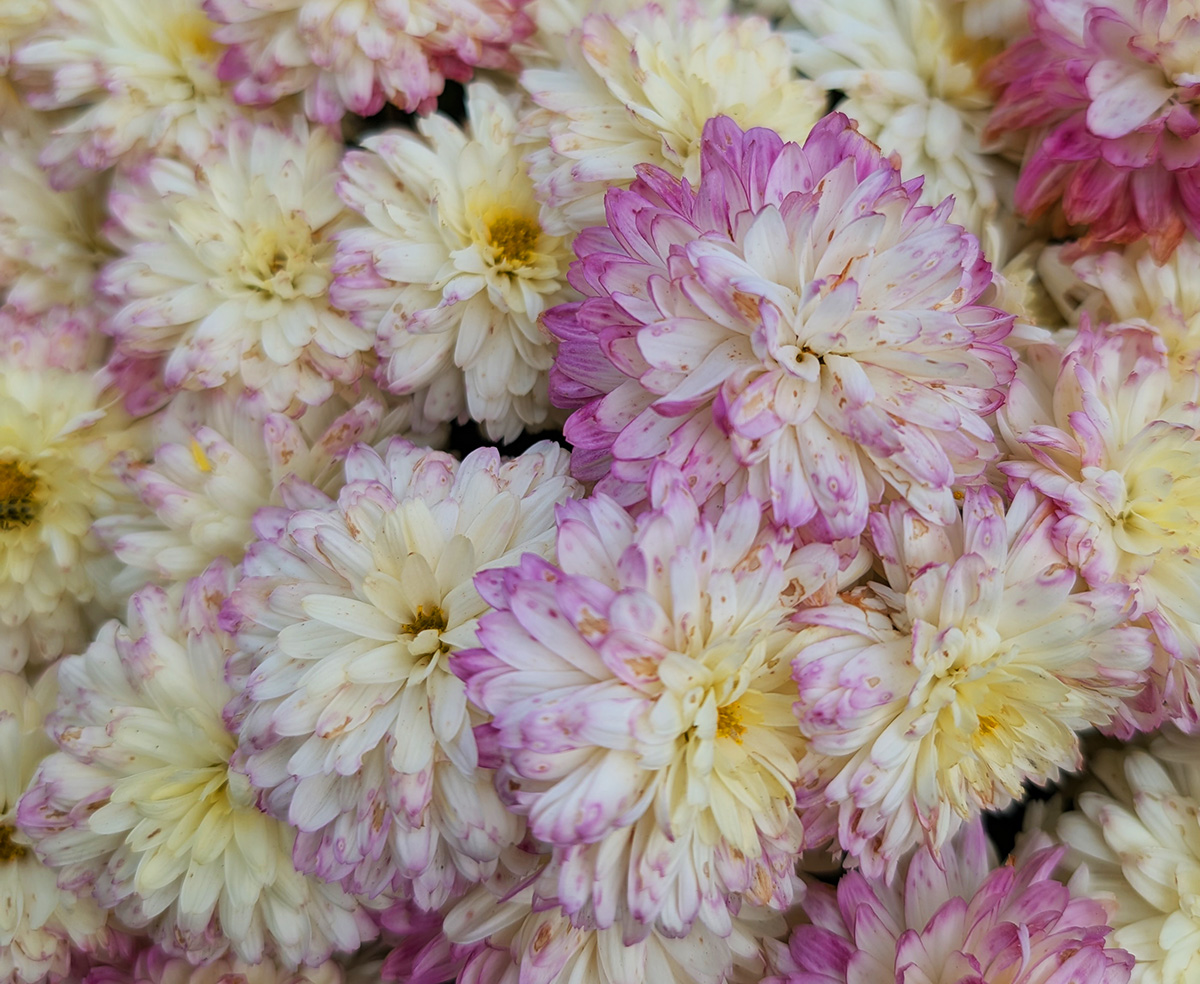
Chrysanthemum morifolium
Taxonomy
Domain: Eukaryota
Kingdom: Plantae
Subkingdom: Tracheobionta
Superdivision: Spermatophyta
Division: Magnoliophyta
Class: Magnoliopsida
Clade: Eudicots
Clade: Asterids
Order: Asterales
Family: Asteraceae
Genus: Chrysanthemum
Species: Chrysanthemum morifolium
Common Names by Region
- United States / Canada: Garden mum, hardy mum, florist’s chrysanthemum, fall mum
- United Kingdom / Ireland: Chrysanthemum, “mum”
- China (origin): Júhuā (菊花) — cultivated for well over 2,000 years and one of the “Four Gentlemen” of classical Chinese art
- Japan: Kiku (菊) — the imperial emblem and namesake of the Chrysanthemum Throne
- General: Mum
Description
Quick ID
- Growth form: Bushy, mounding herbaceous perennial, typically 1–3 feet tall and wide, woody at the base. Reads as a dense cushion of bloom in fall.
- Flowers: Composite heads (this is the daisy family), each “flower” a packed dome of many ray and disc florets. This strain is a full double type — layered petal-like rays nearly hiding the center. Heads roughly 1–3 inches across, borne in profusion.
- Color: Enormously varied across the species — white, yellow, gold, bronze, red, pink, purple, and bicolors. This is a cream-to-pale-yellow base flushing rose-pink at the petal tips, with light freckling.
- Bloom forms: The trade sorts mums by head shape — decorative, pompon, cushion, spider, quill, spoon, and others. This dense, rounded, incurving type reads as a decorative/cushion form.
- Leaves: Aromatic, lobed, and toothed, gray-green, giving off the distinctive pungent chrysanthemum scent when crushed.
Blooming
- Late summer through fall. Mums are short-day plants — they set bud as nights lengthen, which is why they’re the signature autumn flower and why greenhouse growers manipulate light to time them.
Look-alikes
- Aster (Symphyotrichum spp.): Overlaps in fall bloom and daisy form, but asters show open, single, daisy-like flowers with obvious yellow centers and lack the pungent chrysanthemum foliage scent.
- Dahlia: Larger, fleshier heads on hollow stems from tubers; no aromatic mum foliage.
- Florist “spider mums” and other showpiece chrysanthemums: Same species, different bred head form.
Known Range
- Origin: A hybrid species of ancient cultivation, derived from wild chrysanthemum species of East Asia (China). It does not exist as a truly wild plant — it’s a product of millennia of selection.
- In cultivation: Grown worldwide. Ubiquitous across the United States, including throughout Pennsylvania, where “hardy garden mums” are the dominant fall bedding and container plant. Hardiness varies by cultivar and planting time — many sold as fall décor are only marginally hardy here and are treated as annuals.
Care / Habitat
Light
- Full sun, six-plus hours, for compact growth and heavy bloom. Shade stretches the plant and thins the flowering.
Soil
- Rich, well-drained soil with steady organic matter. Dislikes soggy ground, which rots the crown over winter.
Water
- Even moisture through the growing season; avoid wetting the foliage to limit fungal problems. Ease off as blooms finish.
Overwintering (the key issue here)
- Mums bought in fall bloom rarely survive winter in our climate — they put energy into flowers instead of roots and heave out over winter. For a mum to return as a perennial, plant it in spring, pinch it back through early summer, and let it establish roots before it blooms.
Pinching
- Pinch growing tips through early July for a dense, well-branched mound covered in bud. Stop pinching by mid-summer so buds can set for fall.
Typical Habitat (when cultivated)
- Sunny beds, borders, container plantings, and fall porch displays — well-drained, open sites.
Propagation / Reproduction
- Cuttings and division are the standard methods, and the way named cultivars are kept true.
- Division every couple of years also rejuvenates old clumps that have died out in the center.
- Seed is possible but won’t come true from hybrids; the named strains are all vegetatively propagated.
Pests / Diseases / Threats
- Aphids, thrips, spider mites, and leaf miners are the common insect pests.
- Powdery mildew, leaf spot, and root/stem rot in humid, crowded, or poorly drained conditions.
- Chrysanthemum white rust is a serious regulated disease in the trade.
- Not invasive; hybrid garden plants don’t naturalize.
Additional Notes
Ecology & Use
- Single and daisy-form mums are good late-season pollinator plants, feeding bees and butterflies when little else is blooming — though dense doubles like this one, with the disc florets buried under rays, offer pollinators far less than the open forms.
- Cultural weight: few ornamentals carry more. The chrysanthemum is one of the “Four Gentlemen” of Chinese painting, the imperial emblem and Chrysanthemum Throne of Japan, and a flower of remembrance in much of Europe, where mums are traditionally placed on graves.
- Practical uses beyond the border: chrysanthemum tea and culinary petals in East Asian cuisine, and the insecticide pyrethrum — derived from a related chrysanthemum species (Tanacetum cinerariifolium), one of the oldest botanical insecticides.
- A backbone of the global cut-flower trade and the definitive fall garden-center plant.
Management
- Want it to return next year? Plant in spring, not fall, and pinch through early summer.
- Want the fullest bloom? Full sun, steady feeding, and pinch tips until early July.
All Cernunnos Foundation materials are free to use for any educational purpose.
Views: 234