
Kingdom: Plantae
Clade: Tracheophytes
Clade: Angiosperms
Clade: Eudicots
Order: Ericales
Family: Polemoniaceae
Genus: Phlox
Species: Phlox paniculata L.
General / English: Tall Garden Phlox
Other English Names: Garden Phlox, Summer Phlox, Fall Phlox, Perennial Phlox
Scientific Name: Phlox paniculata
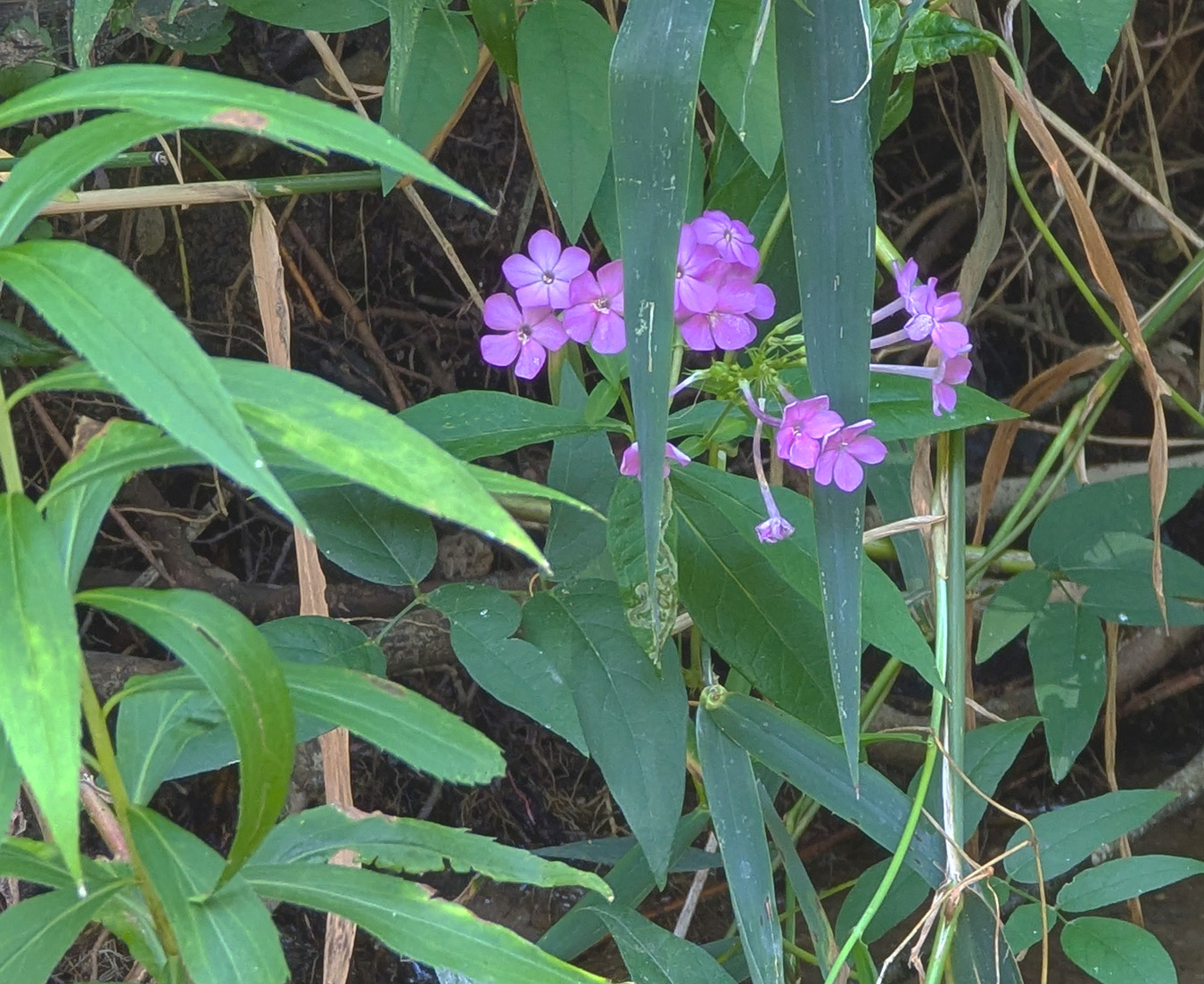
The plant shown here is tall garden phlox, Phlox paniculata, or a cultivated variety derived from that species.
It is an upright, clump-forming herbaceous perennial with opposite leaves and conspicuous terminal clusters of tubular flowers. Individual flowers open into five broad, flattened lobes, giving each bloom a rounded, nearly pinwheel-like appearance. Garden forms occur in numerous shades of pink, purple, lavender, red and white.
The photographed plant bears loose clusters of bright pink-purple flowers with pale centers. The exact cultivar cannot be established from the image alone because many cultivated varieties have similar coloration and floral structure.
The species commonly grows approximately 2–4 feet tall, although some selections may be shorter or taller.
Tall garden phlox is native to portions of eastern and central North America.
Its natural distribution is associated principally with the eastern United States, although centuries of cultivation, horticultural selection and escape from gardens have complicated its modern distribution. It has become naturalized beyond portions of its original range.
Because Phlox paniculata is widely planted and represented by many cultivars, an individual encountered near human landscaping should not automatically be treated as a naturally occurring wild population.
In natural settings, tall garden phlox occurs in relatively moist, open habitats, including:
Cultivated plants are commonly installed in:
The species generally performs best in fertile, consistently moist but well-drained ground. Full sun encourages dense flowering, while some partial shade may be tolerated. Good airflow is important because crowded or persistently damp foliage can encourage powdery mildew.
Tall garden phlox flowers primarily from midsummer into early autumn.
The blossoms are held in branched terminal clusters. Each flower consists of a narrow tube opening into five broad lobes. Depending on cultivar, blooms may be:
Many cultivated forms are fragrant, particularly during warm weather and toward evening. The long flowering period makes the plant useful for maintaining color and nectar availability after many spring and early-summer flowers have finished.
The leaves are generally arranged in opposite pairs along stiff, upright stems.
They are usually:
Lower leaves may have short stalks, while upper leaves may sit almost directly against the stem. Mature stems can become sufficiently tall and top-heavy that plants grown in shade or rich soil may lean without support.
The visible leaves in the photograph agree with this pattern: broad at the lower portion, narrowing toward an extended point and arranged along an erect green stem.
Although tall garden phlox is best known as an ornamental, its flowers also function as a useful nectar source.
Visitors may include:
The narrow floral tube favors animals capable of reaching nectar held below the flower opening. Butterflies and hummingbirds are particularly associated with flowering garden phlox.
Where the species occurs within its native ecological range, it can contribute nectar to late-season pollinator communities. Cultivated selections may vary in nectar production, fragrance, flower structure and accessibility.
Tall garden phlox is a perennial. Its above-ground stems die back after the growing season, while the root system remains alive and produces new shoots the following year.
The plant can reproduce through:
Cultivated plants are frequently propagated by division or cuttings to preserve the characteristics of named varieties. Seed-grown offspring may differ from the parent in height, flower color, disease resistance or growth habit.
Established clumps can broaden over time and may benefit from occasional division when their centers become crowded or flowering declines.
Tall garden phlox is widely used to provide vertical structure and concentrated summer color in perennial plantings.
Typical landscape functions include:
The photographed specimen was being used as filler within the garden being documented. It occupied an opening among taller foliage and surrounding plants rather than serving as the dominant feature of the planting.
That role is well suited to garden phlox. Its erect stems rise through neighboring vegetation, while the flower clusters provide visible color above or between otherwise green plant masses.
Tall garden phlox generally favors:
Light: Full sun to partial shade
Soil: Fertile, moist and well drained
Moisture: Consistent moisture without prolonged waterlogging
Bloom Period: Mid-summer through early fall
Habit: Upright, clump-forming perennial
Typical Height: Approximately 2–4 feet
Plants should be spaced sufficiently to allow air circulation. Water directed toward the soil rather than repeatedly wetting the foliage may reduce fungal pressure. Removal of spent flower clusters can improve appearance and may extend flowering in some cultivars.
The most familiar disease problem associated with garden phlox is powdery mildew.
This fungal condition produces a pale or white coating on leaves and is encouraged by susceptible cultivars, crowding, poor airflow and certain combinations of humidity and leaf dryness. It is often cosmetically severe without immediately killing the plant.
Other potential problems include:
Modern cultivars are often selected for improved mildew resistance, although resistance varies considerably.
Tall garden phlox is not generally regarded as globally threatened.
Wild populations remain part of eastern North American flora, while the species is also extremely common in cultivation. However, cultivated abundance should not be confused with the condition of genetically distinct wild populations.
Habitat alteration, streambank modification and replacement of native vegetation can still reduce naturally occurring local colonies even while horticultural varieties remain widespread.
The genus name Phlox derives from a word meaning flame, a reference to the intense flower colors found among members of the genus.
The specific epithet paniculata refers to the branched panicles in which its flowers are carried.
Tall garden phlox has been cultivated for generations, producing an extensive range of named varieties. These selections vary in:
For that reason, photographs often permit confident identification to species or horticultural group without allowing a reliable cultivar identification.
Species: Phlox paniculata
Common Name: Tall Garden Phlox
Plant Type: Herbaceous perennial
Identification Confidence: Strong at species or cultivated-species level; cultivar undetermined
Image Context: Cultivated garden planting
Landscape Function: Used as filler among surrounding vegetation
The plant was not the central structural element of the garden. It had been placed among other vegetation to fill space and introduce a concentrated patch of summer color.
Its position illustrates one of the most common practical uses of tall garden phlox: allowing upright stems and bright flower clusters to emerge through a crowded mixed planting without requiring the plant to dominate the composition.
This profile and its associated original photograph are part of the Cernunnos Foundation natural-history archive.
The image documents not merely the isolated form of the species but the way plants are actually used and encountered—in this case, as ornamental filler woven into a larger garden composition. Such contextual photographs preserve information about human planting choices as well as plant morphology.
Text and imagery may be used for educational, artistic, research and reference purposes in accordance with the Foundation’s publication policy.