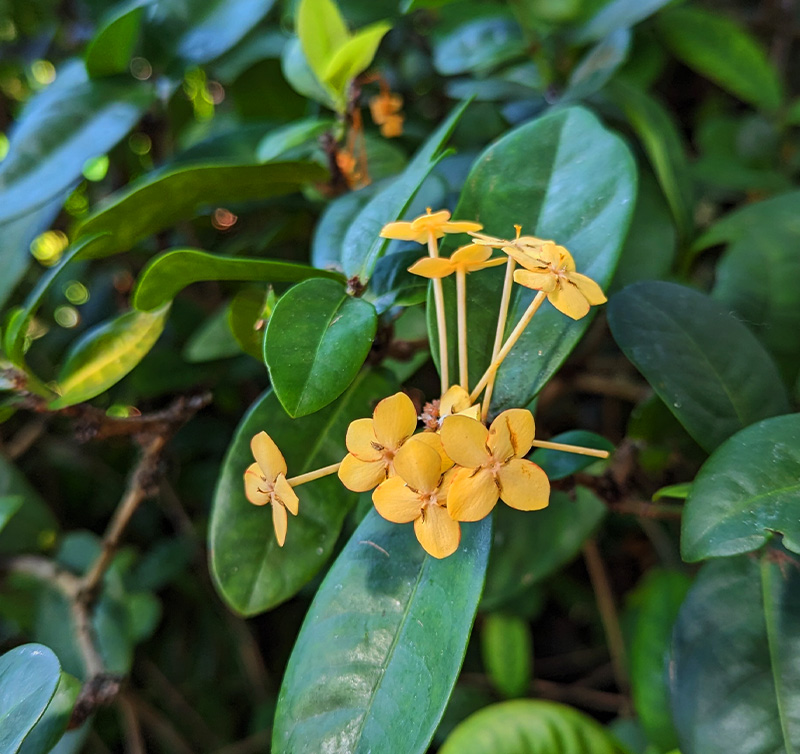
Ixora chinensis
Taxonomy
- Kingdom: Plantae
- Clade: Tracheophytes
- Clade: Angiosperms
- Clade: Eudicots
- Clade: Asterids
- Order: Gentianales
- Family: Rubiaceae
- Genus: Ixora
- Species: Ixora chinensis
Common Names by Region
- Chinese Ixora
- Jungle Flame
- Jungle Geranium
- Santan (Philippines)
- West Indian Jasmine (misnomer — not a true jasmine)
Description
Growth Habit
Ixora chinensis is a compact, evergreen tropical shrub forming dense, rounded, multi-stemmed clumps. Left unpruned it builds a tight, twiggy framework — well suited to hedging and container culture.
Leaves
Leaves are:
- oblong to elliptic with a rounded-to-pointed tip
- glossy, deep green, and leathery
- arranged oppositely, sometimes appearing whorled at the stem tips
- marked with a pale central midrib and a slightly quilted surface
Flowers
The defining feature:
- Dense, domed clusters (corymbs) of small four-lobed, star-shaped flowers
- Warm butter-yellow in this specimen (the species and its cultivars also occur in red, orange, pink, and white)
- Each bloom sits atop a slender floral tube — adapted for long-tongued nectar feeders
- Individual clusters open progressively, extending the display over weeks
Known Range
- Native to: southern China, Taiwan, and mainland Southeast Asia
- Widely cultivated across:
- Southeast Asia
- the Indian subcontinent
- the Caribbean and tropical Americas
- frost-free zones of the southern United States (Florida, Gulf Coast)
In temperate regions it is grown as a container or conservatory plant, moved indoors before frost.
Care / Habitat
- Light: Full sun to bright partial shade (heaviest flowering in full sun)
- Soil: Well-drained, slightly acidic, rich in organic matter
- Water: Consistent moisture; dislikes both drought and waterlogging
- Temperature: Warm and frost-free; foliage damages below roughly 40°F
Thrives in:
- tropical hedges and foundation plantings
- large containers
- pollinator and butterfly gardens
Propagation / Reproduction
- Primarily propagated by:
- semi-hardwood stem cuttings (most reliable)
- seed (slower, less common in cultivation)
Cuttings root best with warmth and high humidity. Established plants flush repeatedly through the warm season, with peak bloom in summer.
Pests / Diseases / Threats
Generally hardy in suitable climates but may encounter:
- Aphids
- Scale insects
- Spider mites (in hot, dry indoor air)
Chlorosis — yellowing between leaf veins — is common in alkaline soils, where iron and manganese lock up. Root rot follows poor drainage.
Ecological Role
A dependable nectar plant.
Attractive to:
- butterflies and skippers
- sunbirds and hummingbirds (in respective ranges)
- bees and other long-tongued pollinators
The narrow floral tube rewards nectar specialists, making it a useful support species in structured pollinator plantings.
Additional Notes
- One of the most widely planted flowering hedges in the tropics
- Prized for near-continuous bloom under warm conditions
- The yellow form reads as a warm signal color in a planting palette while still doing ecological work
- Non-invasive in most cultivated settings but should be sited thoughtfully in frost-free regions where it naturalizes readily
Maintenance / Management
- Light, frequent tip-pruning maintains density and drives new flowering wood
- Avoid hard shearing, which sacrifices bloom for a season
- Feed with an acidifying fertilizer during the growing season; correct chlorosis with chelated iron
- In colder zones, overwinter indoors in bright light and reduce watering
Cernunnos Foundation Note
Ixora chinensis is a workhorse of the warm-climate planting toolkit — a plant that holds structure as a hedge, carries sustained color, and feeds nectar specialists across a long bloom window. In system design it operates as both boundary (dense evergreen mass) and support (reliable nectar resource), earning its place where form and function are asked to overlap.
Field Note — ID caveat
Yellow-flowered ixoras are easy to mislabel. The glossy oblong leaves and four-lobed corymbs place this firmly in Ixora, and the filename calls it I. chinensis, which is consistent with the growth habit here. That said, much of the yellow ixora in cultivation is sold under Ixora coccinea cultivar names or as unnamed hybrids, and the two species intergrade in the trade. Published as the best read; correction welcome if a grower tag or flowering detail says otherwise.
Post Views: 196