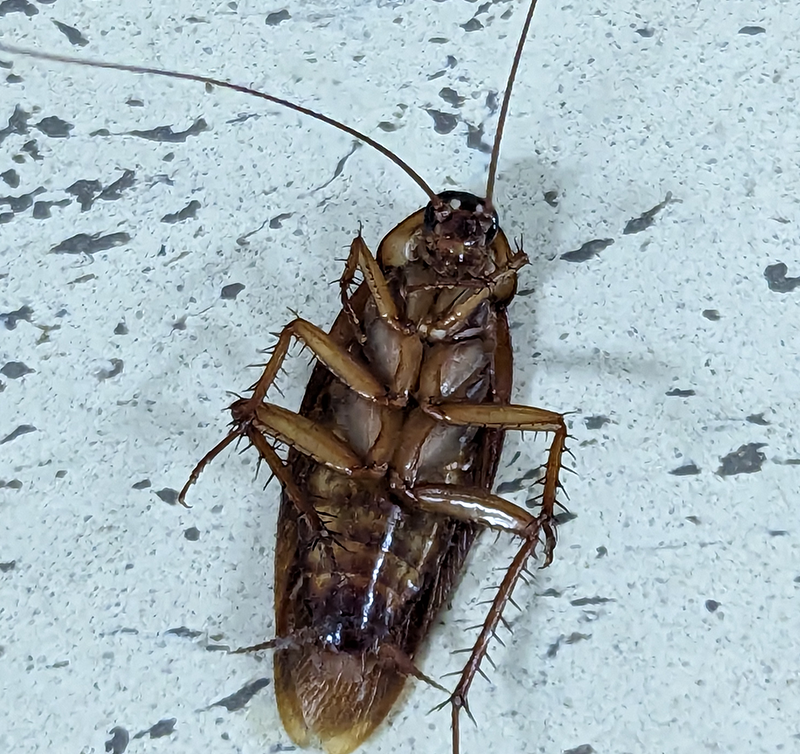
Periplaneta americana
Taxonomy
- Domain: Eukaryota
- Kingdom: Animalia
- Phylum: Arthropoda
- Class: Insecta
- Order: Blattodea
- Family: Blattidae
- Genus: Periplaneta
- Species: Periplaneta americana
Common Names by Region
- United States / Canada: American cockroach, waterbug, palmetto bug (especially in the South), flying waterbug
- United Kingdom: American cockroach, ship cockroach
- General: Sewer roach, water bug
Description
Quick ID
- Size: Large — roughly 1.2–2 inches, one of the biggest cockroaches to invade buildings, and the largest common house-associated species in North America.
- Color: Reddish-brown to mahogany, with a paler yellowish margin and a figure-8 / halo pattern on the pronotum (the shield behind the head).
- Wings: Fully developed in both sexes, extending to or past the tip of the abdomen. Adults can fly (or glide) in warm conditions, though they mostly run.
- Legs: Long, spined, and built for speed — among the fastest running insects, clocked at remarkable body-lengths per second.
- Antennae: Very long, thread-like, often exceeding the body length — visible trailing off the head here.
- This view: Photographed ventral (belly-up), showing the segmented abdomen, the leg spination, and the mouthparts and antennae at the head.
Range
- Despite the name, not native to the Americas. Periplaneta americana is believed to have originated in tropical Africa and spread worldwide through human commerce and shipping — an early and thorough hitchhiker on ocean trade.
- Now cosmopolitan, found across the globe wherever warmth and moisture allow, including throughout the United States.
Habitat & Behavior
- Favors warm, damp, dark places: sewers, drains, basements, steam tunnels, crawlspaces, boiler rooms, and the humid undersides of buildings. The “sewer roach” and “waterbug” names come from exactly this.
- Nocturnal; hides by day in cracks and cavities and forages at night. A scatter of them fleeing when a light snaps on is the classic encounter.
- Fast, cold-sensitive, and moisture-dependent — it thrives in the tropics and in the heated, humid infrastructure of temperate cities, but doesn’t survive hard cold outdoors in the north.
- Largely outdoor and structural rather than a true indoor breeder like the German cockroach, but readily comes inside through drains and gaps.
Diet
- Omnivorous scavenger — one of the least fussy eaters in the animal world. Takes decaying organic matter, food scraps, crumbs, grease, paper and book bindings, glue, hair, and just about any organic material.
- This dietary flexibility is a big part of why it succeeds anywhere humans generate waste.
Reproduction
- Females produce a dark, purse-shaped egg case (ootheca) holding roughly 14–16 eggs, deposited or glued in a sheltered spot.
- A female can produce many oothecae over her life, yielding hundreds of offspring.
- Nymphs hatch resembling small wingless adults and mature through a series of molts over months; adults are long-lived by insect standards, often surviving a year or more.
Pests / Threats / Notes
- A significant household and public-health pest. It doesn’t bite or sting, but it mechanically carries bacteria and pathogens across surfaces as it travels from drains and waste to food areas, and its droppings and shed skins are a known allergen and asthma trigger.
- Control leans on moisture reduction, sanitation, and exclusion — sealing gaps, fixing leaks, and denying food and water — with baits and targeted treatments as backup. A dry, sealed, clean building is inhospitable to it.
Additional Notes
Ecology & Significance
- Ironically named twice over: not American, and not really a “waterbug” in the true-bug sense — just a roach that likes damp places.
- One of the planet’s great evolutionary successes. Cockroaches as a lineage are ancient — the group predates the dinosaurs — and P. americana embodies why they persist: generalist diet, fast breeding, hardiness, speed, and a tolerance for exactly the warm, waste-rich environments humans build.
- A workhorse laboratory animal. Its size and hardiness have made it a standard subject in the study of insect physiology, neurobiology, and locomotion — cockroach leg and escape-reflex research has directly informed robotics and the design of fast, stable walking machines.
- In its outdoor and tropical range it plays the ordinary ecological role of a decomposer, recycling dead organic matter — the same appetite that makes it a nuisance indoors makes it useful outdoors.
As an Encounter
- The specimen here turned up indoors on tile, belly-up — the usual way most people meet one, and a decent chance to actually see the anatomy that a live, fleeing roach never holds still long enough to show: the spined running legs, the long sensory antennae, and the full-length wings of a large, ancient, and stubbornly successful insect.
All Cernunnos Foundation materials are free to use for any educational purpose.
Views: 252