
Taxonomy
Common Names by Region
Description
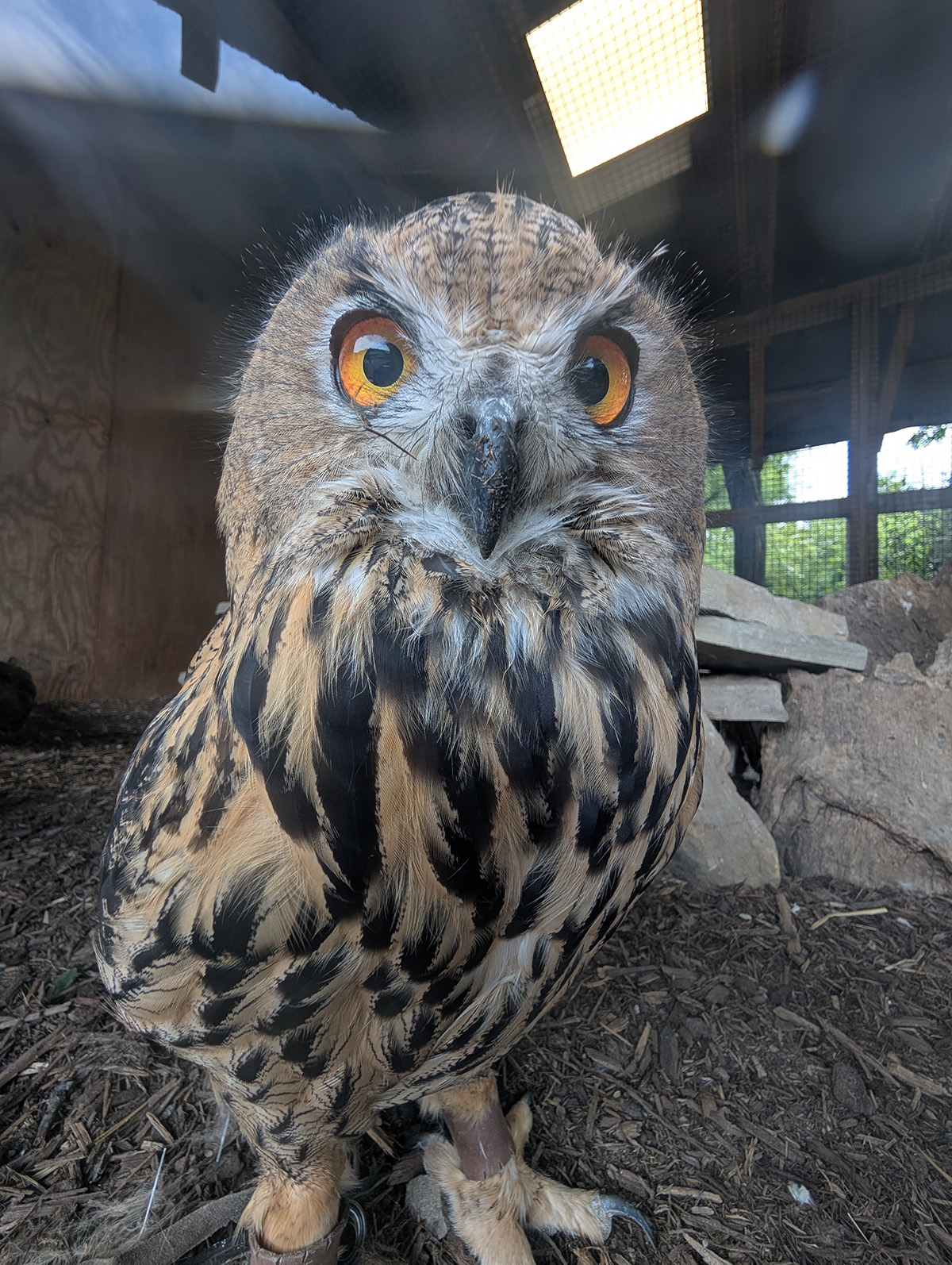
General Appearance Bubo bubo is one of the largest and most powerfully built owls on earth — a barrel-chested nocturnal predator with a broad head, prominent ear tufts, and a forward stare of unsettling intensity. The overall impression at close range is of mass and stillness: a bird that does not flinch, holding the observer in two large orange eyes set in a soft, mottled facial disc. The plumage reads as camouflage rather than ornament, a dense layering of tawny, buff, black, and grey that resolves into bark and shadow against a rock face and dissolves the bird entirely in low light. The feet are feathered to the talons, and the talons themselves are the working business end of the animal — heavy, curved, and disproportionate to the soft exterior.
Size Length: 56–75 cm Wingspan: 1.3–1.9 m Weight: females 1.75–4.6 kg; males 1.2–2.7 kg
The species shows reverse sexual dimorphism typical of birds of prey — females are substantially larger and heavier than males. Among the world’s owls it ranks at or near the top for size and bulk.
Coloration and Markings Upperparts are mottled tawny-brown to rufous, heavily streaked and vermiculated with blackish-brown. The underparts are paler buff, marked by bold dark vertical streaks across the upper breast that break into finer horizontal barring lower down — the pattern clearly visible on this individual. The facial disc is buff-grey and less sharply defined than in many owls, bordered with dark. The eyes are bright orange to orange-red. The bill is dark and heavy, partly hidden in facial bristles. A white throat patch shows when the bird calls. Legs and toes are densely feathered, ending in dark talons.
Distinguishing Features Very large size — among the largest owl species Prominent, mobile ear tufts (display feathers, not ears) Bright orange eyes — the key mark separating it from the yellow-eyed great horned owl Heavy dark streaking over a warm tawny ground Fully feathered legs and toes Deep, far-carrying ooh-hu territorial call
Juvenile / Immature Appearance Chicks hatch in white down, replaced by a buff second down. Juveniles resemble adults in pattern but appear softer and more uniformly barred, with shorter, less developed ear tufts and duller eye color. Young birds leave the nest as flightless “branchers” — clambering across ledges and limbs weeks before they can fly — and remain dependent on the adults for months.
Known Range Bubo bubo is one of the most widely distributed owls in the world, ranging across most of Eurasia from Iberia and Scandinavia eastward through Russia and Central Asia to China and the Pacific coast, with marginal presence in North Africa and the Middle East. Numerous subspecies span this range. The species was heavily persecuted and lost from much of Western Europe by the mid-20th century, then recovered through legal protection and reintroduction; recolonization of Britain is ongoing and its wild status there is debated. It does not occur as a native bird in North America. The great horned owl (Bubo virginianus) is its close ecological counterpart in the New World and the owl actually present along Pennsylvania waterways — the bird more likely to be heard over the Stonycreek on a winter night.
Habitat and Behavior Habitat: Rocky country, cliffs, gorges, forest edge, steppe, semi-desert, quarries, and mountain terrain — typically a mix of crags or cliffs for nesting with open ground for hunting Activity: Nocturnal and crepuscular Social: Solitary; pairs hold large territories year-round
The Eurasian eagle-owl is an apex avian predator across its range, with essentially no natural enemies as an adult. It hunts from an elevated perch or in low, near-silent flight made possible by soft-fringed flight feathers, dropping onto prey and dispatching it with the feet. Pairs are strongly territorial and defend their ground with deep booming calls audible over long distances — the basis of the onomatopoeic German name Uhu. By day the bird roosts on a sheltered ledge, in a cave, or against a tree trunk, where its plumage renders it close to invisible. It is long-lived and site-faithful, often returning to the same nesting cliffs across years.
Diet Diet Type: Carnivore
The species takes an exceptionally broad prey range — among the widest of any owl. Mammals form the bulk: voles, rats, rabbits, hares, hedgehogs, marmots, and on occasion animals as large as young foxes. Birds are taken freely, including gamebirds, ducks, corvids, herons, and other raptors and owls. Reptiles, amphibians, fish, and large insects round out the diet. In effect it will take anything from a beetle to prey approaching its own body weight, hunting by sound and sight in darkness and killing with the talons.
Propagation / Reproduction Breeding Season: Late winter to early spring; territorial calling begins the preceding autumn Clutch Size: 1–4 eggs, commonly 2–3, white Incubation: 31–36 days, by the female Parental Care: Female broods and tends; male provisions the family
The eagle-owl builds no real nest, laying directly on a cliff ledge, in a cave or rock crevice, on the ground in sheltered terrain, or in an abandoned raptor nest. The female incubates while the male hunts and delivers food. Young leave the nest as branchers around five to seven weeks, well before full flight, and remain dependent through much of their first summer. Lifespan is long — around twenty years in the wild and far greater in captivity, where individuals have reached several decades and records approach sixty years.
Pests / Diseases / Threats Conservation Status: Least Concern (IUCN)
The global population is large and, in parts of Western Europe, increasing following reintroduction. The dominant human-caused mortality is electrocution on power lines and collision with wires and vehicles; historical persecution, habitat disturbance at nest cliffs, and secondary poisoning are additional pressures. As an apex predator the adult has no significant natural predators, though eggs and branchers are vulnerable to foxes and other ground predators. The species’ recovery across Europe is one of the clearer raptor-conservation successes of recent decades, driven by protection, reintroduction, and the insulation of dangerous infrastructure.
Maintenance / Management In captivity Bubo bubo is common in falconry, education, and zoological collections, and is a multi-decade commitment given its lifespan. It requires a large, secure aviary with elevated perches, shade, and shelter, and a varied whole-prey diet — rodents, day-old chicks, rabbit, and similar. Falconry and education birds are managed by weight and accustomed to handling from an early age; the feet, not the bill, are the hazard, and demand respect. Enrichment and visual barriers reduce stress in housed birds. In the wild, management is habitat- and infrastructure-based: protecting nesting crags, insulating power lines, and supporting reintroduction programs.
Additional Notes The binomial Bubo bubo is a tautonym — genus and species spelled identically — a naming form reserved for a handful of well-known animals. Bubo is the Latin word for the eagle-owl itself, an onomatopoeic rendering of the call, echoed again in the German Uhu. The “eagle” in the common name reflects both the bird’s size and its standing as an apex nocturnal hunter that preys on other raptors and owls. In European folk tradition owls of this kind are birds of cliffs, ruins, and ill omen, and the eagle-owl was historically employed as a live lure in crow- and raptor-shooting, its presence drawing mobbing birds within range. Its resemblance to the great horned owl is a case of convergent form across two continents: the same niche, the same silhouette, separated by an ocean and distinguished most readily by eye color — orange here, yellow there.
Field Notes (CF Observation) Photographed at close range inside a mesh-and-timber enclosure with flagstone and mulch substrate, in daylight, the bird facing the lens directly with a slight head tilt and no sign of alarm. The housed setting, the relaxed proximity, and the daytime activity all indicate a resident education or rehabilitation animal rather than a wild encounter — consistent with the same facility visit that produced the black swan image from the same date. The orange iris, heavy breast streaking, prominent ear tufts, and fully feathered toes confirm Bubo bubo over the superficially similar Bubo virginianus. As a non-native species, any eagle-owl encountered in North America is a captive, escaped, or collection bird; the working field identification for this region remains the great horned owl, which this profile should not be mistaken for.
All images and written content published on this site are provided freely for educational and artistic use. Attribution appreciated but not required. Knowledge grows when shared.