
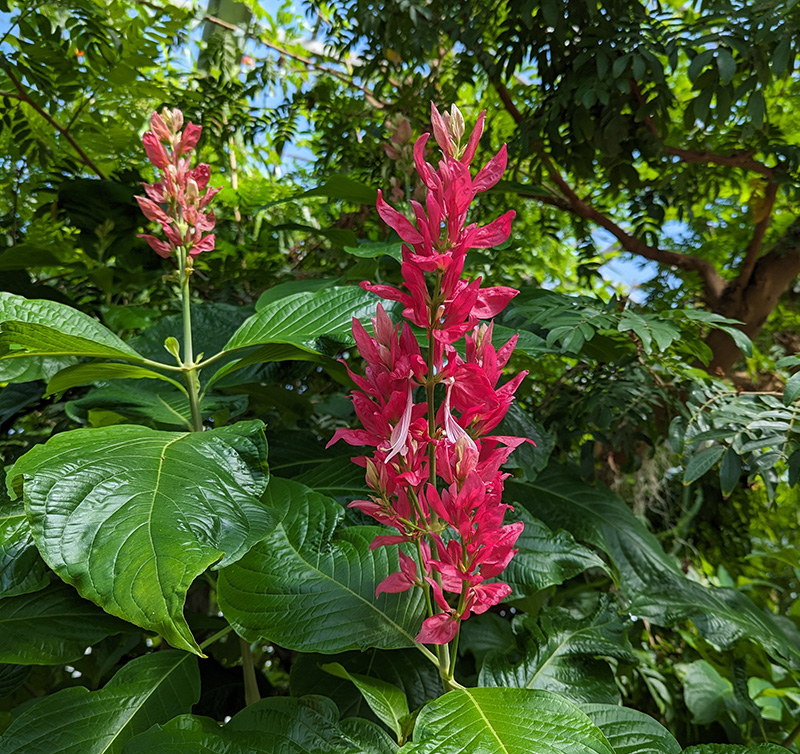
Megaskepasma erythrochlamys is a large, bold tropical shrub that announces itself from across a garden. Mature plants form dense, upright to slightly arching mounds of deep green foliage, typically 6–10 feet tall and nearly as wide, though specimens in ideal conditions can exceed 12 feet. The overall impression is of a plant operating at maximum tropical intensity — enormous leaves, dramatic flower spikes, and a growth rate that justifies its common name. Everything about it is scaled up.
Leaves are among the most striking features of the plant outside of flower. They are large — 8–14 inches long, sometimes larger — elliptical to broadly ovate, with a deep glossy green surface, prominent midrib and lateral veins, and a wavy or slightly undulate margin. Petioles are short and stout. The leaf texture has a slight sheen that catches light well, making the plant visually effective even when not in bloom. New growth emerges with a slightly lighter, warmer tone before deepening to the characteristic dark green.
The inflorescence is a terminal spike, 8–18 inches long, composed of overlapping scarlet to deep crimson bracts from which small white to pale lavender tubular flowers emerge. The bracts are the primary visual element — they are densely packed, intensely colored, and persist on the spike long after the small true flowers have dropped, extending the ornamental display considerably. Individual flowers are two-lipped, white with faint purple markings, and are primarily attractive to hummingbirds and long-tongued insects. Bloom typically peaks in late summer through autumn in cultivation, though in tropical conditions flowering can occur across much of the year. The spikes are produced at the tips of branches and can appear simultaneously across the plant, creating a striking massed effect.
Fruits are small capsules typical of the Acanthaceae family, each containing a few small seeds. In cultivation outside the tropics, seed set is infrequent and propagation is typically accomplished by other means. The spent flower spikes retain ornamental value as the bracts fade gradually rather than dropping cleanly.
Native to Venezuela and adjacent regions of northern South America, where it grows in humid tropical forest margins, clearings, and disturbed areas at low to mid elevations. Typically found in areas with high rainfall, warm temperatures year-round, and protection from sustained cold.
Widely grown as an ornamental throughout the tropical and subtropical world, including Florida, Hawaii, coastal California, the Caribbean, Central America, Southeast Asia, and Australia. Cultivated as a container specimen and overwintered indoors in temperate zones. A staple of botanical garden tropical collections globally.
Light: Full sun to part shade. Performs best with morning sun and some afternoon protection in hot climates; tolerates light shade but may flower less prolifically.
Soil: Rich, well-drained, moisture-retentive loam. Responds strongly to good fertility. Not tolerant of waterlogged conditions.
Moisture: Consistently moist. Does not tolerate extended drought well; requires regular irrigation in dry climates. Mulching around the root zone helps maintain soil moisture and temperature.
USDA Zones: 10–12 outdoors year-round. Can be grown as a container plant and overwintered indoors in zones 8–9 with protection.
Typical Habitat: Humid tropical forest margins, clearings, and garden settings with warmth, moisture, and shelter from frost.
In tropical and subtropical landscapes, Megaskepasma erythrochlamys is a vigorous grower requiring periodic hard pruning to maintain shape and encourage fresh flowering growth. Cut back by one-third to one-half after the main bloom flush to stimulate new branching and subsequent flower spikes. In container culture, repot as needed and fertilize regularly through the growing season with a balanced fertilizer. Indoors, provide maximum available light and maintain temperatures above 55°F (13°C). The plant will drop leaves in cold or very dry conditions but typically recovers with warmth and moisture. Scale and vigorous growth make this a plant that rewards commitment — a mature, well-grown specimen is genuinely spectacular.
Megaskepasma erythrochlamys belongs to one of the most ecologically and horticulturally productive plant families in the tropics — Acanthaceae — a group that has given cultivation an enormous range of ornamental and medicinally significant plants. The genus name translates roughly from Greek as “great cloak,” a direct reference to the large, enveloping bracts that define the inflorescence. The species epithet erythrochlamys similarly means “red cloak.” The plant was formally described by the German botanist Gustav Lindau in 1895, and despite its relative obscurity outside of tropical horticulture, has become a beloved specimen in botanical collections worldwide for exactly the qualities visible here — sheer presence, rich color, and the kind of unambiguous tropical drama that makes a garden feel genuinely different.
The hummingbird relationship is worth noting. The tubular white flowers nested within the scarlet bracts are adapted for pollination by hummingbirds, which are attracted by the red of the bracts from a distance and rewarded with nectar on arrival. In cultivation in Florida and Hawaii, the plant reliably draws hummingbirds and serves as a valuable late-season nectar source when many other plants have finished.
Photographed in cultivation, two spikes visible at different stages of development — the taller spike at full display, the smaller spike at earlier bud stage, offering a useful comparison of inflorescence development. The deep crimson bracts are fully saturated in the foreground specimen, the small white tubular flowers just visible between the bract layers. Foliage is in excellent condition — large, deeply green, and glossy — consistent with a well-established plant in appropriate growing conditions. The canopy visible above is characteristic of a tropical garden or conservatory setting. No defensive posture was required during observation, which is typical for a plant.
Identification as Megaskepasma erythrochlamys is consistent with the inflorescence structure, bract color and arrangement, leaf size and texture, and overall plant scale visible in the image.
All images and written content published on this site are provided freely for educational and artistic use. Attribution appreciated but not required. Knowledge grows when shared.