
Kingdom: Animalia
Phylum: Chordata
Class: Aves
Order: Suliformes
Family: Sulidae
Genus: Sula
Species: Sula leucogaster (Boddaert, 1783)
General / English: Brown Booby
Scientific / Conservation: Sula leucogaster
Spanish: Bobo Pardo, Piquero Pardo
French: Fou Brun
Regional Maritime Use: Booby
The Brown Booby is a large tropical seabird built for fast, direct flight and plunge-diving into marine waters.
Adults are strongly patterned, with a dark brown head, neck, back, and upper breast contrasting sharply with a white lower breast and abdomen. Juveniles are less distinctly divided in coloration and may appear predominantly gray-brown or mottled, with paler underparts developing as they mature.
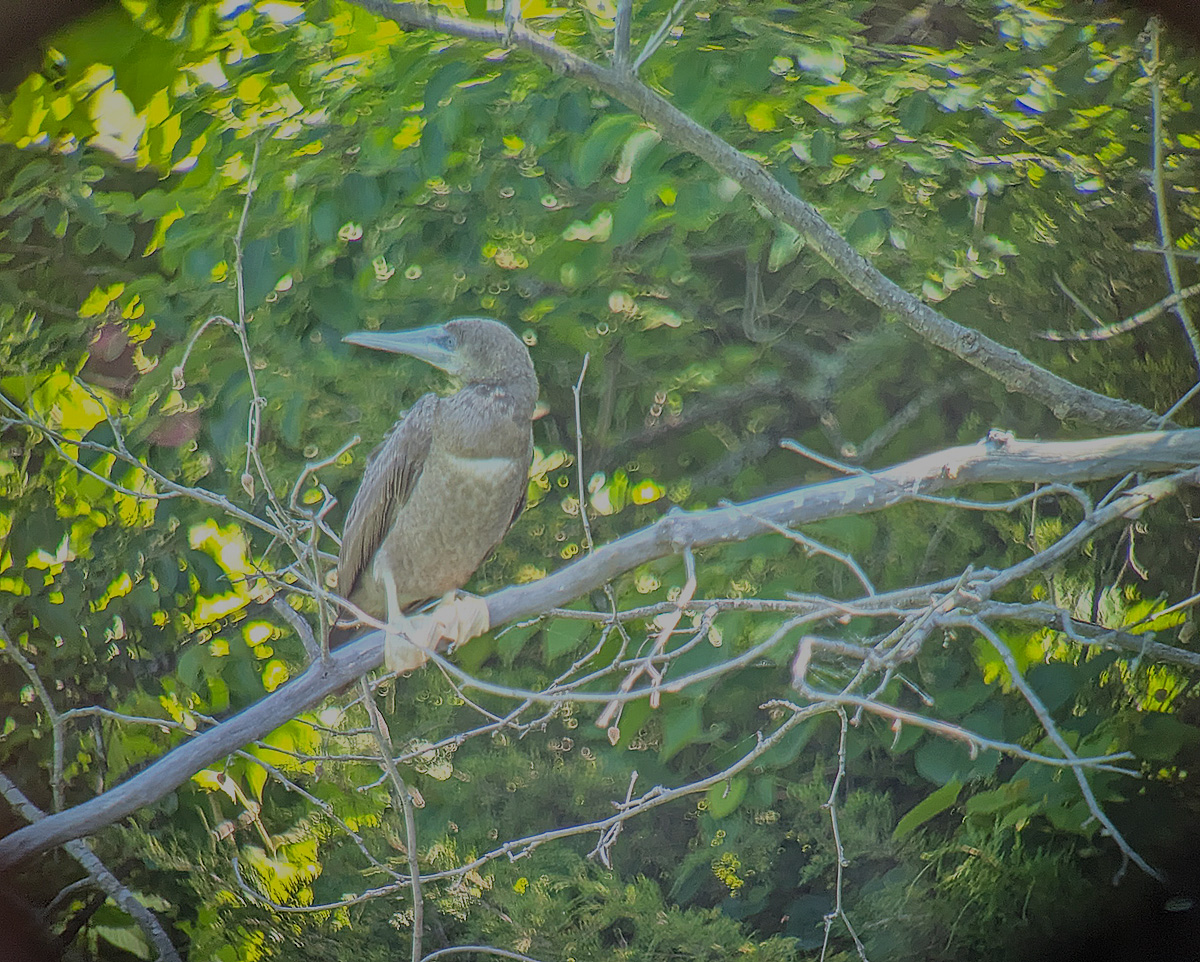
The bird photographed here is a juvenile.
Adults typically reach:
Females are generally larger than males.
Brown Boobies possess:
Their body shape reflects a life divided between sustained flight, surface resting, and rapid aerial attacks on fish.
The Brown Booby is principally a tropical and subtropical marine species.
Its broad distribution includes portions of the:
Breeding colonies are generally associated with islands, rocky coastal areas, cliffs, and other sites near productive marine feeding grounds.
Inland appearances are exceptional.
The individual shown in the associated photograph was observed at Spring Mill State Park near Mitchell, Indiana, in June 2024.
Indiana Department of Natural Resources personnel confirmed the bird as a juvenile Brown Booby. The occurrence represented only the second documented record of the species in Indiana. The previous state record occurred at a private lake in Zionsville in May 2019.
The 2024 bird remained near the Lakeview Activity Center and was documented fishing and resting on fallen trees and park structures.
The photograph presented in this profile was taken June 11, 2024, at the pond behind the Lakeview Activity Center at Spring Mill State Park.
The main lake lies downhill from the observation location.
Brown Boobies normally inhabit warm marine environments.
Typical habitat includes:
Breeding birds depend heavily on relatively secure terrestrial sites located within practical flight distance of productive waters.
The Spring Mill State Park observation was therefore highly abnormal for the species. Indiana DNR described the bird as having wandered naturally beyond its normal range.
Its temporary use of inland ponds and lake habitat demonstrates the ability of a displaced marine bird to exploit unfamiliar freshwater environments when suitable fish and resting sites are available.
Brown Boobies primarily feed on fish and other marine prey.
Common food resources include:
The species is a plunge-diver.
A hunting bird searches from the air, identifies prey near the surface, and descends rapidly into the water. Its streamlined shape and pointed bill allow the bird to penetrate the surface with limited resistance.
Brown Boobies may also pursue prey underwater after entry.
Ecologically, the species functions as a mobile upper-level marine predator connecting surface fish populations with island and coastal ecosystems.
Nutrients carried onto nesting islands through waste, discarded prey, feathers, eggs, and dead birds can contribute significantly to terrestrial island nutrient cycles.
Brown Boobies are powerful and efficient fliers.
Behavioral traits include:
Unlike many birds poorly adapted to water entry, Brown Boobies repeatedly transition between air and water as part of normal feeding behavior.
The Indiana juvenile attracted substantial attention from birders and wildlife observers.
According to Indiana DNR, the bird remained in the vicinity of the Lakeview Activity Center, where it fished and rested on fallen trees and the newly constructed floating dock.
The individual shown here was photographed while perched on a tree limb above the pond behind the activity center.
This photograph was made using a mobile phone manually aligned with a birder’s spotting scope.
Brown Boobies are colonial seabirds.
Breeding generally occurs on islands and isolated coastal sites.
Typical nesting habitat includes:
The nest is usually a relatively simple ground structure assembled from available vegetation and debris.
Females generally lay one or two eggs.
Both parents participate in incubation and care of the young.
Young birds remain dependent on adults after hatching and develop the flight and feeding skills necessary for an aerial marine predator over an extended juvenile period.
Juvenile plumage differs substantially from the sharply divided brown-and-white pattern of mature adults.
IUCN Status: Least Concern
The Brown Booby maintains a very large global distribution. BirdLife’s current species assessment nevertheless indicates that the global population is suspected to be declining.
Threats affecting Brown Boobies and other colonial seabirds include:
Marine debris is of particular concern at breeding colonies because Brown Boobies may incorporate human waste into nest structures, creating risks of entanglement and ingestion.
The name booby is derived from historical descriptions of these seabirds as unusually tame or unwary around humans.
Their apparent awkwardness on land contrasts dramatically with their abilities in flight and water.
The Spring Mill State Park individual provides an exceptional example of avian dispersal.
A bird fundamentally adapted to tropical marine environments appeared in the forested interior of southern Indiana, located suitable water, found fish, and remained long enough to become one of the state’s most heavily observed individual birds of the period.
Indiana’s assistant state ornithologist confirmed the individual as a juvenile Brown Booby and the state’s second documented occurrence of the species.
The event also illustrates the value of public wildlife observations. Once the bird was recognized, professional biologists, experienced birders, photographers, and casual observers collectively documented an occurrence that would otherwise have been extraordinarily easy to miss.
Species: Sula leucogaster
Common Name: Brown Booby
Life Stage: Juvenile
Observation Date: June 11, 2024
Observation Location: Pond behind the Lakeview Activity Center, Spring Mill State Park, Mitchell, Indiana, United States
Occurrence: Naturally occurring vagrant; second documented Indiana record
Image Type: Field photography through spotting scope
The animal was observed perched above the pond in the vicinity of the Lakeview Activity Center.
Numerous birders and wildlife observers were present, many using dedicated cameras and spotting scopes. The accompanying image was captured by manually aligning a mobile-phone camera with the eyepiece of one of those spotting scopes.
This profile and associated imagery are released by the Cernunnos Foundation as part of its open knowledge initiative. Text and images may be used freely for educational, research, artistic, and reference purposes, with attribution appreciated but not required.
The goal of this archive is to expand public access to accurate natural history information and to support artists, educators, students, and field observers in exploring the remarkable diversity of life on Earth.