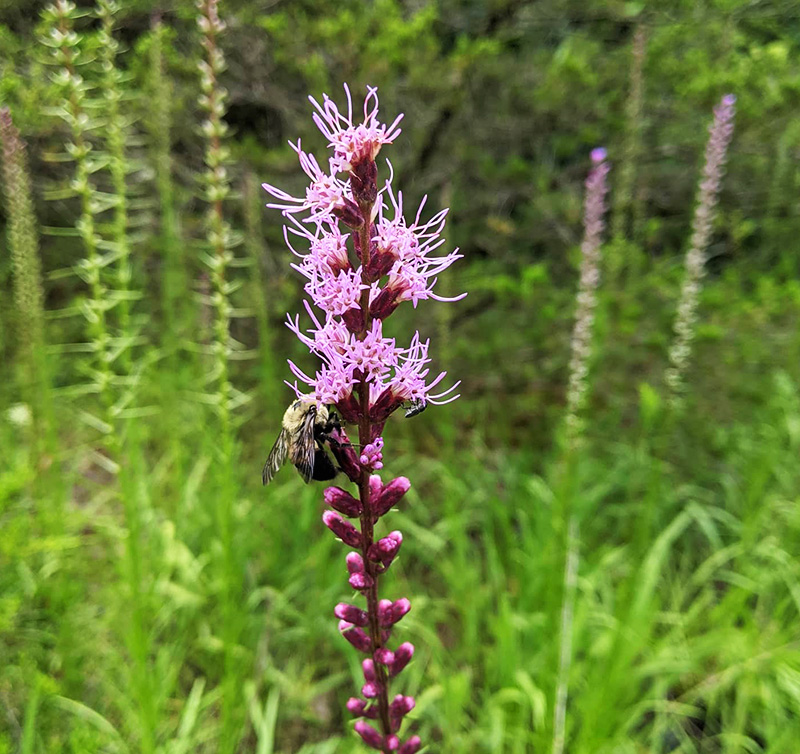
Prairie Blazing Star
Liatris pycnostachya
Taxonomy
- Kingdom: Plantae
- Clade: Tracheophytes
- Clade: Angiosperms
- Clade: Eudicots
- Clade: Asterids
- Order: Asterales
- Family: Asteraceae
- Genus: Liatris
- Species: Liatris pycnostachya
Common Names by Region
- Prairie Blazing Star
- Prairie Gayfeather
- Cattail Gayfeather
- Kansas Gayfeather
Description
Growth Habit
A tall, erect perennial forming a single unbranched flowering stalk (occasionally a few) rising from a basal cluster and an underground corm. Stems reach 2–5 feet, giving the plant its characteristic vertical, spire-like presence in a meadow.
Leaves
Leaves are:
- narrow, grass-like, and linear
- densely arranged, crowding the stem and shrinking upward toward the flower spike
- deep green, giving the lower stem a fine, feathery texture
Flowers
The signal feature:
- A long, dense terminal spike packed with small rose-purple flower heads
- Each head is a fringe of thread-like disc florets — no ray petals — creating a soft, tufted look
- Blooms top-down: the spike opens from the tip downward, the reverse of most spike-flowering plants
- Unopened buds below the bloom line show as tight rose-purple knobs, visible on the lower stem here
Known Range
- Native to: the tallgrass prairies of the central United States — roughly the Great Plains and Midwest, from the Dakotas and Minnesota south to Texas and Louisiana, east into the Ohio Valley
- Widely planted well beyond its native core in pollinator gardens, meadow restorations, and native-plant landscaping across eastern North America, including Pennsylvania
Hardy through cold winters; dies back to the corm and returns in spring.
Care / Habitat
- Light: Full sun (essential — flops and weakens in shade)
- Soil: Well-drained; tolerates lean, sandy, and rocky ground; dislikes wet winter soil
- Water: Drought-tolerant once established; needs moderate moisture while establishing
- Temperature: Cold-hardy; a true prairie perennial
Thrives in:
- native meadow and prairie plantings
- pollinator and butterfly gardens
- lean, sunny, well-drained sites where showier ornamentals struggle
Propagation / Reproduction
- Propagated by:
- seed (needs cold stratification to break dormancy)
- corm division in dormancy
- offset cormels from established plants
Slow to reach flowering size from seed — typically two or more seasons — but long-lived and self-sustaining once established.
Pests / Diseases / Threats
Robust in the right site, but watch for:
- Rust and leaf spot in humid, crowded, or poorly drained conditions
- Corm rot in wet winter soil (the most common cause of loss)
- Occasional rodent or vole damage to the corms
- Flop in over-rich soil or too much shade
The broadest threat is regional: loss of native tallgrass prairie, which has removed most of this plant’s original habitat.
Ecological Role
A premier late-season nectar plant.
Attractive to:
- bumble bees (Bombus spp.) and other native bees
- butterflies — monarchs, swallowtails, fritillaries, skippers
- moths and other long-tongued nectar feeders
The tall, dense spike is a high-visibility beacon in a meadow, and the top-down bloom sequence extends the nectar window over weeks. Goldfinches and other seed-eating birds work the seed heads after bloom, extending the plant’s value into fall.
Additional Notes
- The top-down flowering habit is diagnostic and unusual — a quick field ID for Liatris
- A keystone-grade meadow species: high pollinator draw, long bloom, strong vertical structure
- The corm is a fire- and drought-survival organ, part of what makes it a true prairie plant
- Excellent as a cut flower; the spikes hold color well
Maintenance / Management
- Site in full sun with sharp drainage — the single most important factor
- Leave seed heads standing into fall for goldfinches and winter structure
- Divide crowded corms every few years to maintain vigor
- Minimal feeding; rich soil produces weak, floppy stems
- Cut back to the ground in late winter before new growth
Cernunnos Foundation Note
Liatris pycnostachya is a model of structure earning its keep. It gives a meadow vertical architecture, a weeks-long nectar supply timed by its top-down bloom, and a fall seed crop for birds — three distinct functions from one unbranched stalk. In restoration terms it’s a high-return anchor species: it draws the pollinator traffic that makes a planting work while asking only for sun and drainage. Its story also carries the weight of what’s been lost — this is a tallgrass-prairie plant, and the prairie it evolved with is largely gone. Planting it into an Appalachian meadow is a small act of carrying a vanished system’s function forward into a new ground.
Companion Pollinator
Common Eastern Bumble Bee
Bombus impatiens
Taxonomy
- Kingdom: Animalia
- Phylum: Arthropoda
- Class: Insecta
- Order: Hymenoptera
- Family: Apidae
- Genus: Bombus
- Species: Bombus impatiens
Common Names
- Common Eastern Bumble Bee
- Eastern Bumblebee
Description
A robust, fuzzy bumble bee with the genus’s classic rounded, densely-haired body. Diagnostic pattern: a yellow thorax and a mostly black abdomen with yellow confined largely to the first abdominal segment — the short yellow “band up top, black below” look visible on this individual. Workers are variable in size; queens are notably larger.
Range
The most common bumble bee across eastern North America, from Ontario and the Northeast south through the Appalachians and into the Southeast. Abundant in Pennsylvania. One of the few Bombus species currently expanding its range while many relatives decline.
Ecological Role
A generalist, high-value pollinator. Capable of buzz pollination (sonication) — vibrating flowers to shake loose pollen that honey bees can’t access — which makes it disproportionately important to many native plants and crops. Long-tongued enough to work tubular and spike flowers like Liatris, and active in cooler, dimmer conditions than most bees, extending the daily and seasonal pollination window.
Behavior / Life Cycle
- Annual, eusocial colony cycle: a solitary overwintered queen founds a nest in spring, usually in an abandoned rodent burrow or similar cavity
- Colony grows through the season; new queens and males emerge in late summer
- Only new mated queens overwinter; the rest of the colony dies at season’s end
Conservation Note
Currently stable-to-expanding and commercially reared for greenhouse pollination — an outlier among bumble bees, many of which are in steep decline. Its success makes it a useful baseline against which the losses of its rarer relatives can be measured.
Cernunnos Foundation Note
The pairing shown here — Bombus impatiens working a Liatris spike — is the whole point of the plant made visible. This is a generalist native bee doing exactly the work the flower is built to reward, and it’s one of the few bumble bees still thriving. That resilience is worth protecting as a reference point: it tells us what a healthy bumble bee population looks like even as scarcer species slip away.
Views: 194