
Kingdom: Animalia
Phylum: Chordata
Class: Amphibia
Order: Anura
Family: Hylidae
Genus: Dryophytes
Species: Dryophytes chrysoscelis
Authority: Cope, 1880
Older / Synonymous Usage: Hyla chrysoscelis
Cope’s Gray Treefrog
Cope’s Grey Treefrog
Cope’s Treefrog
Tree Toad — informal regional name
Gray Treefrog Complex — when visual identification between D. chrysoscelis and D. versicolor is uncertain
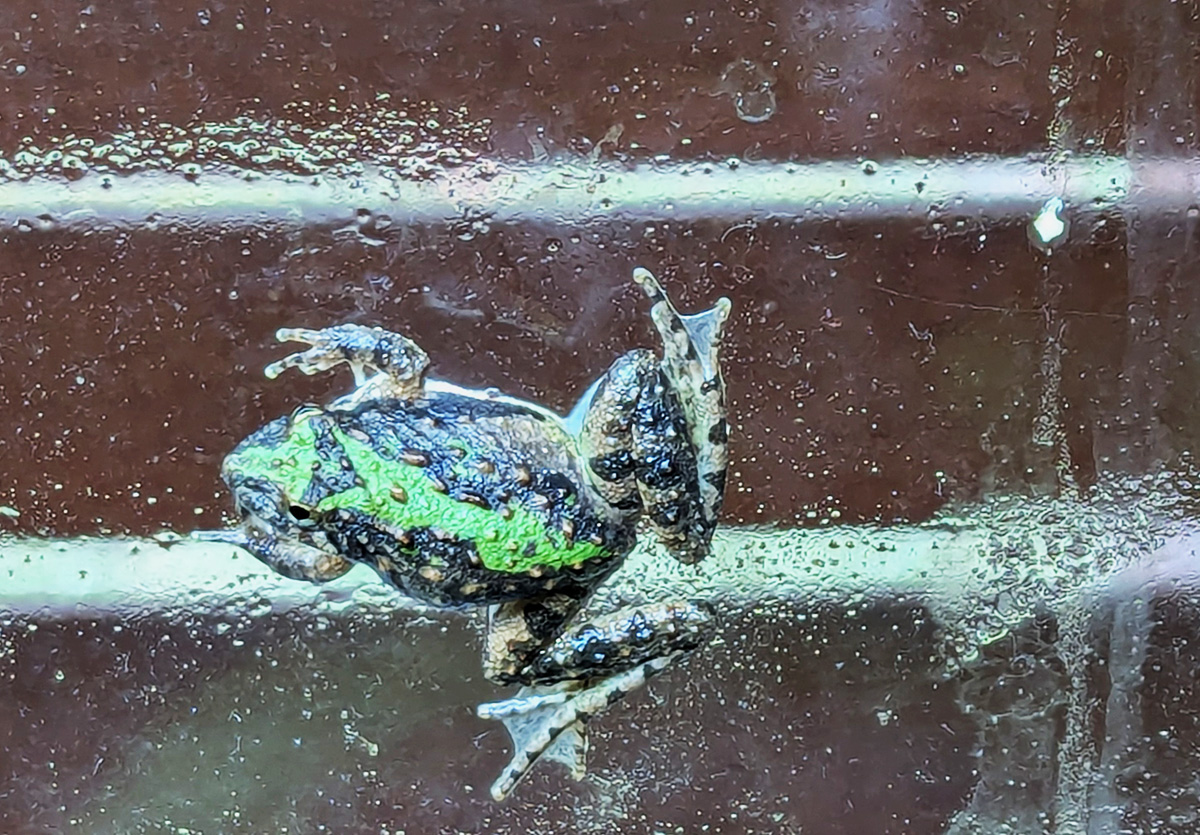
Cope’s Gray Treefrog is a small, highly adaptable treefrog of eastern North America. It is part of the gray treefrog complex and is nearly identical in outward appearance to the Eastern Gray Treefrog, Dryophytes versicolor. Both species can appear gray, green, brownish, lichen-mottled, or nearly bark-patterned depending on moisture, temperature, stress, and background. Because of this, photographs alone usually cannot separate the two species with confidence.
Adult length is typically about 3.2–5.1 cm, or roughly 1.25–2 inches. The body is compact, with a rounded head, strong limbs, and large adhesive toe pads that allow the frog to cling to bark, leaves, glass, siding, pool walls, and other vertical surfaces.
Color is extremely variable. Individuals may appear:
A key field mark is the yellow to orange flash coloration on the inner thighs, often visible when the frog jumps or stretches its rear legs. This hidden color is shared with the Eastern Gray Treefrog and should not be used alone to separate the two species.
The call is the most useful field distinction from the Eastern Gray Treefrog. Cope’s Gray Treefrog gives a faster, harsher, more rapid trill. The Eastern Gray Treefrog gives a slower, more musical trill. Temperature affects call speed, so hearing both species close in time and under similar conditions is especially valuable.
Cope’s Gray Treefrog is widely distributed across much of the eastern United States and reaches into parts of southern Canada. Its range overlaps broadly with the Eastern Gray Treefrog, which is one reason field identification can be difficult without call, locality, or genetic information.
In Pennsylvania and nearby regions, locality records and call confirmation are especially important because both gray treefrog species may occur within the broader region, and visual identification can be unreliable.
Cope’s Gray Treefrogs are associated with woodland edges, deciduous woods, brushy habitat, old fields, wetland margins, ponds, temporary pools, ditches, and other fish-free or low-predator breeding waters. They are often encountered near human structures, especially where lights attract insects at night.
Adults spend much of their lives away from open water, using trees, shrubs, vines, walls, windows, and other elevated surfaces. Breeding activity brings them back toward ponds, pools, wetlands, and ditches.
This is an arboreal frog: built for climbing, clinging, and vanishing against bark. During the day, individuals may rest in shaded vegetation, tree cavities, loose bark, crevices, siding, garden structures, or damp hiding places. At night, they become more active and hunt small invertebrates.
Their ability to shift color makes them one of the more visually dramatic local frogs. The same animal may look like a dull gray bark chip one day and a bright green jewel the next.
Cope’s Gray Treefrogs are insectivorous predators.
Typical prey includes:
They are useful around porch lights, garden edges, pools, and outbuildings because they feed on many small insects attracted to those areas.
Breeding usually occurs in warm weather from late spring into summer, depending on local climate. Males call from vegetation near breeding sites, including ponds, temporary pools, ditches, and wetland edges. Females lay eggs in shallow water, often in small clusters or loose masses. Tadpoles develop in the water and metamorphose into small terrestrial juveniles.
Temporary fish-free pools can be especially valuable because fish are major predators of amphibian eggs and tadpoles. However, these pools must last long enough for larval development to finish.
Natural threats include:
Human-related threats include:
Like other amphibians, Cope’s Gray Treefrogs have permeable skin and should not be handled unless necessary. Sunscreen, soap, insect repellent, oils, and other residues on human hands can harm amphibians.
Cope’s Gray Treefrog and Eastern Gray Treefrog are a classic example of species that defeat casual photo identification. They may look identical, share similar habitat, and overlap in range. The call is the field naturalist’s best tool.
The name chrysoscelis refers to the golden or yellowish color of the legs, a fitting name for a frog whose brightest color is usually hidden until it moves.
This species is also a strong reminder that backyard biodiversity is not minor biodiversity. A frog on a pool wall, window, deck box, or porch light may represent a whole nearby system: trees, insects, moisture, breeding pools, leaf litter, and seasonal movement.
For wildlife gardens, ponds, and naturalized edges, Cope’s Gray Treefrogs benefit from:
In managed landscapes, the goal is not to “stock” frogs, but to preserve the structure that lets them arrive and survive.
All images and reference material on the Cernunnos Foundation website are provided for educational, artistic, and ecological reference use.
They may be used freely for study, artwork, and teaching, provided they are not misrepresented as original work by others.
The goal of this archive is the open sharing of natural knowledge for the benefit of science, culture, and education.