
General Appearance
Pulmonaria rubra is a low-growing, clump-forming herbaceous perennial that earns its place in the garden primarily through timing — it is among the earliest plants to flower in the temperate garden, often opening while snow is still present or frost still a nightly event. The plant forms a spreading rosette of large, softly hairy leaves from which flowering stems emerge in late winter to early spring, carrying clusters of coral-red to brick-red tubular flowers that represent an unusual color for the genus. Most lungworts lean toward blue, violet, or pink-purple; Pulmonaria rubra commits to red and delivers it without apology, making it immediately distinguishable from its more commonly encountered relatives.
The overall impression is of a tough, unpretentious woodlander that has been blooming reliably at the wrong time of year — in the best possible sense — for centuries of garden cultivation.
Leaves
Leaves are the other half of the Pulmonaria story and in P. rubra they are notable primarily for what they lack. Unlike the heavily silver-spotted foliage of P. saccharata or P. officinalis, the leaves of P. rubra are typically unspotted or only faintly marked — plain, large, broadly elliptical to ovate, medium to deep green, and covered in soft, somewhat bristly hairs that give the surface a distinctly tactile quality. Basal leaves can reach 20–30 cm in length at maturity; stem leaves are smaller and sessile. The hairy surface and the unspotted green distinguish this species from most other cultivated lungworts at a glance. Foliage remains attractive through the growing season in suitable conditions, forming effective low ground cover in shaded areas.
Flowers
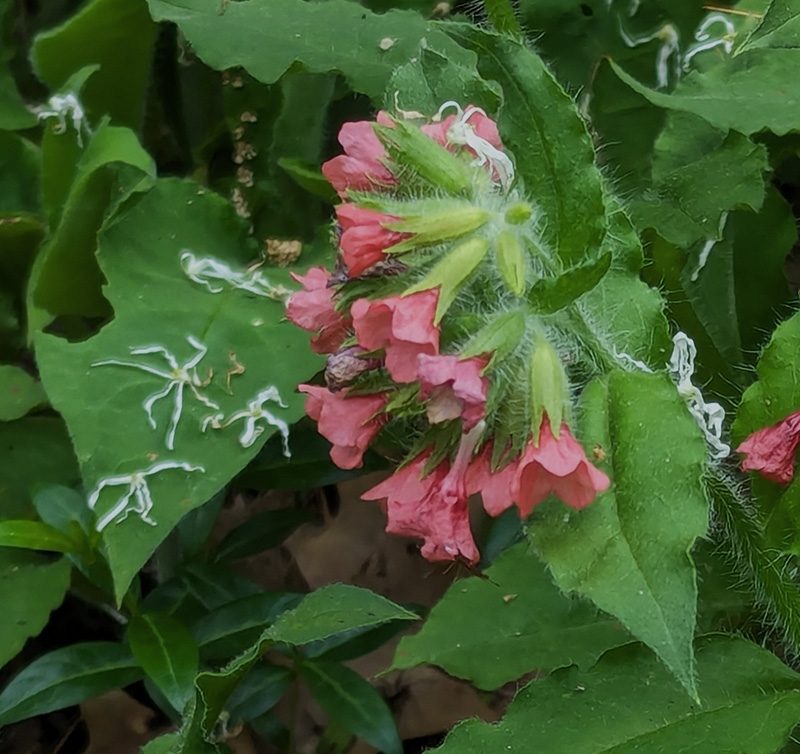
The inflorescence is a coiled, scorpioid cyme — the characteristic Boraginaceae flower arrangement — that uncurls progressively as buds open. Flowers are tubular, five-lobed, approximately 1.5–2 cm long, and coral-red to brick-red in color, produced in clusters at the tips of hairy, leafy stems 20–30 cm tall. The calyx is prominently hairy and star-shaped, clearly visible between and below the flower tubes, contributing a structural green element to the overall display. Bloom is early — February through April depending on latitude and local conditions — making P. rubra one of the most important early-season nectar sources available to emerging queen bumblebees and other early pollinators. Unlike many Pulmonaria species, P. rubra does not undergo the characteristic color change from pink to blue as flowers age — the coral-red is consistent through the bloom period.
Quick ID
Native Range
Native to southeastern Europe, with the core range centered in Romania, Bulgaria, and the eastern Balkans, extending into parts of Turkey and the Caucasus region. Grows in deciduous and mixed woodland, forest margins, shaded stream banks, and moist, humus-rich clearings at low to moderate elevations. In its native habitat it is a plant of dappled shade and cool, moisture-retentive woodland soil.
Introduced / Cultivated Range
Widely cultivated across temperate Europe and North America as a shade garden perennial. Naturalized locally in parts of Western and Central Europe where garden escapes have established in suitable woodland habitats. Numerous named cultivars exist in the trade, including ‘David Ward’ (cream-edged leaves) and ‘Redstart’ (particularly vivid coral-red flowers), which have extended the species’ garden presence considerably beyond the straight species.
Light: Part shade to full shade. Performs best under deciduous canopy or in north-facing beds. Tolerates more sun in cool, moist climates but foliage scorches and wilts in hot afternoon sun.
Soil: Rich, humus-rich, consistently moist but well-drained. Performs best in loam amended with organic matter. Tolerates clay if drainage is adequate. Dislikes dry, sandy soils.
Moisture: Consistently moist. Does not tolerate drought well, particularly in summer. Mulching helps maintain soil moisture and cool root temperatures.
USDA Zones: 4–8.
Typical Habitat: Deciduous woodland, shaded stream banks, moist forest margins, and shade garden settings with cool, humus-rich soil.
Pulmonaria rubra is low-maintenance in a suitable site. After flowering, cut back spent flower stems to the base to encourage fresh foliage growth and reduce powdery mildew pressure. If summer foliage becomes tatty or mildewed, plants can be cut back hard and will produce a fresh flush of leaves with adequate moisture. Divide every three to four years to maintain vigor — older clumps can become congested and flower less freely. Mulch annually in autumn with leaf mold or composted bark to maintain soil moisture and feed the plant. In appropriate conditions of shade and consistent moisture, P. rubra requires little intervention and will gradually spread to form a satisfying ground-covering colony.
The genus name Pulmonaria derives from the Latin pulmo, meaning lung, and reflects the ancient Doctrine of Signatures — the pre-scientific belief that a plant’s appearance indicated its medicinal use. The white-spotted leaves of several species were interpreted as resembling diseased lung tissue, and lungworts were accordingly used in traditional medicine for respiratory complaints. Pulmonaria rubra, with its relatively unspotted leaves, fits the doctrine less tidily than its relatives, but it carries the name regardless.
The ecological value of early-blooming Pulmonaria species is increasingly recognized in ornamental horticulture. Queen bumblebees emerging from overwintering in late winter and early spring require reliable nectar sources before other plants are in flower, and P. rubra — blooming in February and March in much of its cultivated range — occupies a critical window. A well-established clump in a shaded garden can be genuinely important to the local bee population at a time when almost nothing else is open.
The cultivar ‘David Ward’ — with its striking cream-margined leaves — is among the more recognized selections in contemporary shade gardening, and has introduced P. rubra to a wider audience than the straight species alone might have reached. ‘Redstart,’ named for the robin-like bird, is valued for the particular intensity of its coral-red flower color, which is warmer and more saturated than typical straight species plants.
Field Notes (CF Observation)
Photographed at close range in what appears to be a garden or cultivated setting, the plant captured at active bloom with multiple flower stages visible simultaneously — open coral-red tubular flowers, swelling buds at various stages, and the prominently hairy star-shaped calyces clearly rendered between and above the flower tubes. Foliage visible in the frame shows the characteristic large, softly hairy, unspotted green leaves of the species. A small quantity of what appears to be dried plant material or spider silk is visible on the leaf surface in the left frame — consistent with early spring garden conditions. The coral-red color of the flowers is consistent throughout the cluster, with no visible color transition to blue or violet, confirming the identification as Pulmonaria rubra rather than one of the color-changing species.
Identification as Pulmonaria rubra is consistent with the coral-red flower color, the unspotted or minimally marked foliage, the hairy calyx structure, and the overall plant habit visible in the image.
All images and written content published on this site are provided freely for educational and artistic use. Attribution appreciated but not required. Knowledge grows when shared.