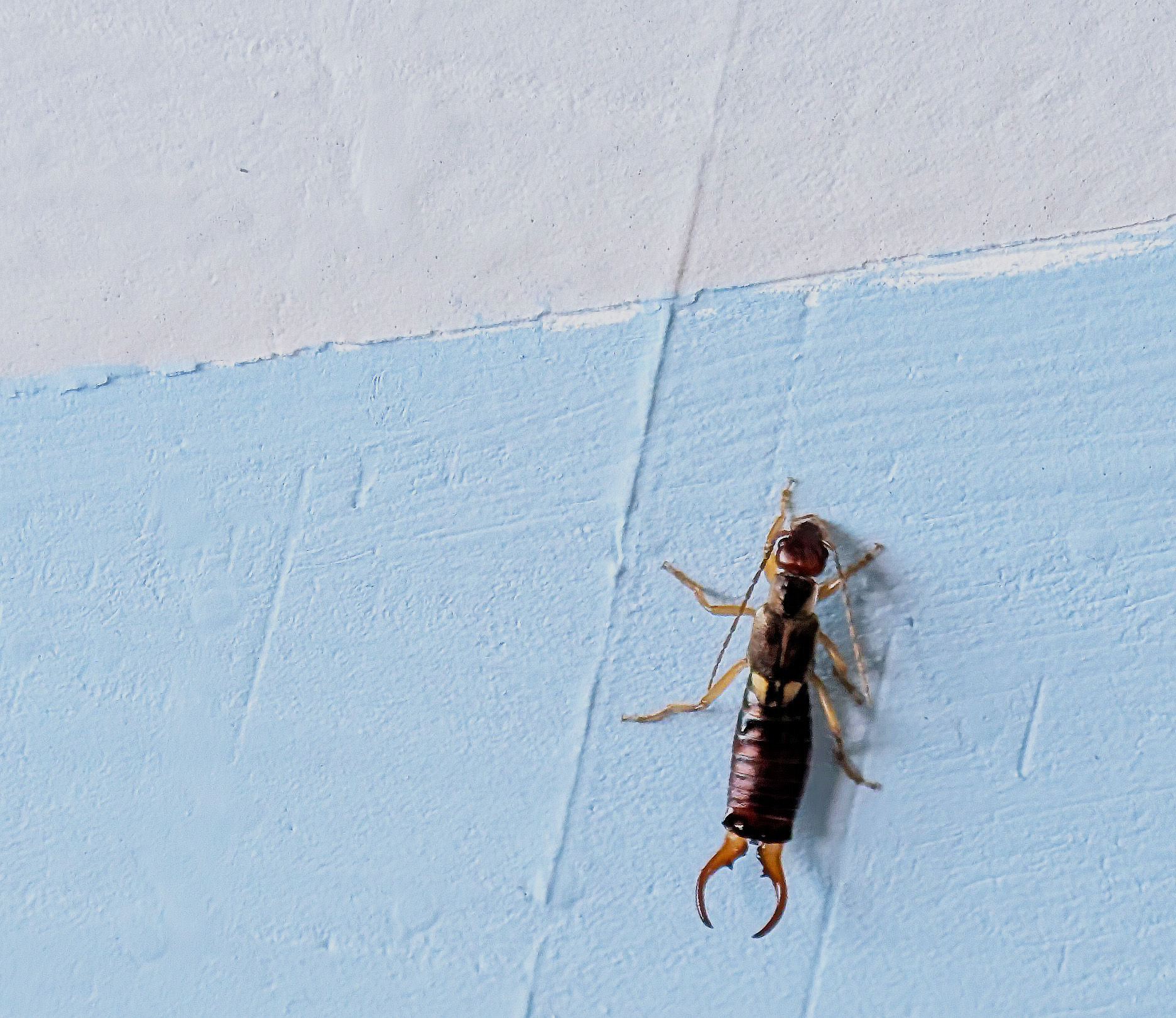
Forficula auricularia
Taxonomy
- Kingdom: Animalia
- Phylum: Arthropoda
- Class: Insecta
- Order: Dermaptera
- Family: Forficulidae
- Genus: Forficula
- Species: Forficula auricularia
Common Names by Region
- European Earwig
- Common Earwig
- Pincher Bug
- Forkytail / Forkytail Bug (regional US)
Description
Body
An elongated, flattened, fast-moving insect with a leathery reddish-brown to dark-brown body, typically around 12–15 mm long. The flattened build lets it slip into tight cracks, under bark, and beneath stones — the earwig’s whole way of life is built around wedging into narrow shelter.
Head & Antennae
- Reddish-brown head with chewing mouthparts
- Long, thread-like antennae, roughly half the body length
- Compound eyes; no ocelli
Wings
- Short, hardened forewings (elytra) cover the thorax like a cropped jacket
- Membranous hindwings fold in an intricate fan beneath them
- Capable of flight but rarely bothers — it’s overwhelmingly a walker and a hider
Forceps (Cerci)
The signal feature and the sex marker:
- Paired pincer-like appendages at the rear of the abdomen
- Males: strongly curved, bowed, caliper-like forceps — as on this individual
- Females: nearly straight and parallel
The forceps are used in defense, in prey handling, in courtship, and in folding the delicate hindwings back into place.
Known Range
- Native to: Europe, western Asia, and North Africa
- Now established across North America, Australia, New Zealand, and much of the temperate world — one of the most widely distributed introduced insects
Thoroughly at home in Pennsylvania, including in and around buildings, gardens, and painted exterior walls like the one here.
Habitat
- Cool, dark, humid, and tight — under mulch, bark, stones, boards, and inside cracks and crevices
- Nocturnal; hides by day and forages after dark
- Drawn to the moist margins of gardens, foundations, and structures; will wander indoors seeking damp shelter but does not breed or thrive inside
Diet
- Omnivorous scavenger
- Eats decaying plant matter, algae, fungi, and organic litter
- Preys on aphids, mites, insect eggs, and other small soft-bodied invertebrates
- Will chew soft plant tissue, seedlings, flower petals, and soft fruit — the behavior that earns it garden-pest status
The balance of that diet is why it’s neither purely friend nor foe in a garden: it eats aphids on one hand and nibbles seedlings on the other.
Behavior / Life Cycle
- Overwinters as mated adults in underground burrows
- Maternal care — the standout trait: the female lays a clutch of eggs in a chamber and guards them, cleaning each egg to fend off mould, then continues to tend the nymphs after they hatch until their first molt
- Nymphs resemble small wingless adults, developing through several instars
- Typically one to two generations per year
That brooding behavior is genuinely unusual. Most insects lay and leave; the earwig mother stays, grooms the eggs against fungal infection, and shepherds the young — a rare vertebrate-like investment in a small brown insect most people step around.
Predators / Threats
- Birds, toads, and predatory insects
- A specialized parasitoid tachinid fly (Ocytata pallipes and relatives) targets earwigs
- Broadly abundant and under no conservation pressure — if anything, too successful in its introduced range
Ecological Role
A decomposer and a soft-bodied-pest predator. The European earwig processes decaying organic matter back into the soil system and suppresses aphid and mite populations while doing it. In an ecological ledger it belongs with the cleanup crew — the litter-shredders and small predators that keep a garden’s underlayer cycling. Its damage to living plants is real but usually minor and localized, weighed against steady service as a scavenger and aphid-eater.
Additional Notes
- The name is a fossil of folklore: an old European belief held that earwigs crawled into sleepers’ ears and bored into the brain. They do not. The name likely derives instead from the ear-shaped hindwing.
- Despite the fearsome look, the pincers are essentially harmless to humans — a male can deliver a faint pinch, but there’s no venom and no meaningful bite.
- Earwigs release a mild defensive odor when handled — part of why predators and people alike leave them be.
- Their attraction to tight, dark, humid spaces is exactly why they turn up in porch corners, under siding, and along painted trim.
Cernunnos Foundation Note
The European earwig is a case study in reputation versus role. It carries centuries of undeserved dread in its very name, yet the animal underneath is a litter-recycler, an aphid-predator, and — most strikingly — one of the few insects that guards and grooms its own young. That maternal investment reframes the whole creature: the pincers that make people flinch belong to an animal doing patient, unglamorous care work in the dark. In system terms it’s a reminder that the members of an ecosystem we find ugly or unsettling are often the ones quietly holding a functional niche — decomposition, pest control, nutrient return — that the visible, charismatic species depend on. Judge the work, not the face.
Field Note — ID
The strongly curved, bowed forceps identify this as a male, and the body form, coloration, and pincer shape are a clean match for Forficula auricularia, the common European earwig — by far the most likely earwig on a Pennsylvania wall. Solid ID; low uncertainty here.
Views: 215