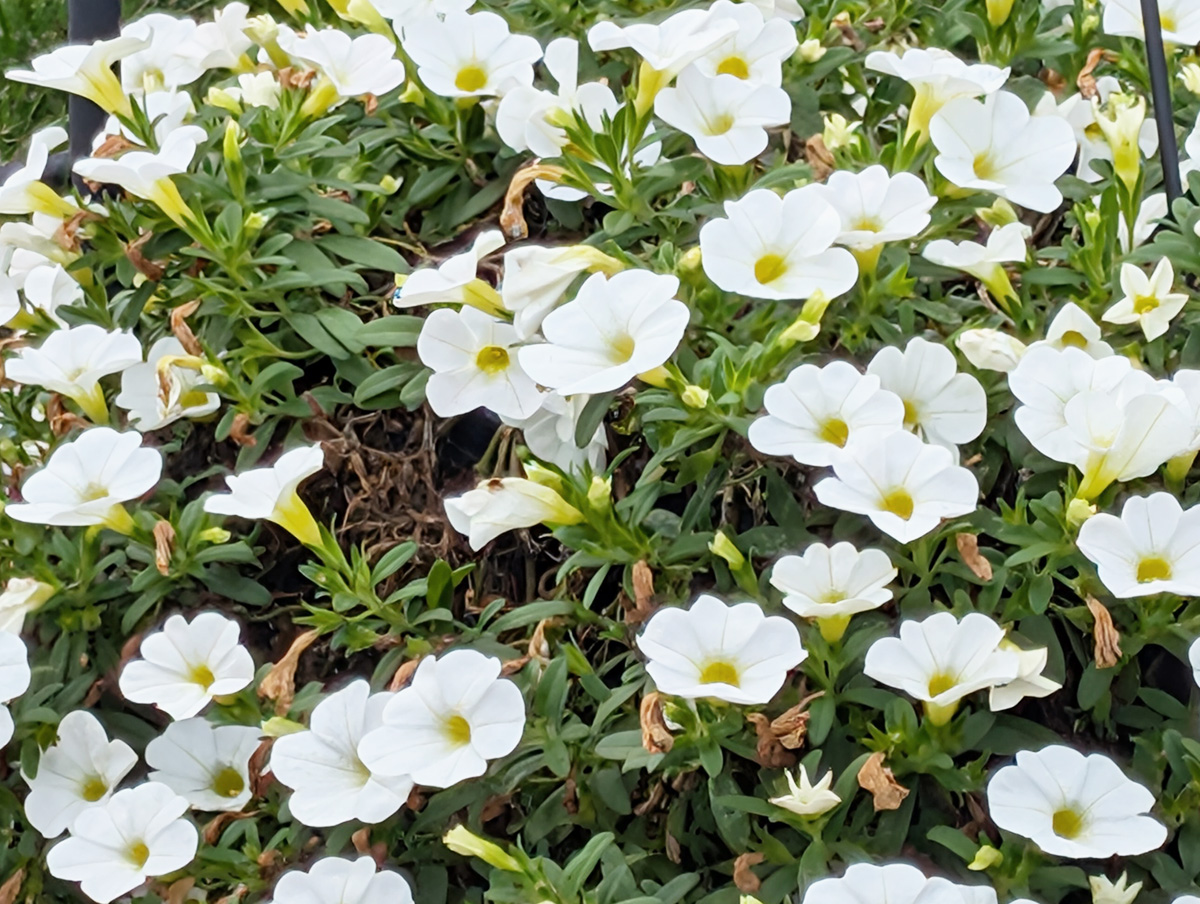
Calibrachoa × hybrida
Taxonomy
Domain: Eukaryota
Kingdom: Plantae
Subkingdom: Tracheobionta
Superdivision: Spermatophyta
Division: Magnoliophyta
Class: Magnoliopsida
Clade: Eudicots
Clade: Asterids
Order: Solanales
Family: Solanaceae
Genus: Calibrachoa
Species: Calibrachoa × hybrida (garden hybrids)
Common Names by Region
- United States / Canada: Million bells, calibrachoa, mini petunia, trailing petunia
- Trade names: Million Bells®, Superbells®, MiniFamous®, Cabaret® and others — most garden plants are patented, trademarked hybrid series
- South America (native range): Local-language equivalents; the genus honors Mexican botanist Antonio de la Cal y Bracho
Description
Quick ID
- Growth form: Low, mounding-to-trailing tender perennial, almost always grown as an annual. Spills densely over the edge of containers and baskets — the signature “waterfall” habit.
- Flowers: Masses of small, petunia-like trumpets, roughly 1 inch across — noticeably smaller than a true petunia. Borne in enormous numbers, which is the whole point (the “million bells”).
- Color range: One of the widest in bedding plants — reds, oranges, yellows, pinks, magentas, purples, blues, near-white, plus bicolors, stars, and dark-veined patterns.
- Center details: Small five-lobed flared trumpet, often with a contrasting yellow or dark throat.
- Leaves / stems: Small, oval, slightly sticky (glandular) leaves on trailing stems — the tacky feel and nightshade-family look separate it from lookalikes.
Blooming
- Spring through frost, near-continuously. A defining trait: it’s self-cleaning — spent flowers drop on their own, so no deadheading is needed to keep it blooming.
Look-alikes
- Petunia (Petunia × hybrida): The close cousin and the plant Calibrachoa was split out of. Petunia flowers are larger (2–4 in.), the foliage coarser and stickier, and most petunias do need deadheading. If the blooms are small and the plant self-cleans, it’s Calibrachoa.
- Petchoa (× Petchoa): An intergeneric Petunia × Calibrachoa hybrid splitting the difference — mid-sized flowers, self-cleaning; a newer trade group that blurs the line.
Known Range
- Native: South America — Brazil, Argentina, Uruguay, Peru, and neighboring regions, in warm grassland and rocky, open habitat.
- In cultivation: Grown worldwide as a warm-season container and basket annual. Ubiquitous in United States garden centers, including throughout Pennsylvania. A tender perennial (roughly USDA zone 9+); in our climate it’s frost-killed and replanted each year, not a persisting or naturalizing plant.
Care / Habitat
Light
- Full sun. Six-plus hours drives the heavy bloom; shade thins the flowering and stretches the plant.
Soil
- Light, well-drained, slightly acidic potting mix. Calibrachoa is prone to iron chlorosis (yellowing between leaf veins) in alkaline or high-pH conditions — a common container problem fixed with acidic feed or iron supplement.
Water
- Even moisture, but sharp drainage is essential. It resents soggy roots and will rot if overwatered, yet wilts fast if allowed to dry out completely in a hot basket — the balance is the main growing challenge.
Feeding
- A heavy feeder. Container plants bloom hardest with regular liquid fertilizer through the season; underfed plants pale and stall. Most performance complaints trace back to too little food, wrong pH, or bad drainage.
Typical Habitat (when cultivated)
- Hanging baskets, window boxes, mixed containers, and bed edges — sunny, well-drained, regularly fed spots where the trailing habit can spill.
Propagation / Reproduction
- Cuttings, almost exclusively. The named series are patented hybrids grown from vegetative cuttings to hold true to type — home propagation of patented cultivars is legally restricted.
- Seed is a minor path: most hybrids are sterile or don’t come true, though a few seed-grown strains exist.
- Pinch young plants to encourage branching and a fuller mound.
Pests / Diseases / Threats
- Root and stem rot from overwatering or poor drainage — the number-one killer.
- Iron chlorosis in high-pH mixes, as above.
- Aphids, thrips, and whiteflies on tender growth; occasional budworm.
- Not weedy or invasive — a frost-tender ornamental that ends with the season.
Additional Notes
Ecology & Use
- A magnet for hummingbirds and a nectar source for butterflies and bees — the small trumpets and long bloom season make it a genuine pollinator draw despite being a bred ornamental.
- A relatively recent garden plant: the first “Million Bells” series was introduced by Suntory in the early 1990s, and the explosion of colors and forms since has made it one of the top-selling basket annuals in the trade.
- Split taxonomically from Petunia on genetic evidence (Calibrachoa carries a different chromosome count), which is why an old plant you might remember as a “mini petunia” now sits in its own genus.
Management
- Want maximum bloom? Full sun, steady feeding, and let it self-clean — no deadheading required.
- Struggling plant? Check the three usual suspects in order: drainage, fertilizer, and soil pH. Correct those and it typically rebounds.
Open Reference / Educational Use (CF Standard)
This profile is provided for open educational reference, field identification support, and art/illustration reference in the spirit of the Cernunnos Foundation field guide project. Reuse is encouraged with attribution to CF and your on-site page as the source.
Views: 233