Anser Indicus
Taxonomy
- Domain: Eukaryota
- Kingdom: Animalia
- Phylum: Chordata
- Class: Aves
- Order: Anseriformes
- Family: Anatidae
- Subfamily: Anserinae
- Genus: Anser
- Species: Anser indicus
Common Names by Region
- United States / Canada: Bar-headed goose
- United Kingdom: Bar-headed goose
- South & Central Asia (native range): Numerous regional names; a familiar bird on the high lakes of Tibet, Ladakh, and Mongolia and on the wintering waters of the Indian subcontinent
- General: Bar-head
Description
Quick ID
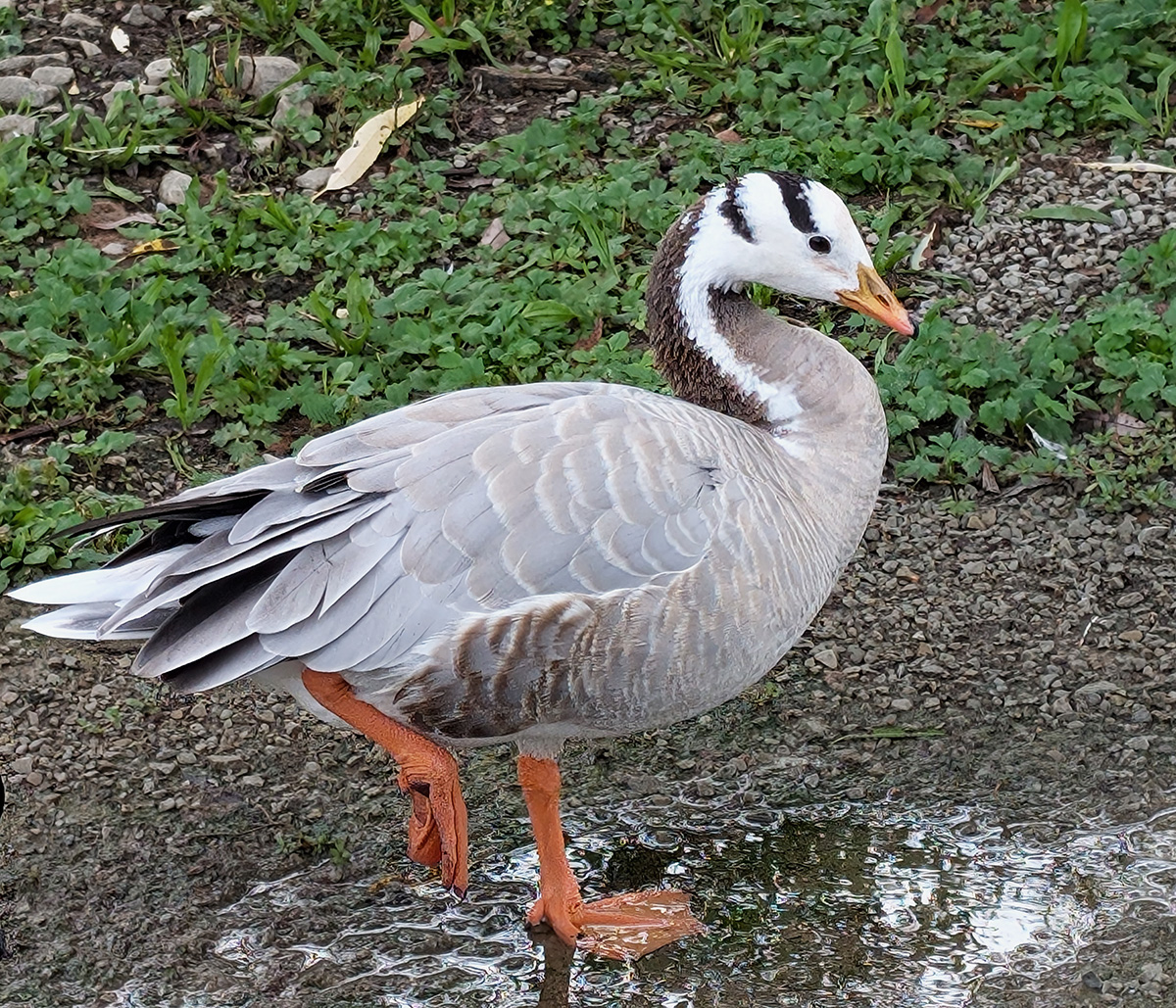
- Head: White, crossed by two bold black bars curving over the crown and nape — the diagnostic field mark and the source of the name.
- Neck: Dark brownish-gray with a white stripe running down each side, from the white cheek toward the body.
- Body: Pale silvery-gray, finely marked with darker gray barring across the flanks and folded wing.
- Bill and legs: Yellow-orange bill with a dark tip; bright orange legs and webbed feet — vivid against the muted plumage, as here.
- Size: A medium-large goose, roughly 28–30 inches long, smaller and paler than a Canada goose.
Range
- Native to Central and South Asia. Breeds on high-altitude lakes and marshes of the Tibetan Plateau, Ladakh, Mongolia, and neighboring highlands; winters at lower elevations across the Indian subcontinent — Pakistan, India, Bangladesh, and Myanmar.
Habitat & Behavior
- Breeds in colonies on islands and shores of high mountain lakes; winters on lowland lakes, rivers, reservoirs, and farmland.
- Grazes like other true geese — walks on land cropping grass and crops, and feeds in shallow water.
- The signature trait — extreme high-altitude migration: the bar-headed goose crosses the Himalaya on its seasonal journeys, flying at some of the greatest heights recorded for any bird. Tracked birds routinely clear high passes, and the species is documented flying in the thin air near the world’s tallest peaks.
- Its physiology is specially adapted for it: a hemoglobin that binds oxygen more efficiently, denser wing-muscle capillaries, larger lungs, and the ability to hyperventilate without ill effect — a whole system built to power flight where the air holds a fraction of the oxygen at sea level.
Diet
- Herbivorous grazer. Grasses, sedges, and low herbs on land; roots, shoots, and aquatic plants in and around water; agricultural grain and crops on the wintering grounds.
Reproduction
- Nests colonially near high-altitude water, usually on the ground on islands, sometimes on cliffs or in trees where pressure demands.
- Lays a clutch of several eggs; the goslings are led to water soon after hatching and reared by both parents.
- Pairs are long-term, and family groups stay together through the first migration.
Threats / Conservation / Notes
- Globally not threatened — populations are stable across a wide range — but locally sensitive to wetland loss, disturbance at breeding lakes, and hunting.
- Kept and bred widely in collections, parks, and ornamental waterfowl flocks worldwide; escapees have established small feral populations well outside the native range, including in Europe and North America.
- Because of that, a bar-headed goose on North American water is nearly always an exhibit, park, or escaped feral bird rather than a wild migrant.
Additional Notes
Ecology & Significance
- A flagship of extreme animal physiology — the go-to textbook example of how a bird engineers its whole oxygen system to fly higher than almost anything else alive. Few animals illustrate adaptation to environmental extremes so vividly.
- Culturally significant across its range, a familiar and admired bird of the high Asian lakes and the wintering wetlands of the subcontinent.
- Its worldwide popularity as an ornamental waterfowl is exactly why it shows up on park ponds far from Asia — striking, hardy, and content in a collection.
Field Note
- Photographed on a pond edge — the calm, approachable manner and the setting are consistent with a collection or park bird rather than a wild migrant, which fits how the species almost always occurs on this continent. The two black head-bars, white face stripe, and orange legs make it unmistakable wherever it turns up.
All Cernunnos Foundation materials are free to use for any educational purpose.
Views: 230