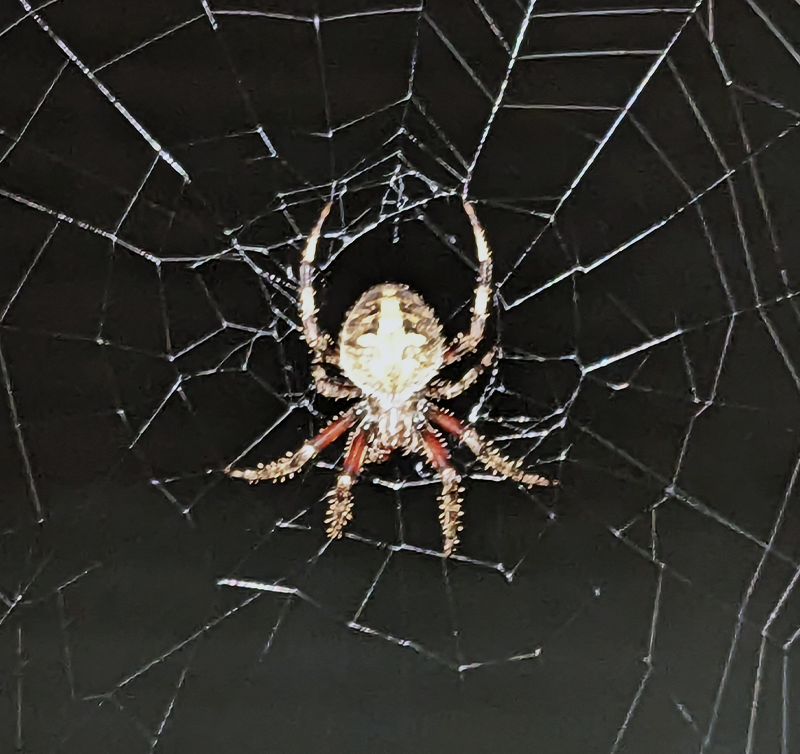
Neoscona crucifera

Comments:0 Comments

Spotted Orb-weaver


Taxonomy

  • Domain: Eukaryota
  • Kingdom: Animalia
  • Phylum: Arthropoda
  • Subphylum: Chelicerata
  • Class: Arachnida
  • Order: Araneae
  • Family: Araneidae
  • Genus: Neoscona
  • Species: Neoscona crucifera

Common Names by Region

  • Hentz Orb-weaver
  • Spotted Orb-weaver
  • Barn Orb-weaver (informal, often misapplied)
  • Fall Orb-weaver


Description

Overall Form

A robust, medium-to-large orb-weaver with a rounded abdomen and proportionally strong legs. Females are significantly larger and more conspicuous than males.

Coloration & Markings

Highly variable, but typically:

  • Abdomen tan, brown, rust, or orange-brown
  • Distinct pale folium (leaf-shaped marking) centered dorsally
  • Strongly banded legs
  • Reddish or brick-colored femurs (upper leg segments), especially noticeable under flash or porch lighting

The underside is darker, often with contrasting pale markings.

Size

  • Females: ~10–20 mm body length
  • Males: Smaller and more slender

Late summer females can appear impressively large due to egg development.


Known Range

Native to North America, widely distributed across:

  • The Midwest (including central Indiana)
  • The Northeast
  • The Southeast
  • Great Lakes region

Common in suburban, agricultural, and woodland-edge environments.


Habitat

  • Porch eaves
  • Siding and window frames
  • Fences and shrubs
  • Barn exteriors
  • Near artificial lights that attract insects

This species thrives in human-adjacent environments and is particularly abundant in late summer.


Web Architecture

Neoscona crucifera constructs classic vertical orb webs.

Key characteristics:

  • Built at dusk
  • Often removed or consumed by morning
  • Reconstructed nightly
  • Positioned to intercept flying insects

The spider typically rests at the center of the web at night and retreats to a nearby hiding location during the day.

Web diameter can exceed 60 cm in mature females.


Feeding Behavior

Nocturnal ambush predator.

Primary prey includes:

  • Moths
  • Beetles
  • Flies
  • Other flying insects attracted to lights

Prey detection occurs via vibrational signals transmitted through radial silk strands.

Silk serves both as capture system and sensory array.


Reproduction

  • Mating occurs late summer
  • Females produce egg sacs in protected crevices
  • Spiderlings overwinter in egg stage
  • Adults typically die after first hard frost

Peak visibility for large females is August through October.


Pests / Predators / Threats

Predators

  • Birds
  • Paper wasps
  • Larger spiders

Environmental Threats

  • Early frost
  • Habitat disturbance

This species is non-aggressive toward humans. Bites are rare and medically insignificant.


Additional Notes

  • Frequently misidentified as Araneus cavaticus (Barn Spider)
  • Commonly mistaken for European Garden Spider (Araneus diadematus)
  • Highly beneficial insect control agent in residential environments
  • Exhibits strong seasonal population spikes

The reddish femurs and pronounced folium pattern are strong visual identifiers in many individuals.


Field Notes

The Hentz Orb-weaver is an engineer operating on a daily rebuild cycle.

Each evening, the spider constructs a tensile structure from scratch:

  1. Frame lines
  2. Radial spokes
  3. Temporary spiral
  4. Adhesive capture spiral

Old silk is often consumed and recycled.

The web is not random. It is optimized for structural integrity and prey interception. Radial threads handle tension; the spiral provides elasticity and adhesion.

In porch-light environments, this species forms a micro-ecosystem node: artificial light attracts insects → insects attract orb-weavers → orb-weavers regulate insect pressure.

It is a quiet example of ecological adaptation to human infrastructure.


Maintenance / Management

No management required.

If webs are undesirable:

  • Relocate spider gently rather than destroy
  • Reduce exterior lighting to decrease prey attraction

This species is beneficial and should be preserved whenever possible.


Open Use Statement

This Cernunnos Foundation profile is provided freely for educational and artistic use. Text and reference materials may be shared, adapted, and cited to support ecological literacy and open knowledge.

Spread the love

Categories:

Leave a Reply