
Kingdom: Plantae
Clade: Tracheophytes
Clade: Angiosperms
Clade: Eudicots
Clade: Rosids
Order: Rosales
Family: Rosaceae
Genus: Rubus
Species: Rubus canadensis L.
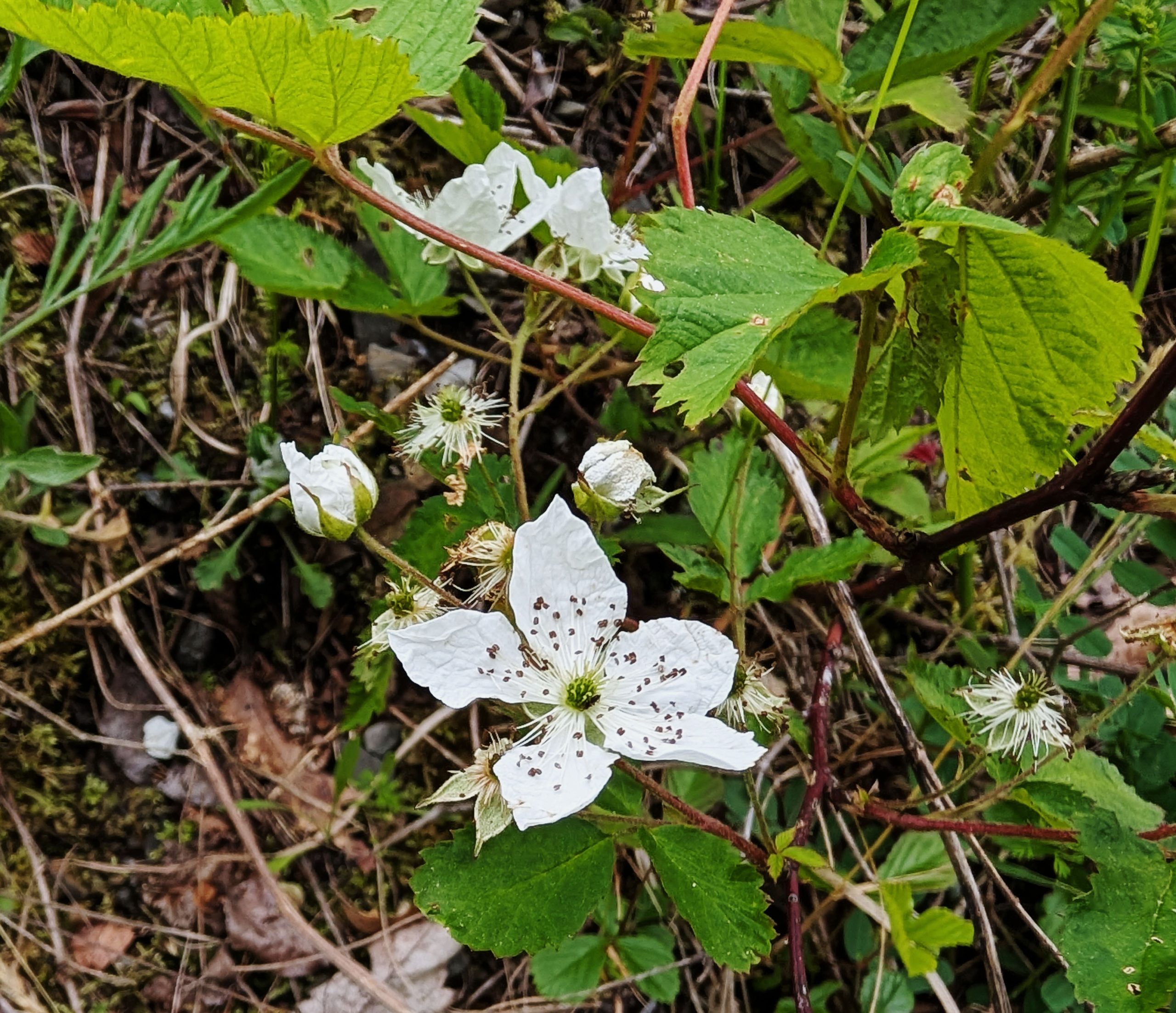
Rubus canadensis is a native perennial bramble forming arching, slender canes that may trail or lean rather than stand rigidly upright. It spreads through tip-rooting and short rhizomes, forming loose colonies rather than dense, armored thickets.
It is generally less aggressive than other eastern blackberries.
First-year canes (primocanes) are:
Compared to many other wild blackberries, the plant feels noticeably less “armored.”
Second-year canes (floricanes) produce flowers and fruit.
Leaves are compound, usually with 3–5 leaflets.
Leaflets are:
Petiole and midrib may have small prickles but lack the heavy bristling seen in more aggressive species.
Flowers appear late spring to early summer.
Flowers are typically flat to slightly cupped and well-formed, attracting native bees and pollinators.
The fruit is an aggregate drupe (blackberry).
Fruit is edible and typically mildly sweet to moderately tart.
Native to eastern North America.
Found from:
Common in Pennsylvania, Indiana, and woodland-edge habitats.
Prefers:
Tolerates partial shade better than many other blackberries.
Often found in less-disturbed or semi-managed landscapes rather than aggressive roadside thickets.
Reproduces by:
Colonies expand gradually rather than explosively.
Common issues include:
As a native species, it is generally resilient in natural ecosystems.
Rubus canadensis is often confused with:
Accurate identification requires observation of:
Hybridization within the genus is common.
In managed landscapes:
In ecological settings, it serves as:
This species represents a lighter-handed blackberry — present, productive, and protective without forming impenetrable barricades. It occupies edges, transitional spaces, and semi-open ground with quiet persistence.
Smooth blackberry is less a conqueror and more a participant in woodland succession.
All plant profiles and educational materials published by the Cernunnos Foundation are released for free educational and artistic use. Attribution is appreciated but not required. Knowledge is meant to circulate.