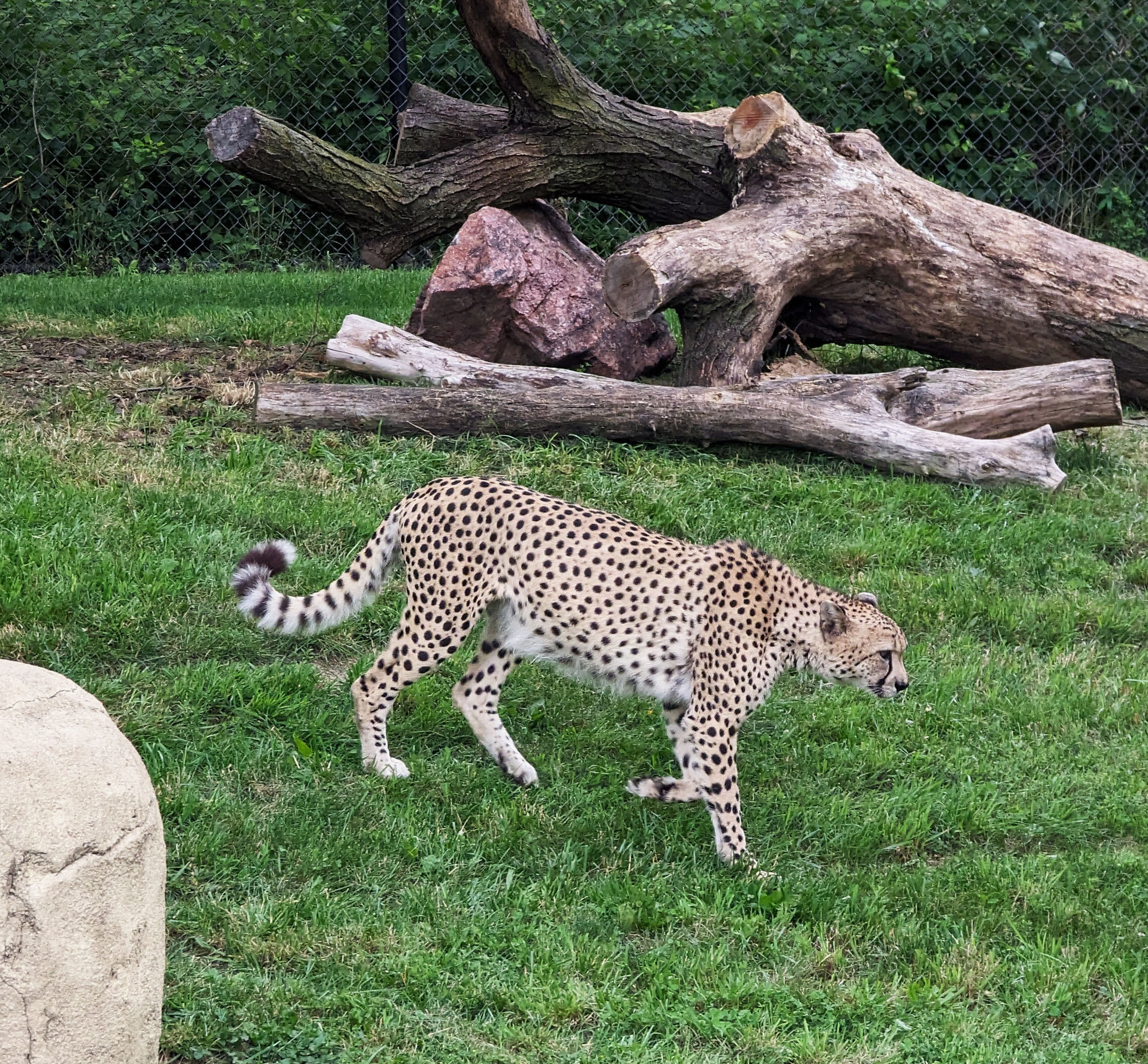
Cheetah
Taxonomy
- Domain: Eukaryota
- Kingdom: Animalia
- Phylum: Chordata
- Class: Mammalia
- Order: Carnivora
- Family: Felidae
- Subfamily: Felinae
- Genus: Acinonyx
- Species: Acinonyx jubatus
Common Names by Region
- Global / General English: Cheetah
- Southern & Eastern Africa (common usage): Cheetah
- Southwest & Central Asia (historical / subspecies context): Asiatic cheetah (for A. j. venaticus, Iran)
Description
Quick ID
A slender, long-legged cat built for sprinting, with:
- Small, rounded head and deep chest
- Tan to golden coat with solid black spots (not rosettes)
- Distinct “tear marks”: black lines from inner eyes down toward the mouth
- Long tail used as a counterbalance during turns
Size & Build
Light-framed compared to other big cats; optimized for acceleration and high-speed pursuit rather than grappling.
Speed & Hunting Style
The cheetah is widely recognized as the fastest land mammal, with top speed figures commonly cited up to ~29 m/s (about 65 mph), though real-world hunting bursts are typically shorter and not always at maximum.
Diet
Primarily medium-sized ungulates (varies by region), with opportunistic takes where conditions allow. Cheetahs rely on daylight hunting and visibility—speed is their edge, not brute force.
Behavior & Social Pattern
- Females are often solitary except when raising cubs
- Males may form coalitions (often brothers) to hold territory and improve hunting/defense odds
- Avoidance of larger predators is a constant constraint; cheetahs frequently lose kills to lions, hyenas, and leopards.
Known Range
Cheetahs now occupy a reduced, fragmented range:
- Most populations: eastern and southern Africa
- Asia: a tiny remnant population persists in central Iran (Asiatic cheetah, A. j. venaticus), with extremely low numbers reported in recent assessments.
Conservation references commonly cite only a fraction of historic range remaining (often stated around ~10%).
Care / Habitat
Wild Habitat
Cheetahs thrive where they can see, run, and finish a chase:
- Open grasslands, savannas, semi-deserts, open scrub, and some lightly wooded mosaics
- Healthy prey base + space to avoid competitor pressure
Captive Care Notes
Cheetahs are specialized:
- Need room for movement and low-stress enclosure design
- Stress management matters (they can be sensitive to chronic disturbance)
- Captive breeding has historically been challenging compared to some other felids, and conservation programs may use assisted reproduction as a backstop.
Propagation / Reproduction
- Breeding: seasonal patterns vary by region and conditions
- Gestation: roughly three months (commonly cited ~90–95 days)
- Litter size: commonly 2–4 (can vary)
- Cub survival: heavily influenced by predator pressure, habitat fragmentation, and human conflict near edges.
(If you want, I can tune this section to match your preferred CF “field practical” tone—more on what drives outcomes than raw numbers.)
Pests / Diseases / Threats
Major Threats
- Habitat loss and fragmentation (loss of space is catastrophic for a wide-ranging sprinter)
- Human–wildlife conflict (retaliatory killing, livestock pressure, boundary conflict)
- Illegal wildlife trade (especially cub trafficking for the exotic pet trade; ongoing seizures and rescues are regularly reported)
- Low genetic diversity affecting resilience and reproduction is widely cited as a species-level concern.
Conservation Status (high level)
- Often summarized as Vulnerable on the IUCN Red List in popular conservation references.
- Listed under CITES Appendix I (international trade controls), with an annotation framework that has existed since the 1970s.
Additional Notes
- The cheetah is a case study in specialization: when your entire design is “win the first 10 seconds,” anything that reduces space, visibility, prey, or safety margins hits harder than it would for a generalist predator.
- Population estimates vary by source and year; one widely cited figure is ~7,100 mature individuals (2016 estimate), with many sources emphasizing continued decline and fragmentation.
Maintenance / Management
In-situ Conservation Priorities
- Keep landscapes connected: corridors and cooperative land stewardship matter more than isolated “islands.”
- Reduce conflict: livestock management support, compensation frameworks, and community-aligned deterrence beat enforcement-only approaches.
- Interrupt illegal trade pipelines: seizures help, but demand reduction and enforcement consistency are the long game.
- Maintain prey base: habitat quality + prey recovery are foundational.
Ex-situ Support
- Genetic banking and assisted reproduction are increasingly discussed as “insurance,” not a primary plan—especially where wild populations continue to shrink.
Views: 424