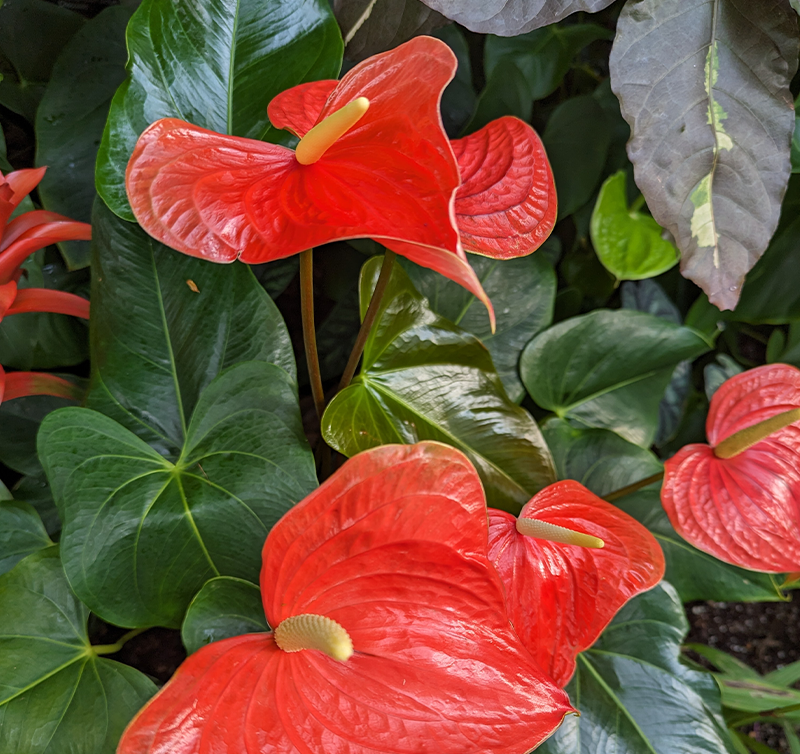
Anthurium andraeanum
Taxonomy
Kingdom: Plantae
Clade: Angiosperms
Clade: Monocots
Order: Alismatales
Family: Araceae
Genus: Anthurium
Species: Anthurium andraeanum Linden ex André
Common Names by Region
- United States: Flamingo Flower, Tailflower
- Hawaii: Anthurium (cut-flower trade staple)
- Caribbean & Central America: Laceleaf
- Floral Industry (global): Anthurium (commercial hybrid forms dominate)
Description
Growth Habit
A tropical evergreen perennial forming a clumping rosette. In cultivation it remains compact (12–24 inches tall), though foliage can expand significantly in greenhouse conditions.
Leaves
- Large, glossy, heart-shaped
- Thick, leathery texture
- Deep green with pronounced veins
- Emergent leaves unfurl with a rolled appearance typical of Araceae
The foliage alone makes this a structural plant in interiorscapes.
Inflorescence (The “Flower”)
What appears to be a flower is actually two structures:
- Spathe: The glossy, brightly colored bract (red in your image). Waxy, reflective, and long-lasting.
- Spadix: The upright, pale yellow cylindrical structure emerging from the center. This holds the true tiny flowers.
Color forms include red, pink, white, orange, and bi-color cultivars. Red remains the iconic form.
The sheen is not ornamental by accident — it is functional, aiding pollinator attraction in its native humid forests.
Known Range
Native to Colombia and Ecuador in tropical rainforest understories.
Now globally cultivated in:
- Florida
- Hawaii
- Netherlands greenhouse industry
- Southeast Asia
It is primarily grown as a houseplant or cut flower outside the tropics.
Care / Habitat
Light
Bright, indirect light. Direct sun scorches leaves.
Water
Moist but never waterlogged.
Allow top inch of soil to dry before watering again.
Soil
Well-draining, airy mix:
- Orchid bark
- Coco coir or peat
- Perlite or pumice
This mimics epiphytic/loose forest floor conditions.
Temperature
65–85°F preferred.
Sensitive below 55°F.
Humidity
Thrives at 60%+ humidity.
Leaf shine increases in properly humid environments.
Propagation / Reproduction
- Division of clumps
- Stem cuttings with nodes
- Commercial tissue culture (dominant in industry)
Seed production is possible but slow and rarely used in home cultivation.
Pests / Diseases / Threats
- Root rot (overwatering)
- Spider mites (low humidity)
- Mealybugs
- Anthracnose fungal issues
Primary cultivation failure is poor drainage.
Additional Notes
- Contains calcium oxalate crystals — toxic if ingested (pets/children).
- One of the longest-lasting cut flowers in global floriculture.
- Symbolically associated with hospitality and longevity due to persistent blooms.
- The shine of the spathe is structural, not wax-coated — a natural surface adaptation.
In commercial systems (including controlled greenhouse aquaponic integrations), it performs well under steady nutrient regimes and consistent humidity.
Maintenance / Management
- Remove spent spathes at the base.
- Flush soil occasionally to prevent salt buildup.
- Repot every 2–3 years to refresh aeration.
- Maintain airflow in high-humidity environments.
Views: 408