
Kingdom: Animalia
Phylum: Arthropoda
Class: Insecta
Order: Lepidoptera
Superfamily: Geometroidea
Family: Geometridae
Subfamily: Ennominae
Genus: Hypomecis
Species: Hypomecis punctinalis
Binomial Name: Hypomecis punctinalis (Scopoli, 1763)
Pale Oak Beauty
Oak Beauty Moth
Gray Geometer
Oak Looper Moth
Many members of the Geometridae family are informally called inchworm moths because of their distinctive larval movement.
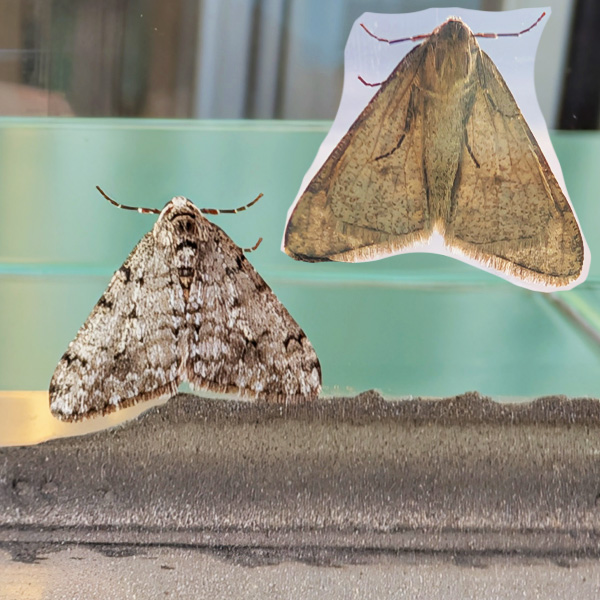
Hypomecis punctinalis is a medium-sized geometrid moth known for its bark-like camouflage and triangular resting posture. When at rest the wings are held flat, forming a broad triangle that blends remarkably well with tree bark, stone, or weathered surfaces.
Adults are primarily active at night but are frequently encountered resting on walls, tree trunks, and windows during the day.
The wings are gray to light brown with a mottled pattern that mimics lichen-covered bark.
Key visual characteristics include:
The camouflage is highly effective, making the moth difficult to notice when resting against natural surfaces.
Typical wingspan ranges from 35–50 mm.
The body is slender and lightly scaled, matching the color of the wings.
Features include:
In males the antennae may appear slightly more feathery, aiding detection of pheromones.
The Pale Oak Beauty is widespread across Europe and parts of temperate Asia and has been reported in some regions of North America through introduction or closely related species complexes.
It is most commonly found in:
The moth is strongly associated with areas containing oak trees, though larvae feed on several hardwood species.
This species prefers deciduous woodland environments where host trees are abundant.
Typical resting locations include:
The mottled coloration allows the moth to remain nearly invisible against bark or rough surfaces.
Adults are nocturnal and are often attracted to artificial lights at night.
During daylight hours they remain motionless, relying on camouflage to avoid predation.
Females lay small clusters of eggs on host plants, particularly on the bark or leaves of hardwood trees.
Eggs hatch into caterpillars commonly known as inchworms.
The larvae are classic looping caterpillars.
They move by:
Because they lack several middle prolegs, their movement forms a looping motion.
Larvae feed on the leaves of:
Pupation typically occurs in soil or leaf litter, where the caterpillar forms a protective cocoon before emerging as an adult moth.
The species has few specialized predators but is commonly eaten by:
The caterpillars may occasionally feed heavily on foliage, but populations are typically regulated naturally by predators and parasites.
As with many moths, habitat loss and artificial light pollution can disrupt normal behaviors.
Geometrid moths play an important role in forest ecosystems.
They function as:
Their caterpillars are particularly important food for nesting songbirds, which rely heavily on soft-bodied insects to feed young chicks.
The name “geometer” comes from Greek meaning “earth-measurer.” It refers to the looping movement of the caterpillars, which appear to measure the ground as they move.
The bark-mimicking patterns seen in adults represent one of the most refined forms of cryptic camouflage in insects. When resting on tree trunks or weathered wood, the moth’s wing pattern can closely resemble patches of lichen or cracked bark.
This camouflage is especially effective when the moth holds its wings flat in the characteristic triangular posture seen in your photographs.