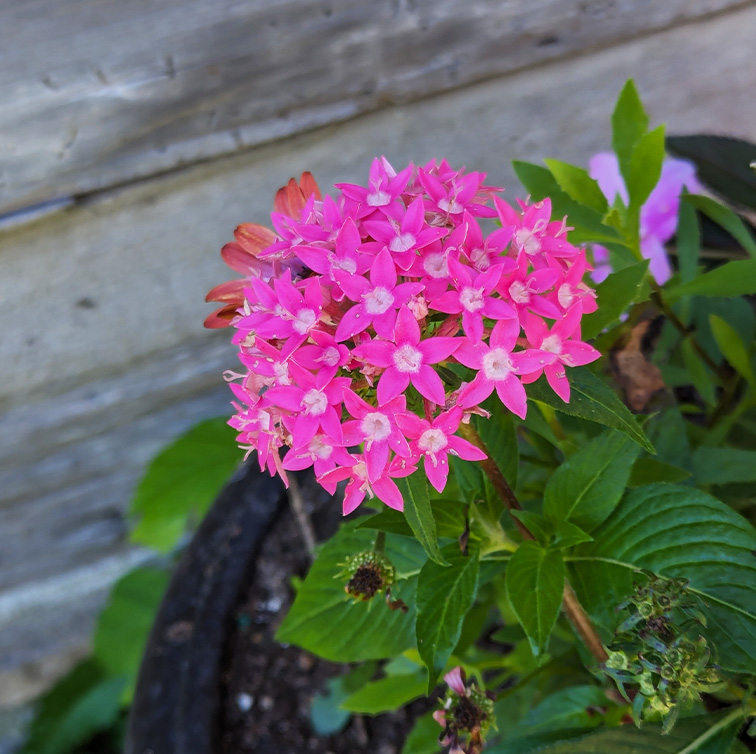
Pentas lanceolata
Taxonomy
- Kingdom: Plantae
- Clade: Tracheophytes
- Clade: Angiosperms
- Clade: Eudicots
- Clade: Asterids
- Order: Gentianales
- Family: Rubiaceae
- Genus: Pentas
- Species: Pentas lanceolata
Common Names by Region
- Egyptian Starcluster
- Pentas
- Star Flower
- Star Cluster Plant
Description
Growth Habit
Pentas lanceolata is a compact, herbaceous perennial (often grown as an annual in cooler climates) forming rounded, bushy clumps.
Leaves
Leaves are:
- lance-shaped (as the species name suggests)
- medium to deep green
- slightly textured with visible veins
- arranged oppositely along the stem
Flowers
The defining feature:
- Dense clusters of five-pointed star-shaped flowers
- Bright pink in this specimen (also occurs in red, white, lavender)
- Each flower has a small central tube—adapted for pollinators with long mouthparts
Clusters are tight, forming a near-spherical bloom head.
Known Range
- Native to: tropical East Africa and Yemen
- Widely cultivated in:
- Southern United States
- Central and South America
- Southeast Asia
- Africa
In temperate regions, it is used as a seasonal ornamental.
Care / Habitat
- Light: Full sun to partial sun (best flowering in full sun)
- Soil: Well-drained, moderately fertile
- Water: Moderate; prefers consistent moisture but not waterlogged soil
- Temperature: Warm climates; sensitive to frost
Thrives in:
- garden beds
- containers (as shown)
- pollinator gardens
Propagation / Reproduction
Seeds germinate readily in warm conditions.
Continuous blooming occurs under:
- long daylight
- warm temperatures
Pests / Diseases / Threats
Generally hardy but may encounter:
- Aphids
- Spider mites (especially in hot, dry conditions)
- Whiteflies
Root rot possible if:
- drainage is poor
- soil remains saturated
Ecological Role
This is a pollinator magnet.
Highly attractive to:
- butterflies (especially swallowtails and monarchs)
- hummingbirds
- bees
The tubular flower structure favors nectar feeders, making it a strong support plant in pollinator systems.
Additional Notes
- One of the most reliable continuous bloomers in warm climates
- Excellent for color density + ecological function
- Works well in structured planting systems where:
- aesthetics
- pollinator support
are both desired
Maintenance / Management
- Deadheading encourages continued blooming
- Light pruning maintains shape and density
- Fertilize lightly during growing season for sustained flowering
In colder zones:
- treat as annual
- or overwinter indoors
Cernunnos Foundation Note
Pentas lanceolata represents a clean intersection of ornamental value and ecological utility—a plant that provides sustained visual density while actively supporting pollinator networks. In system design, it functions as both signal (color, structure) and support (nectar resource).
Post Views: 479