
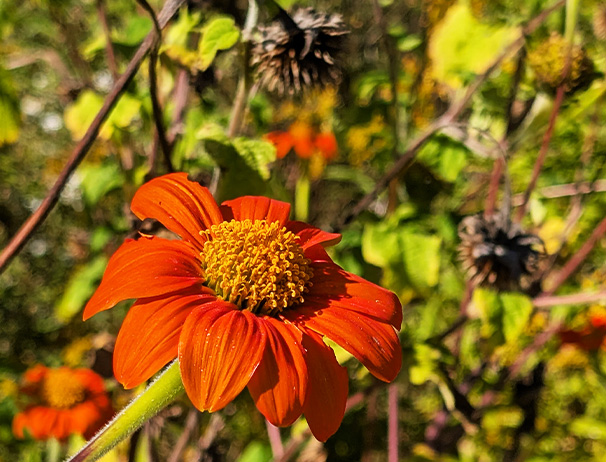
Tithonia rotundifolia is a vigorous, coarse-textured annual in temperate cultivation, behaving as a perennial in its native tropical range where it can reach 4 meters in height. In gardens it typically grows 1.2 to 1.8 meters tall, occasionally taller, with a large central stalk and an open, somewhat rangy branching habit. Stems are hollow, notably brittle, and covered in soft pubescent fuzz. The overall form is bold and upright — a plant that commands space and announces itself at the back of a border.
Leaves are alternate, broadly ovate to deltoid, up to 38 cm long with a long petiole. Margins are subentire to crenate or serrate, and the lower leaves are frequently three-lobed. The upper surface is a deep grayish-green, rough to the touch; the underside is distinctly hairy and paler. Both leaf surfaces and stems carry the same soft pubescence. The foliage is coarse and bold in scale, contributing to the plant’s presence even before bloom.
Flower heads are large, 5–8 cm across and occasionally up to 10 cm, borne singly at the ends of long, hollow, fistulose peduncles — a distinguishing feature of the genus. Ray florets are a vivid vermilion to deep orange, broadly egg-shaped, and arranged around a central disk of golden yellow disc florets. The overall effect is intensely saturated, one of the most striking warm-color composites in the annual garden. Bloom period runs from midsummer through first frost, with production increasing as the season progresses. The flowers are excellent for cutting and highly attractive to pollinators.
Fruit is an achene with a short pappus of two awns. Seeds are small, flat, and angular. The plant produces seed freely and can self-sow in warm climates. In temperate gardens seeds are collected after the first light frost when the heads have dried down.
Native to Mexico and Central America, where it grows primarily in seasonally dry tropical habitats. It is associated with disturbed ground, roadsides, field margins, and open scrub throughout its native range. In its native habitat it is perennial and can reach substantial shrub-like proportions.
Widely cultivated as an ornamental annual throughout temperate North America, Europe, and beyond. It has naturalized in Florida, Louisiana, parts of South America, and scattered tropical and subtropical regions worldwide where it occasionally escapes cultivation into disturbed ground. It is not considered aggressively invasive in most temperate regions due to frost sensitivity, but can establish in warm climates.
Light: Full sun; requires at least 6–8 hours of direct sun for best bloom Soil: Poor to average, well-drained; avoid rich soil or heavy fertilization, which promotes excess foliage at the expense of flowers Moisture: Drought tolerant once established; prefers dry to moderate conditions USDA Zones: Grown as an annual in Zones 2–9; perennial in Zone 10 and above Typical Habitat: Open disturbed ground, roadsides, field margins, and garden borders in full sun; thrives in heat and tolerates dry conditions typical of its native Mexican highland habitat
Tithonia rotundifolia is propagated by seed. Seeds can be direct-sown in the garden after the last frost date, or started indoors 6–8 weeks before the average last frost for earlier bloom. Sow shallowly — light aids germination. Transplant carefully as the hollow stems are brittle and seedlings do not tolerate rough handling. Space plants 60–90 cm apart to allow air circulation and provide mutual support. Plants do not require deadheading to continue blooming but removing spent heads keeps the plant tidy and may encourage additional branching.
Generally very resistant to pests and diseases. Deer largely avoid it. Aphids may occasionally colonize new growth but rarely cause serious damage. Powdery mildew can occur in poorly ventilated conditions late in the season. The primary cultural threats are rich soil and overwatering, both of which produce lush, weak, floppy growth prone to stem breakage. Strong winds are a consistent hazard given the brittle hollow stems — shelter or staking is advisable in exposed positions.
Pinching the growing tips of young plants encourages bushier, more branching growth and reduces the tendency toward a single tall central stem. Taller plants benefit from staking, particularly in exposed locations. Once established, minimal watering is required. Cut flowers should be harvested early in the morning and the hollow stem ends seared briefly over a flame or dipped in boiling water before conditioning — this prevents the stem from collapsing in the vase. At season’s end, allow some heads to dry fully on the plant to collect seed for the following year. Plants are frost-tender and will be killed by the first hard freeze.
Tithonia rotundifolia is one of the most reliably productive pollinator plants available to the temperate garden. Monarch butterflies, tiger swallowtails, painted ladies, bumblebees, longhorned bees, syrphid flies, and a wide range of other pollinators visit the flowers consistently throughout the bloom season. Few annuals match its combination of visual intensity, drought tolerance, pollinator value, and sheer productivity in the late-summer garden. The genus name Tithonia honors Tithonus of Greek mythology — the mortal lover of the dawn goddess Eos, granted immortality but not eternal youth, who eventually withered into a cicada. The name reflects the plant’s association with heat, light, and the burning colors of sunrise. The cultivar ‘Torch’ has been in commercial production since winning an All-America Selections award in 1951 and remains the most widely available selection.
All images and written content published on this site are provided freely for educational and artistic use. Attribution appreciated but not required. Knowledge grows when shared.