
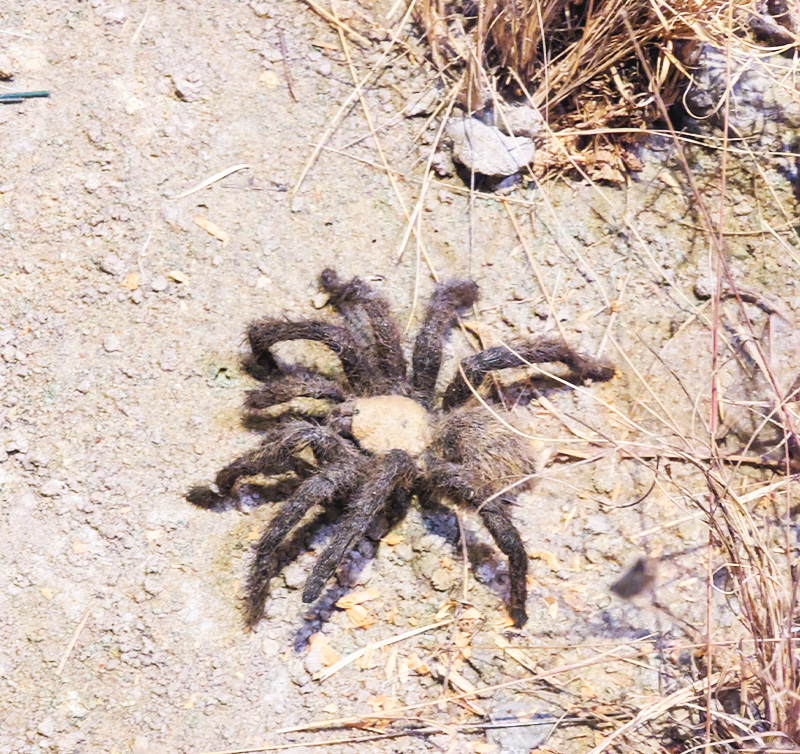
Aphonopelma hentzi is a large, heavily built, ground-dwelling tarantula with a stocky body and eight long, powerful, claw-tipped legs densely covered in dark bristling setae. The overall impression is of something ancient and deliberate — a low, patient, armored animal that has been doing exactly what it does for an extraordinarily long time. Up close, the dense covering of hairs gives the body a textured, almost velvety quality that photographs tend to flatten considerably.
Leg Span: 10–15 cm (4–6 inches); females typically larger than males Body Length: 3.5–5 cm Weight: Up to 85 g or more in large females
Females are significantly more robust than males. Adult males are somewhat more slender and develop enlarged pedipalps and tibial hooks — mating structures — upon reaching sexual maturity.
The body is uniformly dark brown to near-black, with rusty orange to copper-toned hairs on the carapace that catch warm light and give the animal a subtly burnished quality. Males develop distinctly black legs with a more contrasting copper-colored carapace upon maturity. Coloration is most vivid and distinct immediately following a molt, before the new exoskeleton and setae accumulate wear and debris. Juveniles and immature individuals show considerable variation, appearing in various shades of brown with hints of gray and reddish-brown.
Spiderlings emerge from the egg sac as tiny but fully formed miniatures of the adult form. Juveniles display more variation in brown, gray, and reddish tones than adults. They begin burrowing independently within days of leaving the mother and grow extremely slowly, taking anywhere from 5 to 12 years to reach sexual maturity depending on sex and conditions.
Aphonopelma hentzi ranges across the south-central United States including Texas, Oklahoma, Kansas, Missouri, Arkansas, Louisiana, Colorado, New Mexico, and Arizona. The species also extends into the northern border regions of Mexico along the New Mexico and Texas frontiers. It is one of the most common and widespread tarantulas in North America and is the species most likely to be encountered by the general public across its range, particularly during the late summer and fall when mature males begin roaming in search of mates.
Habitat: Grasslands, open scrubland, dry rocky terrain, and disturbed ground Activity: Primarily nocturnal; crepuscular during breeding season roaming Social: Solitary
Aphonopelma hentzi is a terrestrial burrowing species. Individuals construct or appropriate silk-lined burrows in soil, under rocks, logs, or in the abandoned dens of other animals, and spend the majority of their lives within or immediately adjacent to these retreats. Burrow entrances are often reinforced and lined with silk. The animal is an ambush predator, sitting at the burrow entrance at night and detecting prey through substrate vibrations and direct contact. When threatened, it adopts a defensive posture on the hind legs with the front legs raised, and may kick urticating hairs from the abdomen toward the perceived threat — barbed setae that cause significant irritation to skin and eyes of vertebrate predators. Biting is a secondary defense reserved for persistent or direct contact threats. The species is notably docile by tarantula standards and bites are rare in casual encounters.
Every autumn a striking behavioral event occurs across the range: mature males abandon their burrows entirely and begin overland roaming in search of receptive females. This mass movement of large spiders across roads, fields, and open ground is often mischaracterized as a migration — it is in fact a final reproductive mission. Males typically die within months of reaching maturity and mating, having achieved the singular purpose of their adult lives.
A documented and unusual mutualism exists between A. hentzi and narrow-mouthed toads (Gastrophryne spp.), which share burrows with the tarantula. The toads receive protection from predators; the tarantula benefits from the toad’s consumption of small invertebrates that might otherwise prey on spiderlings. The tarantula does not eat the toads.
Diet Type: Carnivore
Aphonopelma hentzi feeds primarily on insects including grasshoppers, crickets, cockroaches, beetles, and other arthropods. Larger individuals may occasionally take small vertebrates such as lizards, small frogs, or mice. Prey is detected through substrate vibration and physical contact, seized with the chelicerae, and subdued with venom before being liquefied and consumed. The species can survive extended periods without food, particularly females during and after egg incubation.
Breeding Season: Late summer through fall Egg Incubation: 45–60 days Egg Sac Size: 200–1,000 eggs Parental Care: Female guards and attends egg sac through hatching
Male maturity is reached in 5–8 years; females require 8–12 years. Upon maturity males begin roaming in search of burrow-holding females. Courtship involves substrate drumming — the male vibrates the ground with his pedipalps and legs to signal his identity and reduce the risk of being attacked as prey. Mating is brief. Females produce an egg sac 4–5 months after mating, suspending it in a silk hammock within the burrow and guarding it actively, repositioning it for optimal temperature and humidity. Spiderlings remain with the female for several days after emerging before dispersing to establish their own burrows. Females are exceptionally long-lived — documented lifespans exceed 30 years in some individuals, making this one of the longest-lived spiders in North America.
Conservation Status: Not evaluated (IUCN)
The primary natural predator of Aphonopelma hentzi is the tarantula hawk wasp (Pepsis grossa), a large parasitoid wasp that paralyzes the tarantula with a sting and lays a single egg on the living but immobilized body. The wasp larva consumes the tarantula from the inside as it develops — one of the more unsettling predator-prey relationships in North American entomology. Other predators include roadrunners, coatis, coyotes, and certain snake species. The annual roaming of mature males makes them highly vulnerable to road mortality during their brief above-ground period. Habitat loss through grassland conversion and collection for the pet trade represent additional pressures, though the species remains common across most of its range.
In captivity A. hentzi requires a terrestrial enclosure with deep substrate — at least 12–15 cm — to accommodate burrowing behavior. A starter burrow or hide is appreciated. Temperature should be maintained between 21–27°C with low to moderate humidity. The species is considered one of the most beginner-friendly tarantulas in the hobby due to its docile temperament, hardiness, and low maintenance requirements. Feed appropriately sized prey items weekly to biweekly, removing uneaten prey within 24 hours. Fresh water should be available at all times in a shallow dish. Molting animals should not be disturbed or fed. In the wild, population management is best served by preserving native grassland habitat and reducing road mortality during fall roaming season.
The species name hentzi honors Nicholas Marcellus Hentz, a French-American entomologist and arachnologist whose 19th-century work laid foundational groundwork for the study of North American spiders. The genus name Aphonopelma derives from the Greek for “silent” and “sole of the foot” — a reference to the quiet, pad-footed movement of these animals across substrate. The Texas Brown Tarantula occupies a significant place in the folklore of the American plains and Southwest, where the autumn appearance of wandering males has generated generations of local legend, misidentified as migration events and woven into seasonal storytelling. Indigenous traditions of the Southwest, particularly Hopi and Navajo, include powerful spider figures in their cosmologies — Spider Woman as creator, teacher, and protector — reflecting a deep cultural familiarity with these animals across millennia of coexistence.
Photographed on dry packed earth and gravel substrate, the animal pressed flat against open ground in full daylight — an unusual posture suggesting either thermoregulation on a warm surface or a brief pause during movement. The dense dark setae covering the legs and abdomen are clearly visible, and the compact, low-slung body profile is characteristic of the species. The rusty tones of the carapace are partially visible at center frame. No defensive posture was adopted during observation. Given the geographic context and the animal’s size, coloration, and ground-dwelling behavior on open terrain, identification as Aphonopelma hentzi is consistent with both the visual evidence and the known range of the species.
All images and written content published on this site are provided freely for educational and artistic use. Attribution appreciated but not required. Knowledge grows when shared.