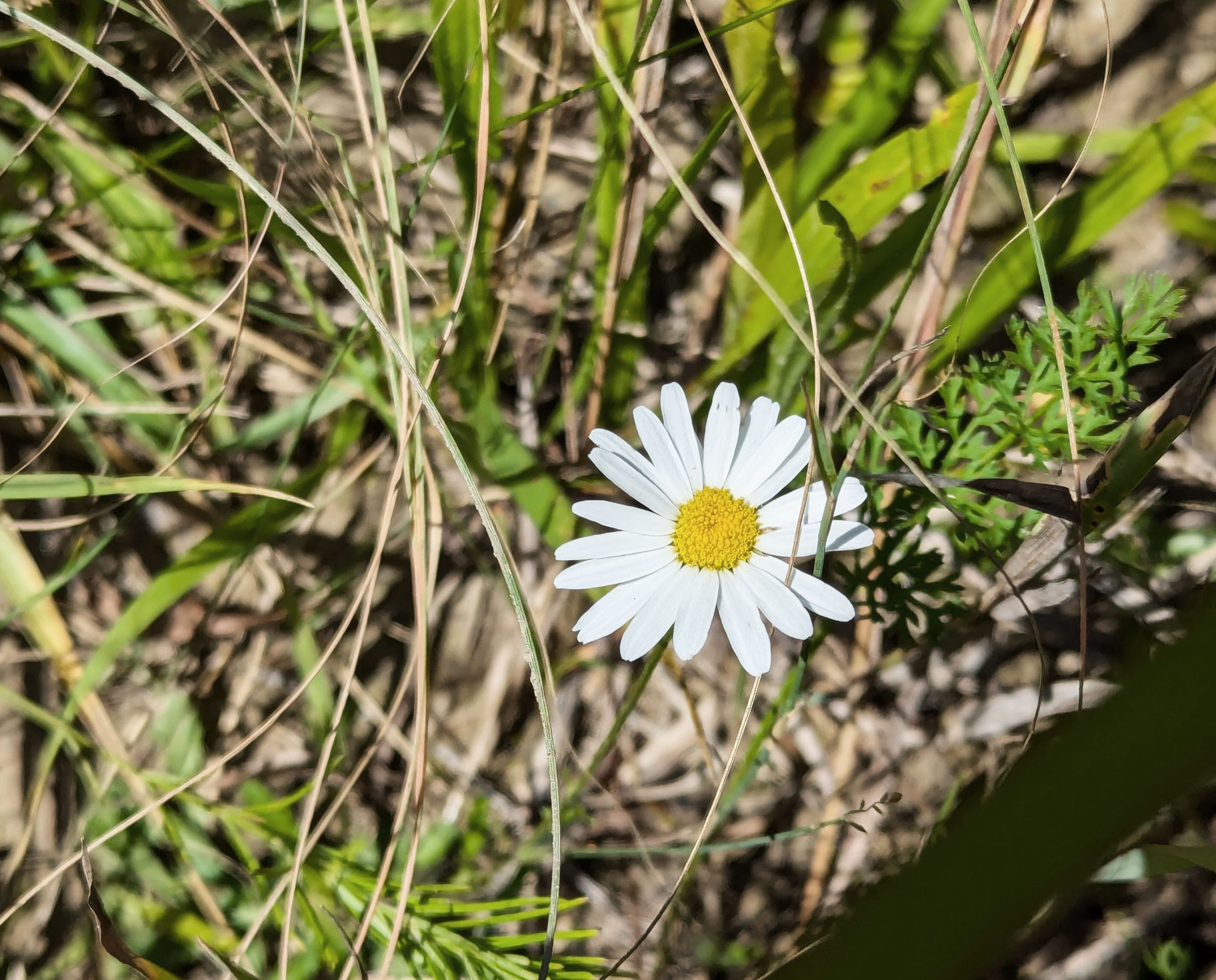
Oxeye Daisy
Taxonomy
- Domain: Eukaryota
- Kingdom: Plantae
- Clade: Tracheophyta (vascular plants)
- Clade: Angiosperms (flowering plants)
- Clade: Eudicots
- Clade: Asterids
- Order: Asterales
- Family: Asteraceae (Aster / Daisy family)
- Tribe: Anthemideae
- Genus: Leucanthemum
- Species: Leucanthemum vulgare (Lam.)
Common Names by Region
- Oxeye daisy (widely used)
- Common daisy (often, but can be confused with Bellis perennis)
- Marguerite / Marguerite daisy (sometimes used loosely; “marguerite” is also used for other daisies)
- Moon daisy (occasionally)
Description
Quick ID
A classic “white-petaled” daisy look: white ray florets around a golden-yellow center disk, typically held singly on a leafless flowering stem above a basal rosette.
Flowers
- One flower head per stem is common (sometimes a few).
- White “petals” (ray florets) surrounding a dense yellow disk.
- Blooms mainly in late spring through summer, depending on local conditions.
Leaves
- Often a basal rosette of leaves near the ground.
- Lower leaves tend to be spoon- to lance-shaped and may show coarse teeth.
- Upper stem leaves (if present) are typically smaller and simpler.
Stems
- Upright, slender, and typically leafless or sparsely leaved above the base.
- Plants often form noticeable patches in open ground.
Lookalikes
- Shasta daisy (Leucanthemum × superbum): a garden hybrid, usually larger flowers and a more “cultivated” look; can escape cultivation.
- Field daisy / other asters: several white-rayed composites can mimic the silhouette—leaf shape and growth habit matter.
- Fleabanes (Erigeron spp.): usually have many more, narrower rays and a “fringier” look than oxeye daisy.
Known Range
- Native: Europe and parts of temperate Eurasia.
- Introduced: Broadly introduced in many temperate regions, including large portions of North America.
- In many places it spreads readily in fields, roadsides, disturbed ground, and open meadows.
Care and Habitat
Habitat
- Prefers full sun to light shade.
- Common in dry to moderately moist soils, especially where the ground is disturbed or regularly opened up by mowing, traffic edges, or old-field succession.
Soil
- Tolerant of a range of soils, often thriving in well-drained sites.
- Will persist in lean soils and can handle relatively poor fertility.
Growth Style
- Perennial or short-lived perennial behavior is common depending on climate and site.
- Frequently spreads by seed and can also expand locally by root/crown growth, forming colonies.
Propagation and Reproduction
- Seed: prolific in many settings; easily wind- and movement-dispersed once mature.
- Division: clumps can be divided where it’s being intentionally kept (ornamental contexts).
- Management note: if you’re trying to prevent spread, the key is removing flowers before seed set and addressing re-growth from the crown.
Pests, Diseases, and Threats
- Generally tough and not heavily limited by pests in many regions.
- Primary “threat” is ecological/management-related: in some areas it can become weedy and displace local meadow plants.
- If it’s in a managed meadow restoration, it may need active control so it doesn’t dominate.
Additional Notes
- This is one of those plants that reads as “storybook meadow” at first glance—bright, simple, iconic—and then surprises people when they learn it can behave aggressively outside its native range.
- For pollinators, it can function as a readily accessible nectar/pollen source, but in restoration contexts the tradeoff is that dense stands can reduce overall plant diversity.
Field Notes (from the attached observation)
- Flower: clean white rays with a strong golden disk; classic daisy architecture.
- Setting: growing among grasses and mixed groundcover in open sun, suggesting a field/edge habitat.
- Impression: solitary bloom standing above the surrounding vegetation—high visibility, low fuss, very “I live here now” energy.
CF Open Use Notice (Education + Art Reference)
All original text and on-site materials published by Cernunnos Foundation are provided to support education, identification practice, and artistic reference. You are welcome to use them in classrooms, personal study, and creative work. Where practical, please credit Cernunnos Foundation and share derivative educational materials in the same spirit.
Post Views: 118