
Kingdom: Animalia
Phylum: Chordata
Class: Amphibia
Order: Anura
Family: Ranidae
Genus: Lithobates
Species: Lithobates catesbeianus
American Bullfrog
Bullfrog
Eastern Bullfrog
Common Bullfrog
Giant Bullfrog (informal)
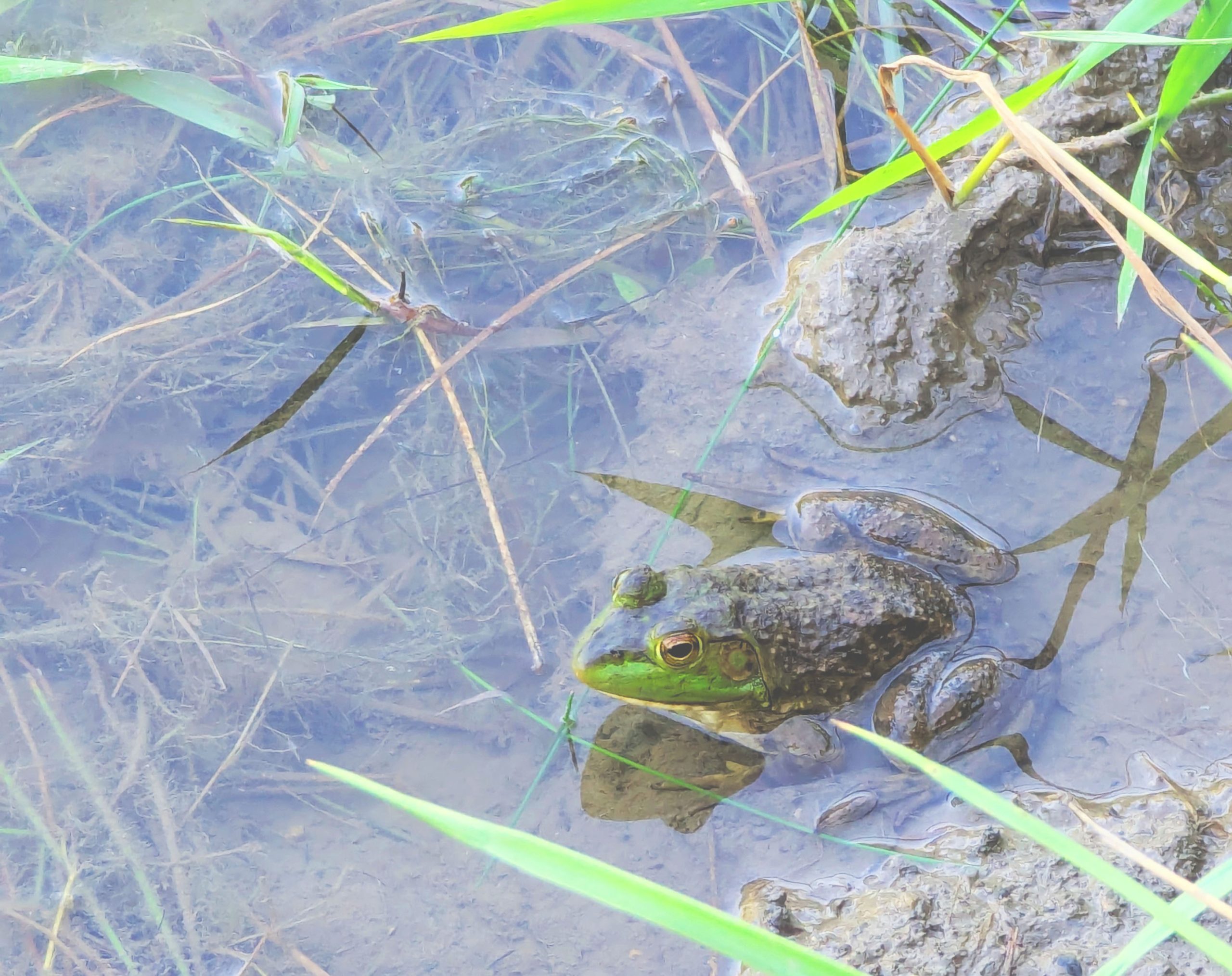
The American Bullfrog is the largest frog native to North America and one of the most recognizable amphibians in the eastern United States. Adults are heavy-bodied, broad-headed, and powerful, with strong hind legs built for both swimming and jumping. Coloration varies from olive green to dark brown, often with mottled or spotted patterns across the back and sides.
A defining feature of the species is the large tympanum (external ear) located behind the eye, which in males is noticeably larger than the eye itself.
Adult length: 9–15 cm (3.5–6 in) body length
Weight: up to 500 g (over 1 lb in large individuals)
Tadpoles may grow very large before metamorphosis and may take more than one year to transform.
Typical coloration includes:
Color may change slightly depending on temperature, moisture, and habitat.
The call of the American Bullfrog is one of the most familiar wetland sounds in North America, often described as:
“jug-o-rum” or “bruum”
Males call primarily during warm evenings in breeding season to establish territory and attract females.
Native range includes most of the eastern United States and southern Canada, extending west into the Great Plains.
Native distribution includes:
The species has also been introduced widely outside its native range, including:
Because of its size and appetite, the American Bullfrog can become invasive in some regions.
American Bullfrogs prefer permanent freshwater habitats, including:
They require water that remains year-round, since their tadpoles may overwinter before metamorphosis.
Bullfrogs are ambush predators and spend much of their time partially submerged, with only the eyes and nostrils visible above the water surface.
They are highly territorial during breeding season, with males defending calling areas along the shoreline.
They are mostly nocturnal but may be active during the day in warm weather.
American Bullfrogs are opportunistic carnivores.
Typical diet includes:
Large individuals will attempt to eat almost anything they can overpower.
Breeding season occurs in late spring through summer depending on latitude.
Process:
Bullfrog tadpoles often overwinter and may take 1–2 years to reach metamorphosis, which is unusually long for frogs in northern climates.
Natural threats include:
Human-related threats include:
In areas where introduced, bullfrogs may become a threat to native amphibians due to their size and aggressive feeding habits.
The American Bullfrog is an important species in both ecology and culture.
It plays a major role in wetland food webs as both predator and prey, and its call is strongly associated with summer wetlands across much of North America.
Bullfrogs have also been used historically as a food source, and the species has been widely transported for farming and stocking, which has contributed to its spread beyond its native range.
Because of its adaptability, the American Bullfrog often thrives in human-altered landscapes, including farm ponds, drainage areas, and artificial wetlands.
In managed wetlands or ponds, bullfrogs require:
In conservation settings, their presence should be monitored where they are not native, as they may displace local amphibian species.
All images and reference material on the Cernunnos Foundation website are provided for educational, artistic, and ecological reference use.
They may be used freely for study, artwork, and teaching, provided they are not misrepresented as original work by others.
The goal of this archive is the open sharing of natural knowledge for the benefit of science, culture, and education.