
Kingdom: Plantae
Clade: Tracheophytes
Clade: Angiosperms
Clade: Monocots
Order: Asparagales
Family: Iridaceae
Genus: Iris
Species: Iris germanica L.
Bearded Iris — United States / UK
German Iris — horticultural trade
Tall Bearded Iris — garden classification
Flag Iris — older English usage
Garden Iris — general use
Iris germanica is a hardy rhizomatous perennial known for its upright sword-like leaves and large, highly ornamental flowers. Plants grow in clumps that slowly expand outward from thick surface rhizomes.
Leaves are long, flat, and glaucous green to blue-green, forming fan-shaped clusters. They persist through much of the growing season and provide structure even when the plant is not in bloom.
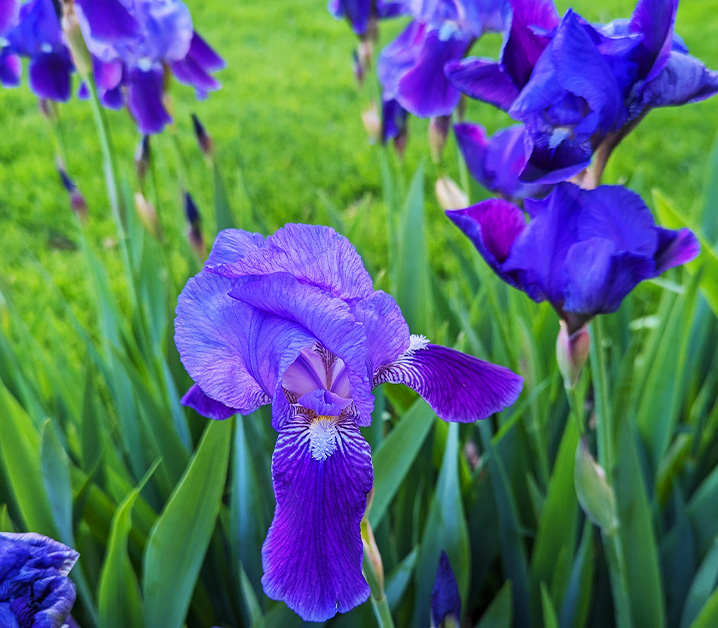
Flowers are large, complex, and strongly architectural, consisting of three upright petals (standards) and three downward-curving petals (falls).
The falls bear a distinctive beard of soft hairs, often contrasting in color.
The specimen shown is a dark blue / violet form, a common but striking color variant widely cultivated in temperate gardens.
Bloom time: late spring to early summer, depending on climate.
The plant grows from thick, shallow rhizomes that sit partially exposed at the soil surface. These rhizomes store energy and allow the plant to survive drought and cold.
Native origin is uncertain; the species is believed to be of hybrid or ancient cultivated origin in southern Europe and the eastern Mediterranean region.
Widely naturalized and cultivated across:
North America
Europe
Asia
Australia
Temperate regions worldwide
It is one of the most common ornamental perennials in human-managed landscapes.
Light: Full sun preferred
Soil: Well-drained, moderately fertile soil
Water: Moderate; drought tolerant once established
Temperature: Very hardy in temperate climates
Best growth occurs when rhizomes are exposed to sunlight and not buried deeply.
Overcrowded clumps should be divided every few years.
Primary method:
Rhizome division
Secondary method:
Seed (rarely used for named cultivars)
Rhizomes are typically divided after flowering and replanted with the top of the rhizome at or slightly above soil level.
Rhizome rot (from poor drainage)
Iris borer (major pest in North America)
Leaf spot fungi
Overcrowding leading to poor bloom
Most problems are caused by excessive moisture or lack of air circulation.
Iris germanica is one of the oldest continuously cultivated ornamental plants, with documented cultivation dating back centuries.
Thousands of cultivars exist, with colors ranging from white and yellow to deep violet, near-black, and bi-colored forms.
Dark blue varieties are especially valued for strong contrast in garden plantings.
The species has become culturally associated with traditional gardens, historic homes, cemeteries, and long-established homesteads.
Divide clumps every 3–5 years
Keep rhizomes exposed to sun
Remove dead leaves after frost
Ensure good drainage
Avoid heavy mulch over rhizomes
Once established, Iris germanica is extremely long-lived and often persists at abandoned homesites long after other garden plants disappear.
All photographs, descriptions, and reference material on the Cernunnos Foundation website are provided for educational, artistic, and research use.
Use is encouraged for:
Art reference
Education
Ecological study
Historical documentation
Open knowledge projects
Attribution to the Cernunnos Foundation is appreciated but not required.
Open use of knowledge is consistent with the mission of the Foundation.