
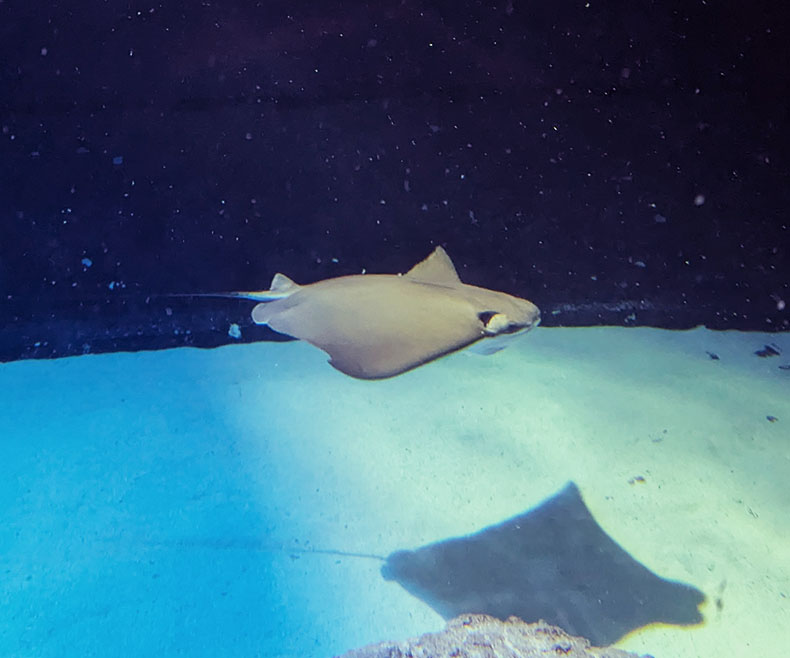
The cownose ray has a distinctive, forward-projecting head with two lobes that resemble a cow’s muzzle — hence the common name. Unlike many flat-bodied rays, its pectoral fins are sharply angled, giving it a more aerodynamic, wing-like appearance.
The body is diamond-shaped, with a long, whip-like tail equipped with one or more venomous barbs near the base.
Dorsal surface: brown to olive-gray.
Ventral surface: pale to white.
Juveniles tend to be lighter; adults deepen in tone with age.
Western Atlantic Ocean:
Seasonally migratory. Large schools form during warmer months, sometimes numbering in the thousands.
They prefer temperate to subtropical waters and are frequently observed in large migratory aggregations.
Cownose rays are benthic feeders.
Diet includes:
They use their “cow-like” lobes to detect prey and powerful dental plates to crush shells.
Ecologically, they influence shellfish populations and sediment turnover. Large schools can significantly alter benthic communities.
Pups are born fully formed and capable of swimming immediately.
Low reproductive rate makes populations vulnerable to overharvesting.
Natural predators:
Primary threats:
Historically, cownose rays were mischaracterized as “pests” in shellfish industries, leading to large-scale culling efforts in some regions.
Despite their intimidating barb, cownose rays are not aggressive. Stings occur almost exclusively when stepped on or handled improperly.
Their schooling behavior — sometimes in immense migratory formations — is one of the most visually striking phenomena in coastal marine ecosystems.
Conservation management requires:
Because of their low reproductive output, population recovery can be slow once reduced.
This profile is published by the Cernunnos Foundation as part of our open biological documentation initiative.
All written content may be used freely for:
Attribution appreciated but not required. Knowledge should circulate.