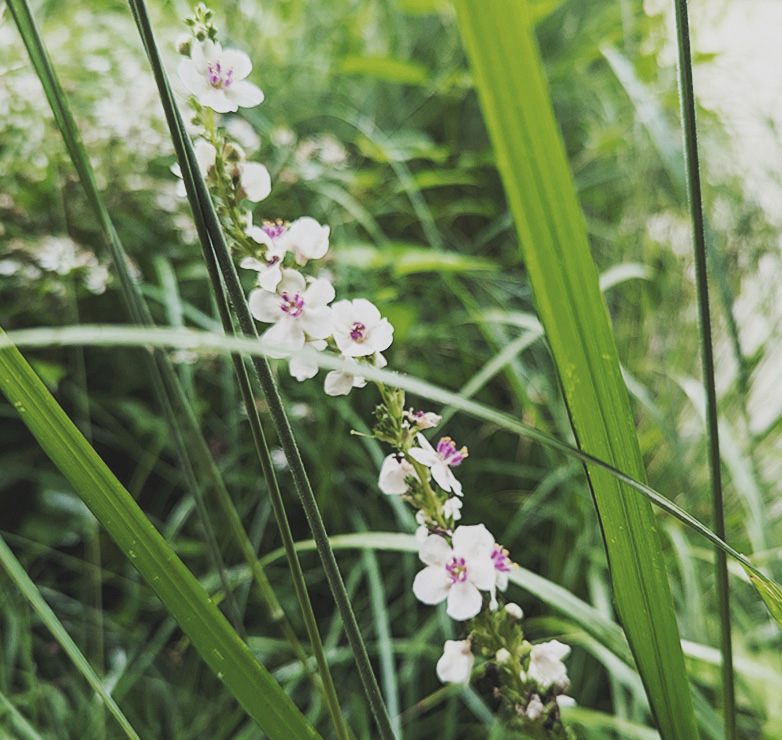
Verbascum chaixii
Taxonomy
Domain: Eukaryota
Kingdom: Plantae
Subkingdom: Tracheobionta
Superdivision: Spermatophyta
Division: Magnoliophyta
Class: Magnoliopsida
Clade: Eudicots
Clade: Asterids
Order: Lamiales
Family: Scrophulariaceae
Genus: Verbascum
Species: Verbascum chaixii
Common Names by Region
- United States / Canada (horticultural use): Nettle-leaved mullein, Chaix’s mullein (also sold as “mullein ‘Album’” for white-flowered forms)
- United Kingdom / Ireland (garden trade): Nettle-leaved mullein, Chaix mullein
- Continental Europe: Often referenced by local-language equivalents of “Chaix’s mullein / nettle-leaved mullein”
Description
Quick ID
- Growth form: Upright, flowering spike (“candle”) rising above a leafy base.
- Flowers: Five-petaled blooms along the spike; commonly pale yellow, but white forms exist.
- Center details: Purple-tinged stamens/hairs create the “purple eye” effect visible in your photo.
- Leaves: (Key check) V. chaixii typically has nettle-like, toothed leaves rather than the thick, woolly gray leaves of common mullein (V. thapsus).
Blooming
- Generally blooms late spring into summer, with flowers opening progressively up the stalk.
Look-alikes
- Moth mullein (Verbascum blattaria): Often a more slender, airy spike; leaves are less “nettle-ish” and the plant tends to read as a wirier roadside species.
- Common mullein (Verbascum thapsus): Big, thick felted gray leaves and usually yellow flowers; the whole plant looks “woolly.”
Known Range
- Native: Parts of Europe (commonly treated as a European species in horticulture and floras).
- Introduced / cultivated: Widely planted as an ornamental and can appear outside gardens in disturbed areas, depending on local conditions.
Care / Habitat
Light
- Full sun is best. Tolerates light shade, but blooms best with sun.
Soil
- Prefers well-drained soil; tolerant of lean, rocky, or sandy ground.
Water
- Drought-tolerant once established. Water during establishment and during prolonged dry periods for best flowering.
Typical Habitat (when naturalized)
- Disturbed ground, field edges, roadsides, open sunny patches—places with sun + drainage.
Propagation / Reproduction
- Seed is the main method.
- Often self-seeds lightly to enthusiastically depending on site conditions.
- To control spread: deadhead before seed set, or thin seedlings in spring.
Pests / Diseases / Threats
- Aphids can cluster on new growth and flower spikes.
- Leaf spot / mildew / rust may appear in humid conditions or crowded plantings.
- Generally tough and not high-maintenance when grown in sun with airflow.
Additional Notes
Ecology & Use
- Mulleins are reliable pollinator plants, offering nectar/pollen along a long bloom period.
- Excellent in prairie-style plantings, cottage gardens, and any “field guide garden” that leans wild but intentional.
Management
- If you want it as a persistent garden resident: allow some reseeding, or save seed and re-sow.
- If you want it contained: deadhead and remove volunteer seedlings early.
Open Reference / Educational Use (CF Standard)
This profile is provided for open educational reference, field identification support, and art/illustration reference in the spirit of the Cernunnos Foundation field guide project. Reuse is encouraged with attribution to CF and your on-site page as the source.
Views: 317