
Domain: Eukaryota
Kingdom: Plantae
Clade: Tracheophytes
Clade: Angiosperms
Clade: Eudicots
Clade: Asterids
Order: Asterales
Family: Asteraceae
Genus: Vernonia
Species: Vernonia noveboracensis
New York Ironweed
Tall Ironweed
Common Ironweed
Ironweed
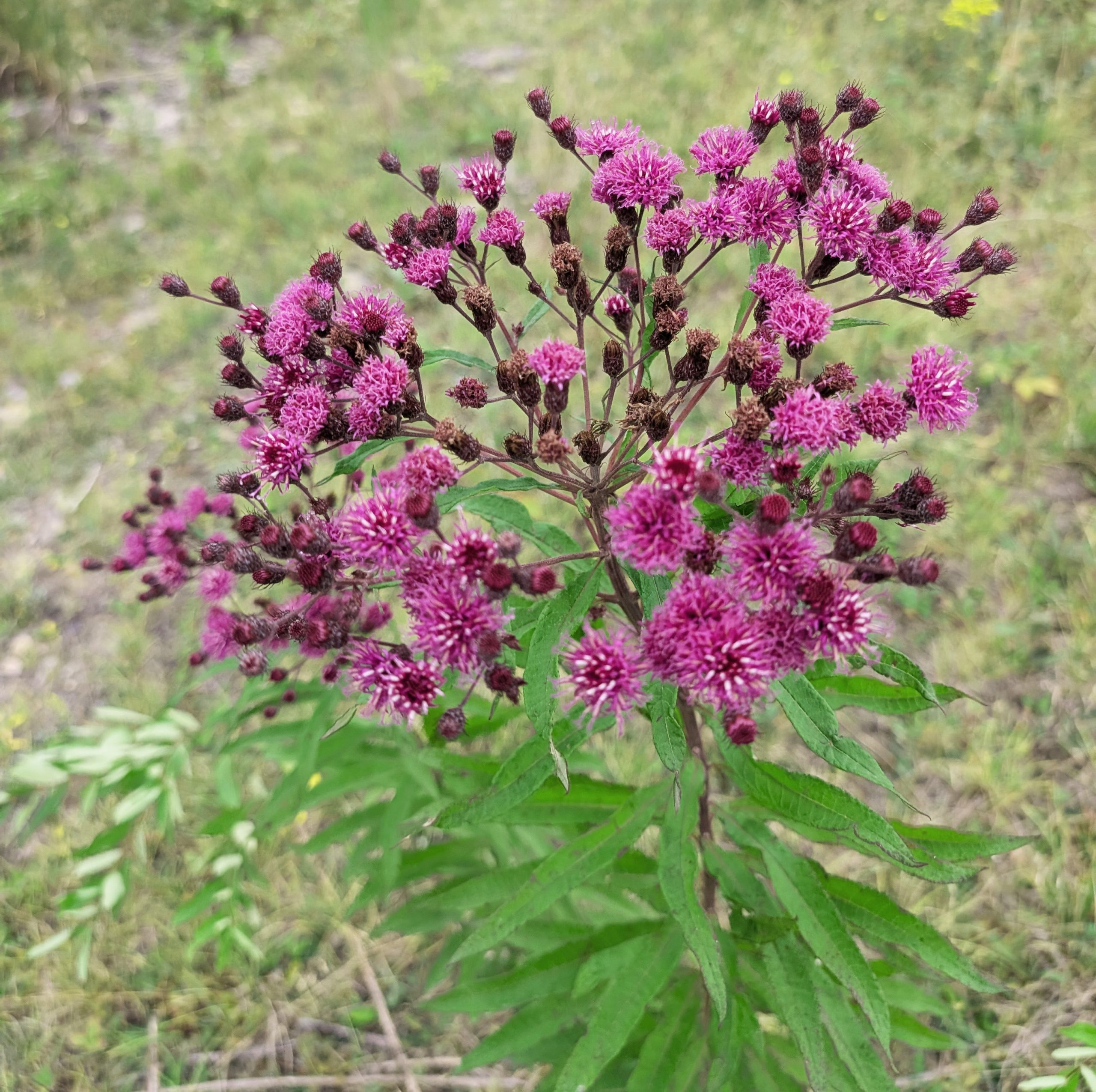
New York Ironweed is a tall perennial wildflower belonging to the aster family. It grows from a robust root system and produces strong upright stems that can reach impressive heights in favorable soil conditions.
Plants commonly reach 4–7 feet tall, sometimes taller in rich meadow soils.
The stems are tough and fibrous, giving rise to the plant’s common name “ironweed.”
Leaves are:
Typical leaf length ranges from 4–10 inches.
The leaves taper to a sharp point and often droop slightly downward along the stem.
The flowers are the most recognizable feature.
Unlike many members of the aster family, ironweed does not have ray petals. Instead, each flower head is composed entirely of dense clusters of tubular disk florets, giving the blooms a soft, brushlike appearance.
Characteristics include:
Bloom time typically occurs from July through September in much of its range.
The flowers are extremely attractive to pollinators.
Stems are:
They remain upright even after frost and winter weather, which contributes to the plant’s “iron-like” reputation for durability.
New York Ironweed is native to eastern and central North America.
Its range includes:
It is particularly common throughout the Appalachian Plateau and surrounding river valleys, including western and central Pennsylvania.
New York Ironweed prefers open sunny environments with moist to moderately wet soils.
Typical habitats include:
It tolerates a wide range of soils but grows best in rich, moisture-retentive ground.
Once established it is extremely hardy and drought tolerant.
Ironweed spreads by both seed and rhizomatous root systems.
Seeds are wind-dispersed and can colonize disturbed soils quickly.
They germinate best when exposed to winter cold stratification.
The plant also expands through underground rhizomes, forming small colonies over time.
Ironweed is generally resistant to most pests and diseases.
Potential issues may include:
However, mature plants are typically avoided due to their tough foliage.
The species is considered stable throughout most of its range.
New York Ironweed is one of the most valuable late-season nectar plants for pollinators in eastern North America.
It supports:
Because it blooms late in the growing season, it provides critical nectar when many other wildflowers have already finished flowering.
Ironweed plays an important role in native meadow ecosystems and is widely used in:
Its height and vivid color also make it a striking visual element in late-summer landscapes.
Despite its toughness, it integrates well into diverse plant communities and helps support biodiversity across its native range.
Cernunnos Foundation Note
Native wildflowers like New York Ironweed are foundational components of healthy meadow ecosystems. Their value extends beyond aesthetics — they support pollinators, stabilize soils, and help maintain the biological diversity that sustains larger ecological systems.
Observation and documentation of native plant species contributes to the preservation of regional ecological knowledge and landscape heritage.