
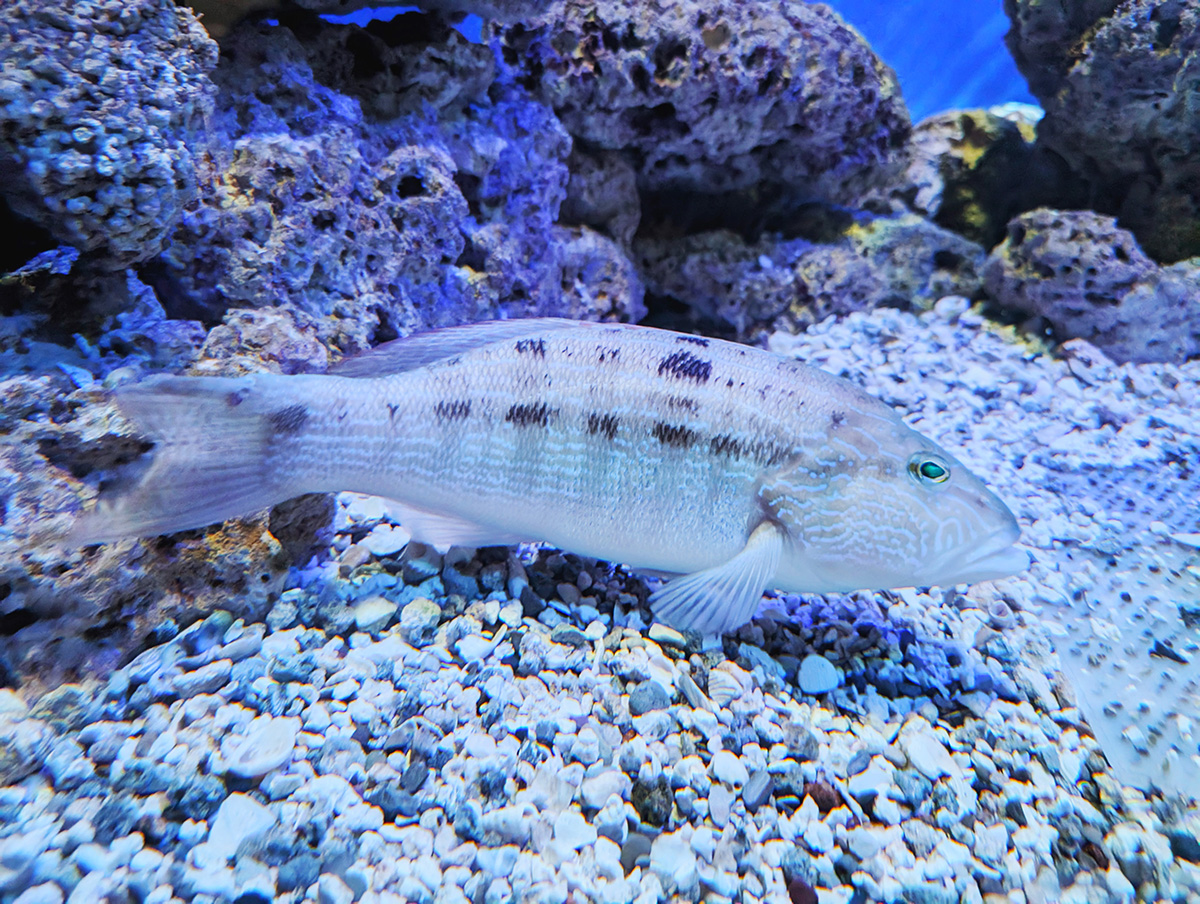
The Slippery Dick is a moderately elongate, laterally compressed wrasse with a pointed snout, thick lips, and a protrusible terminal mouth. Its overall profile is cigar-shaped and streamlined, built for active, constant movement along reef structure and open rubble bottom. The eye is notably large and bright, often displaying a vivid blue-green iris that stands out sharply against the pale body.
Length: Typically 12–23 cm; maximum recorded 35 cm Weight: Up to approximately 146 g at full size
Coloration is highly variable across three life phases. Juveniles are pale to white with a bold dark mid-lateral stripe running from snout through the eye to the tail base, sometimes accompanied by a spot near the rear of the dorsal fin. Initial phase individuals — which include females and some younger males — are pale whitish to pale greenish, with the mid-lateral stripe sometimes breaking into irregular dark blotches toward the rear of the body, and a second fainter stripe running along the lower side. A small bicolored spot, yellow and black, sits just above the pectoral fin base. Terminal phase males, the fully mature adults, shift toward green on the back shading to light greenish yellow on the sides, with the stripes turning purplish and the head developing irregular pink to red banding. The fish in this photograph is an initial phase individual.
Juveniles are predominantly white or very pale with a single bold black stripe from the mouth through the eye to the tail. As the fish enters the initial phase, the stripe may remain solid or begin fragmenting into spots and blotches rearward. Terminal phase coloration develops as the fish matures into a male, with greens, purples, and pink head markings replacing the simpler initial phase pattern.
The Slippery Dick ranges throughout the western Atlantic from North Carolina and Bermuda south to Brazil, including the Gulf of Mexico and throughout the Caribbean Sea. It is reef-associated and generally found in shallow water from 1 to about 15 meters depth, though individuals have been recorded to 40 meters. It is one of the more commonly encountered wrasses across Caribbean reef systems.
Habitat: Coral reefs, rocky substrate, rubble zones, and sandy areas adjacent to reef structure Activity: Diurnal Social: Loose groups; initial phase individuals sometimes school with other species
The Slippery Dick is an active, fast-moving daytime forager that spends most of its time working along the bottom in search of invertebrate prey. It is frequently observed resting directly on substrate — a characteristic wrasse behavior — and will investigate crevices, overturn rubble, and probe sandy patches in pursuit of food. Like other Halichoeres species, it is capable of burying itself in sand when threatened or at night. It has also been documented engaging in opportunistic cleaning behavior, picking ectoparasites from larger fish. The species commonly associates with mixed-species foraging groups alongside goatfish and other wrasses.
Diet Type: Carnivore
The Slippery Dick feeds primarily on benthic invertebrates including crabs, shrimp, sea urchins, brittle stars, polychaete worms, small mollusks, and occasionally small fish. It uses its protrusible mouth and strong canine teeth to seize prey, and grinding plates in the throat to crush hard-shelled items. Foraging is active and constant throughout daylight hours.
Breeding Season: Year-round in tropical range; peaks vary by region Mating System: Protogynous hermaphrodite; diandric
The Slippery Dick is a protogynous hermaphrodite, meaning individuals are born as either male or female, but females may transition to male over the course of their lives. Males that were born male are called primary males; those that changed from female are secondary males. Mature terminal phase males maintain loose territories and spawn with multiple initial phase females. Spawning is pelagic, with eggs and larvae dispersing via ocean currents. Adults provide no parental care.
Conservation Status: IUCN Least Concern
The Slippery Dick faces no major documented threats and maintains stable populations across its range. It is present in numerous marine protected areas throughout the Caribbean. The species is collected for the aquarium trade but not commercially fished for food. It is not known to carry diseases of concern to humans or other fish. Habitat degradation and coral reef decline represent the most likely long-term pressures on the species.
In aquarium settings the Slippery Dick requires a sandy substrate of sufficient depth for burrowing, as it will bury itself to sleep and when stressed. A well-fitted lid is essential, as wrasses are reliable jumpers. It does well on a varied diet of meaty frozen foods including mysis, brine shrimp, and chopped marine flesh. It is generally peaceful with dissimilar tankmates but may harass smaller, more passive fish and is not reef-safe with small invertebrates. A minimum tank of 75 gallons is recommended for adults. In the wild, population management is best served through reef habitat protection and responsible collection limits for the aquarium trade.
The common name Slippery Dick has a straightforward origin: the fish produces abundant slime coat mucus that makes it notoriously difficult to hold, and the word “dick” was once a common sailors’ colloquial term for wrasses generally. The genus name Halichoeres derives from the Greek for “salt pig” — a reference to the rooting, foraging behavior the fish shares with swine. The species is one of the most behaviorally engaging wrasses to observe in the wild, moving constantly and purposefully across the reef bottom with the confident energy of an animal that knows exactly what it is looking for.
Photographed at a zoological aquarium in March 2026, resting directly on a coarse gravel and shell substrate in front of a rocky rubble backdrop under blue-spectrum lighting. The fish was still but alert, holding position low and close to the bottom in the characteristic wrasse rest posture. The pale body with dark dorsal blotching, the vivid green iris, and the thick-lipped pointed snout were all clearly visible and consistent with an initial phase Halichoeres bivittatus. The rocky substrate and the fish’s relaxed bottom-resting behavior closely mimic the rubble zones this species favors in the wild. Identification confirmed by body form, color pattern, eye color, and lateral line profile.
All images and written content published on this site are provided freely for educational and artistic use. Attribution appreciated but not required. Knowledge grows when shared.