
Kingdom: Animalia
Phylum: Chordata
Class: Mammalia
Order: Artiodactyla
Family: Bovidae
Subfamily: Caprinae
Genus: Ammotragus
Species: Ammotragus lervia (Pallas, 1777)
General: Aoudad, Barbary Sheep
North Africa: Aoudad (various local spellings)
United States (introduced populations): Aoudad
Hunting / Wildlife Management Context: Barbary Sheep
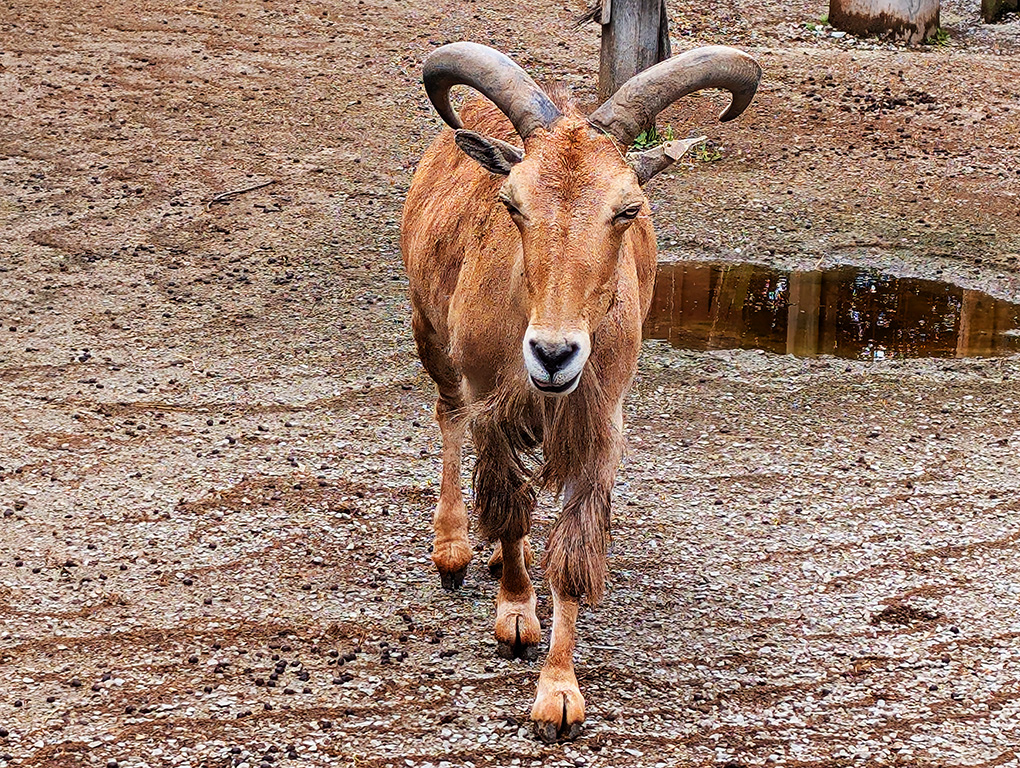
Ammotragus lervia is a large desert-adapted caprid with a distinctive blend of sheep- and goat-like traits. Adult males (rams) are heavily built, typically tan to sandy brown, with a thick mane of long hair extending from the throat down the chest and along the forelegs.
Both males and females carry horns, though males’ are significantly larger. The horns sweep outward, backward, and then curve inward in a broad arc. Mature males may exhibit horns exceeding 30 inches in length.
The shaggy throat and chest mane is the species’ most visually striking feature. The coat coloration closely matches desert rock and sand, offering exceptional camouflage in arid terrain.
Muscular shoulders, strong forequarters, and dense bone structure support agile climbing across cliffs and escarpments. Their hooves are well-adapted for gripping rocky surfaces.
Native to:
North Africa — including Morocco, Algeria, Tunisia, Libya, Egypt, Chad, Sudan, and surrounding Sahel regions.
Introduced and Established Populations:
Southwestern United States (notably Texas and New Mexico), parts of Spain, and other semi-arid regions globally.
Ammotragus lervia favors broken, rugged terrain where elevation and rock provide security from predators.
In native ecosystems:
In introduced ranges (e.g., Texas), populations can become ecologically disruptive:
Breeding season (rut) typically occurs in autumn, though timing varies regionally.
Globally, native populations have declined significantly due to:
In contrast, introduced populations (notably in the U.S.) are stable or expanding and often managed through regulated hunting.
This dual status — threatened in origin, prolific in introduction — creates complex conservation dynamics.
In native range:
Focus on habitat protection and sustainable hunting controls.
In introduced range:
Population management through regulated harvest to mitigate ecological competition with native species.
Ammotragus lervia is a study in displacement.
At home, it struggles.
Abroad, it thrives.
It reminds us that species are not good or bad — only placed or misplaced.
In the desert, it wears the color of survival.
On a foreign ridge, it becomes a question.
Conservation is rarely simple.
The land decides who belongs — eventually.
And sometimes, we are the variable.