
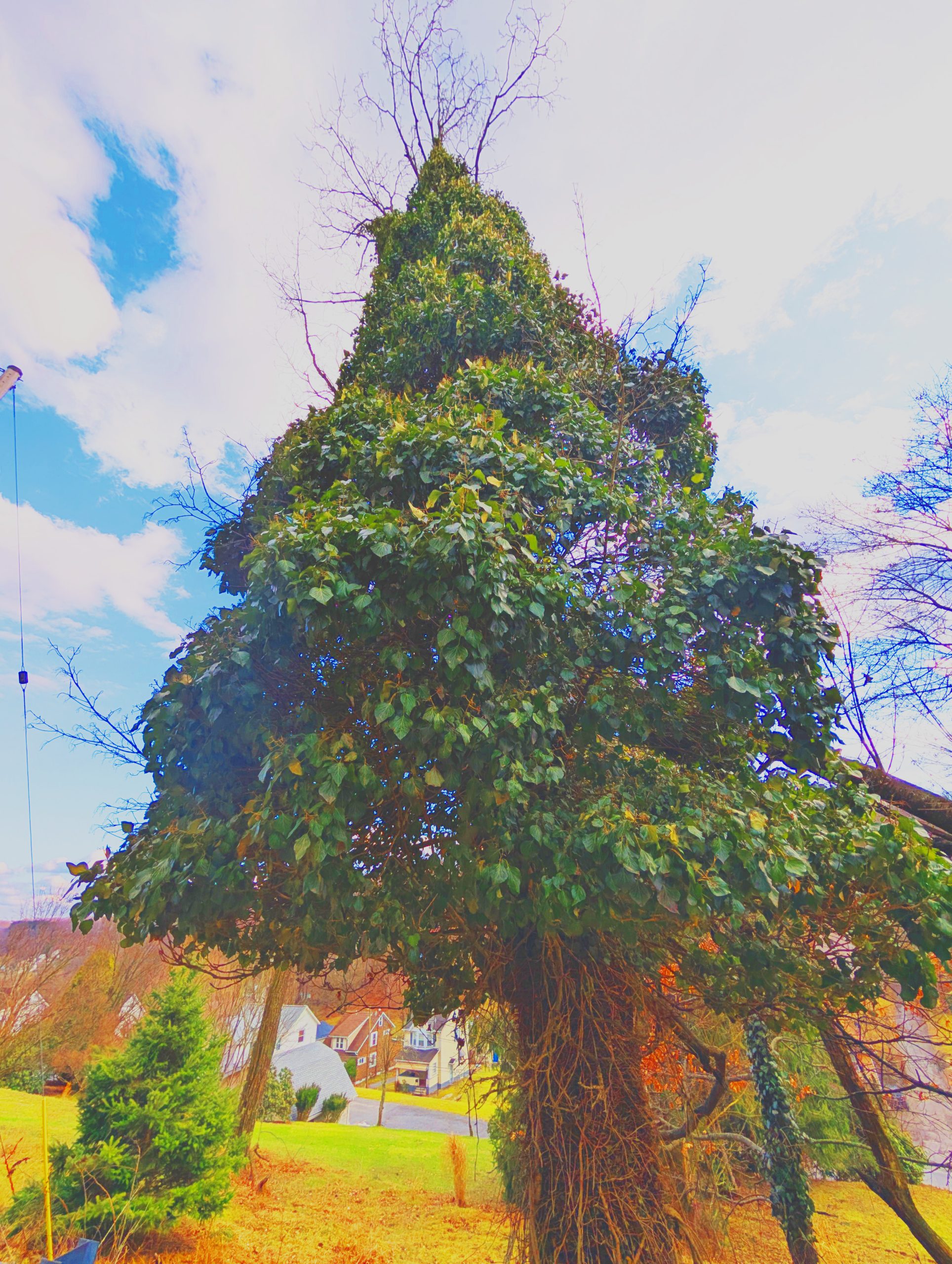
At first glance, it looks like the tree is wearing a cloak.
A heavy one.
From the ground the trunk rises normally enough, narrow and upright. But halfway up something changes. The structure broadens, darkens, and spills outward into a massive triangular cloak of green.
The leaves are dense, layered, and glossy. They gather around the trunk in thick folds, spilling down over the branches until the original shape of the tree is almost lost.
The tree is not wearing the leaves.
It is being engulfed by them.
What we are looking at here is the slow climb of Hedera helix, an evergreen vine that spreads quietly across the ground until it finds something tall enough to climb. Once it reaches a trunk, it begins its ascent using thousands of tiny rootlets that grip the bark like fingertips.
Year by year the vine climbs higher.
The ivy does not strangle the tree the way people sometimes imagine. Instead, it borrows the tree’s strength. The trunk becomes scaffolding. The branches become ladders. Slowly the vine spreads outward along those branches, building its own canopy inside the structure of the tree.
That is the moment captured here.
The dark green mass in the middle of the tree is not the tree’s foliage at all. It is the ivy forming a dense secondary crown, intercepting sunlight before it can reach the tree’s own lower limbs.
In winter the effect becomes dramatic.
The tree has dropped its leaves and stands in seasonal pause, its upper branches bare against the sky. But the ivy remains fully alive, glossy and green, continuing its slow climb while the host tree rests.
From below the balance of power looks almost surreal.
The vine forms a triangular mountain of leaves engulfing the trunk, while the tree’s bare upper branches still reach above it, thin and skeletal, touching the sky.
And at the ends of those branches, small buds wait.
That detail matters.
Those buds mean the tree is still alive. The crown still holds the light. When spring arrives those branches will leaf out again, reclaiming the highest sunlight above the ivy’s green mass.
For now, both plants occupy the same vertical space.
One climbing.
One enduring.
From a distance they almost appear to be a single organism, but what we are really witnessing is a long, quiet negotiation between two different strategies of survival. The vine moves upward by borrowing strength. The tree stands by growing it.
Nature rarely announces its conflicts with noise or motion.
Most of the time the drama unfolds slowly, measured in seasons rather than moments. A patient contest of light, weight, and time.
Here, on a hillside at the end of winter, the ivy continues its steady advance, leaf by leaf, branch by branch.
And the tree, buds set and waiting for spring, is not finished yet.
Nature, after all, is rarely defeated quickly.
It is simply… being engulfed.
Kingdom: Plantae
Clade: Tracheophytes (vascular plants)
Clade: Angiosperms (flowering plants)
Clade: Eudicots
Order: Apiales
Family: Araliaceae (the ginseng / ivy family)
Genus: Hedera
Species: Hedera helix
Growth Form:
Evergreen woody climbing vine.
Climbing Mechanism:
Uses aerial rootlets that attach to bark, stone, or masonry.
Native Range:
Europe, western Asia, and northern Africa.
Status in North America:
Widely naturalized and considered invasive in many regions because it spreads aggressively and can dominate forest understories.
Growth Strategy:
Two distinct phases:
Wildlife Interactions:
Despite its invasive status, mature ivy patches can provide:
Ivy does not parasitize trees directly, but it can overwhelm them by:
Over decades this can lead to branch failure or canopy suppression, which is the dramatic process you captured in your photograph.