
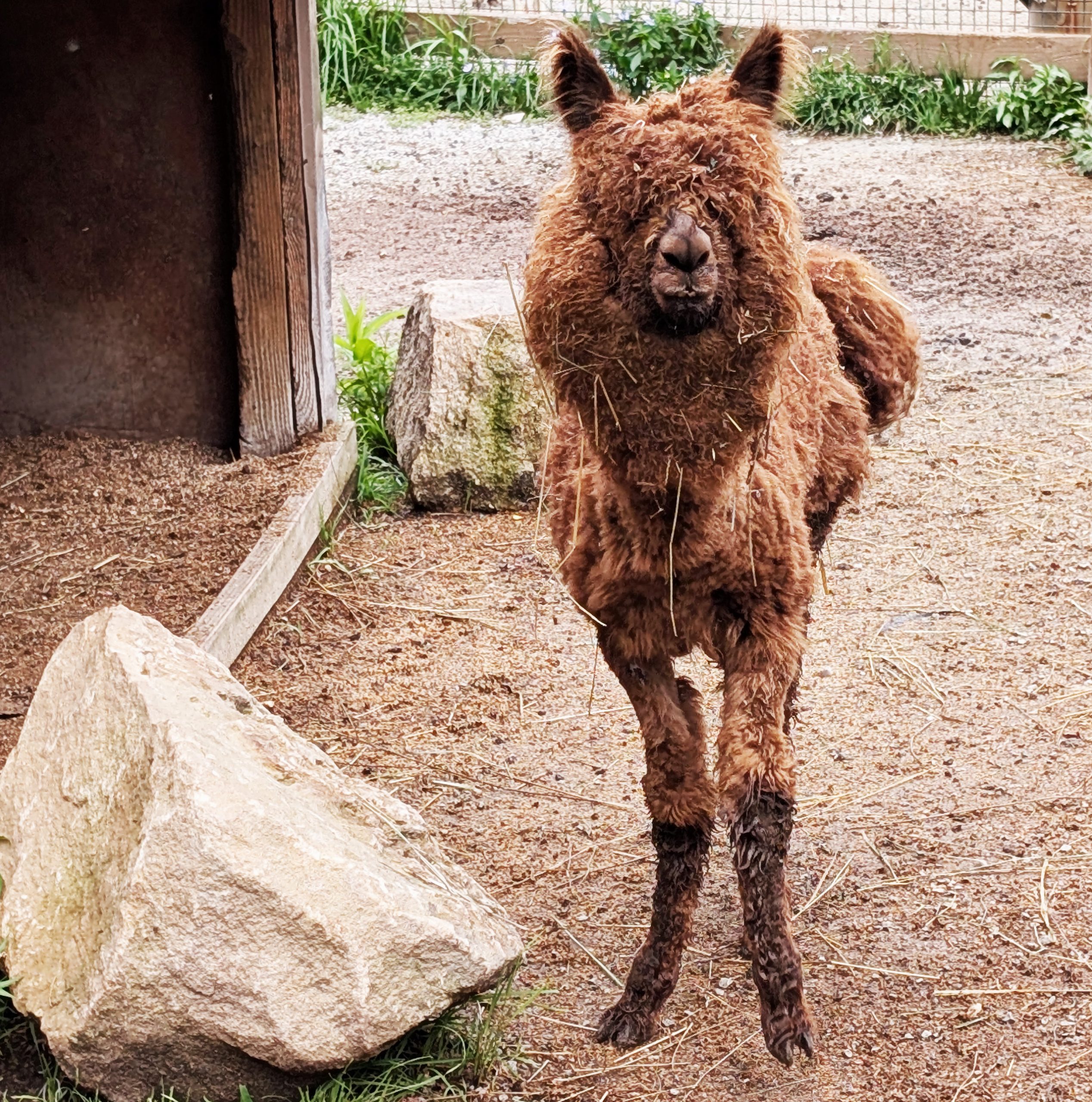
The alpaca is a small domestic camelid originally developed in the Andes of South America for its fleece. It is closely related to the vicuña and more distantly related to the llama, guanaco, and camel. Alpacas are compact, long-necked, soft-footed animals with large dark eyes, upright ears, and dense fiber that can range from fine and cloudlike to long and lustrous depending on type.
The animal in this image appears to be a brown huacaya alpaca, showing the dense, crimped, woolly fleece that gives many alpacas their rounded, plush appearance. Bits of hay caught in the coat are common in enclosure-kept animals, especially those with heavy face fiber.
Alpacas occur in a wide range of natural colors, including:
Their fleece is one of their defining features. It is prized for:
Alpacas are a domestic species, not a naturally wild one in the modern sense. They were developed from wild South American camelid ancestors in the Andes, especially in regions of present-day:
Today alpacas are kept worldwide in:
They are most commonly found on farms, fiber operations, educational farms, petting zoos, and private hobby homesteads.
Alpacas do best in managed pasture or paddock systems with:
They are social animals and should generally be kept with other alpacas or compatible herd companions. A solitary alpaca often experiences stress.
Preferred care conditions include:
Alpacas reproduce sexually and are live-bearing mammals.
Crias are born relatively small, long-legged, and alert. They stand quickly and begin nursing soon after birth. Growth is steady with proper nutrition and herd security.
For domestic alpacas, the major risks are generally tied to husbandry rather than wilderness pressures:
Alpacas were bred primarily for fiber, not as pack animals. That is one of the major practical differences between alpacas and llamas. Llamas are generally larger, longer-faced, and more often used historically for carrying loads, while alpacas were refined for fleece production.
Two main fleece types are recognized:
The more common form, with dense, fluffy, crimpy fiber that grows outward and gives the body a rounded appearance.
Less common, with long, silky locks that hang downward.
Alpacas are often perceived as gentle and curious, though individual temperament varies. They communicate through posture, ear position, body spacing, and a range of vocalizations including humming.
Good alpaca management usually includes:
Because fleece can obscure body condition, hands-on assessment is often just as important as visual evaluation.