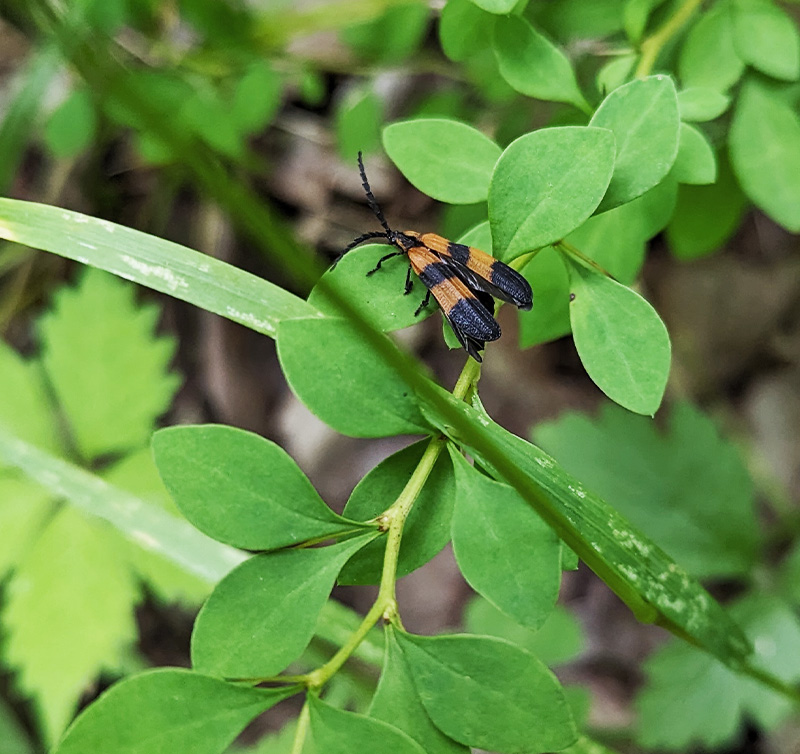
Calopteron discrepans
Taxonomy
- Domain: Eukaryota
- Kingdom: Animalia
- Phylum: Arthropoda
- Subphylum: Hexapoda
- Class: Insecta
- Order: Coleoptera
- Suborder: Polyphaga
- Infraorder: Elateriformia
- Superfamily: Elateroidea
- Family: Lycidae
- Subfamily: Lycinae
- Tribe: Calopterini
- Genus: Calopteron
- Species: Calopteron discrepans
Common Names by Region
- Banded Net-Winged Beetle (United States, general)
- Net-winged Beetle (general colloquial)
- “Banded Lycid” (field/collector shorthand)
Description
General Appearance
A visually striking beetle characterized by bright orange elytra crossed with bold black bands and a distinctly ridged, net-like wing texture. This aposematic coloration signals toxicity or unpalatability to predators.
Size
- Adults: ~10–15 mm in length
- Females typically larger than males
Coloration & Markings
- Elytra: Orange with one central and one terminal black band
- Surface: Raised longitudinal and cross ridges (net-like pattern)
- Thorax: Dark with lighter margins
- Antennae: Serrate, dark
Larval Form
- Flattened, segmented, almost trilobite-like appearance
- Dark with orange accents
- Often found in clustered aggregations prior to pupation
Known Range
- Widely distributed across the eastern United States
- Extends from New England → Florida → west to Kansas and Oklahoma
- Range expansion recorded into southern Canada (Quebec, Manitoba)
Care / Habitat
Preferred Habitat
- Moist deciduous forests
- Woodland edges
- Areas with abundant decaying wood
Microhabitats
- Under loose bark
- Inside rotting logs
- Leaf litter and soil layers
Adult Behavior
- Commonly found resting on leaves (like in your photo), stems, or flowers
- Diurnal to crepuscular activity
- Slow-moving, relies on warning coloration rather than speed
Propagation / Reproduction
- Eggs: Poorly documented in literature
- Larvae:
- Develop within decaying wood ecosystems
- Often aggregate prior to pupation
- Pupation:
- Occurs on or near wood surfaces, sometimes in visible clusters
- Adults:
- Likely short-lived
- Focused on mating and dispersal
Pests / Diseases / Threats
Predators
- Birds, reptiles, and amphibians (though often avoided due to chemical defenses)
Defense Mechanisms
- Aposematic coloration (warning colors)
- Chemical unpalatability
Environmental Threats
- Habitat loss (removal of dead wood)
- Over-cleaned forests or managed landscapes
Additional Notes
- Ecological Role:
- Larvae act as decomposers and micro-predators, aiding nutrient cycling
- Adults may contribute to pollination while feeding on nectar/pollen
- Symbiotic Relationships:
- Strong association with fungal communities in decaying wood
- Helps disperse fungal spores
- Mimicry Complex:
- Part of a broader mimicry system involving moths and other insects that copy its warning coloration
- Field Insight (Your Specimen):
The individual you photographed shows clean band separation and pronounced elytral ridging, consistent with C. discrepans rather than C. reticulatum. The posture—resting along a blade with antennae forward—is typical of low-disturbance behavior.
Post Views: 14