
Kingdom: Plantae
Clade: Angiosperms
Clade: Eudicots
Order: Caryophyllales
Family: Nyctaginaceae
Genus: Bougainvillea
Species: Bougainvillea glabra
General: Bougainvillea, Paper Flower
Latin America: Buganvilla, Bugambilia
Mediterranean: Bougainvillier
Horticulture Trade: Lesser Bougainvillea, Smooth Bougainvillea
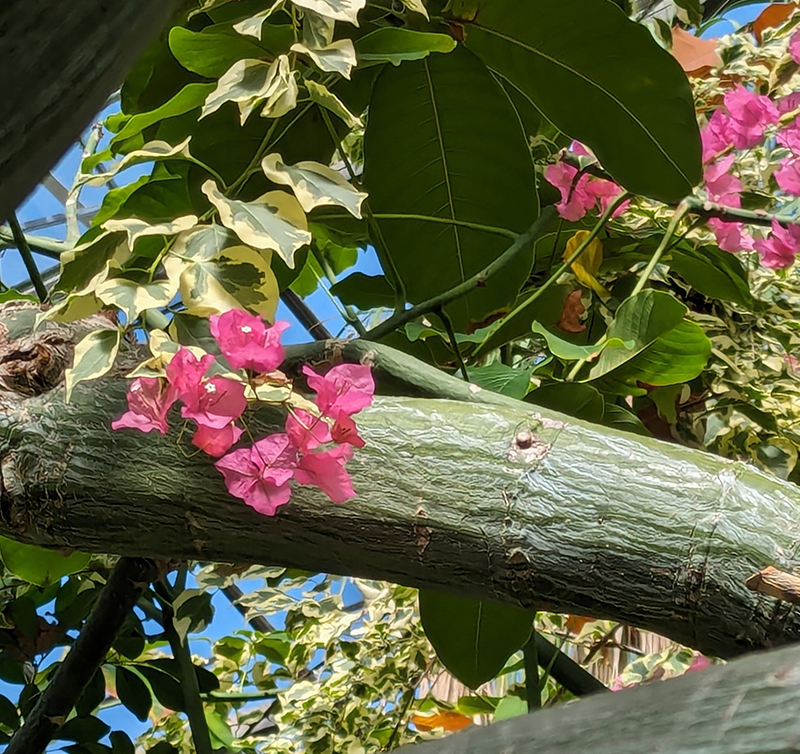
Bougainvillea glabra is a vigorous, woody, evergreen to semi-evergreen climber best known for its vivid, papery bracts that surround small, inconspicuous white flowers. The bracts—commonly magenta, pink, purple, red, orange, or white—are often mistaken for petals and persist far longer than the true flowers.
Leaves are simple, ovate, and smooth-edged, typically deep green but occasionally variegated in cultivated forms. Stems are arching to scrambling, often thorned, and capable of forming dense, structural canopies when trained over trellises, walls, or pergolas.
In favorable climates, flowering can occur nearly year-round, with peak displays triggered by dry periods followed by sun and warmth.
Native Range: Eastern South America (Brazil, Bolivia, Paraguay)
Typical Habitat:
Bougainvillea thrives in environments with intense sunlight, seasonal dryness, and minimal soil fertility—conditions that encourage flowering over vegetative growth.
While not a keystone species, Bougainvillea glabra provides:
In its native range, it integrates into mixed shrub and forest-edge communities. Outside its native range, it should be managed responsibly to prevent uncontrolled spread in sensitive ecosystems.
Ornamental Use:
Cultural Significance:
Bougainvillea is widely associated with resilience, abundance, and tropical architecture—often defining the visual identity of coastal and warm-climate towns.
Maintenance Notes:
IUCN Status: Not Evaluated
Population Trend: Stable in cultivation
The species is abundant in horticulture and not considered threatened, though wild populations benefit from habitat preservation.
Bougainvillea glabra exemplifies a recurring ecological principle: constraint produces beauty. Poor soil, hard sun, and limited water—conditions that suppress many plants—drive this species to its most spectacular expression.
As a living system, it rewards intentional restraint over excess input, making it a fitting ambassador for resilient design, climate-adapted landscaping, and low-input ornamental ecology.