
Kingdom: Plantae
Clade: Tracheophytes
Clade: Angiosperms
Clade: Eudicots
Order: Ranunculales
Family: Ranunculaceae
Genus: Clematis
Species: Clematis × jackmanii (hybrid origin)
Cultivar: ‘Jackmanii’
A vigorous, deciduous, climbing perennial vine that twines by leaf petioles. Typically reaches 8–12 feet in height when supported.
Opposite, compound leaves with smooth margins. Medium to deep green. Leaflets ovate to elliptic, soft but sturdy.
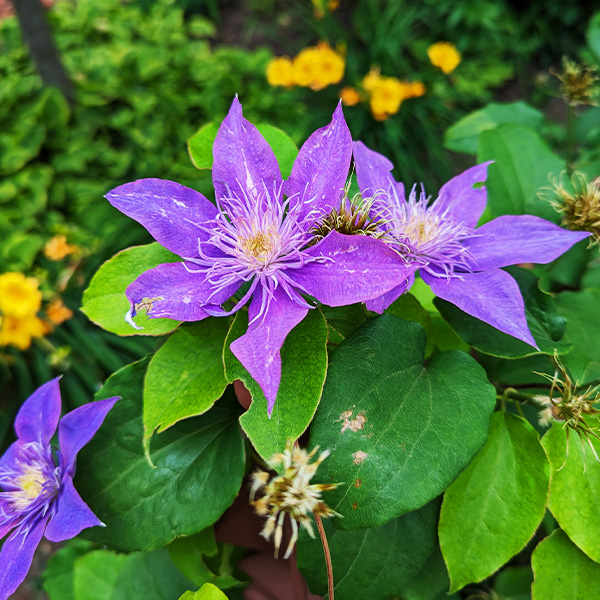
Large (4–6 inches across), star-shaped blooms with 4–8 pointed tepals. Rich violet to deep purple coloration. Central stamens creamy to pale yellow. Blooms heavily on new growth in mid- to late summer.
Petals (technically tepals) may fade slightly toward bluish tones in intense sun.
After flowering, forms distinctive silvery, feathery seed clusters — a persistent ornamental feature.
Cultivated worldwide in temperate climates.
Hardy in USDA Zones 4–8.
Commonly planted across Pennsylvania and the northeastern United States.
Requires structural support such as trellis, fence, arbor, or shrub.
Seed propagation does not reliably produce true ‘Jackmanii’ offspring due to hybrid nature.
Proper airflow and deep planting reduce wilt risk.
Pruning Group 3 (Late-flowering)
Heavy annual pruning encourages vigorous flowering.
‘Jackmanii’ was introduced in 1862 by English nurseryman George Jackman and became one of the most widely planted clematis cultivars in the world.
Because many purple large-flowered hybrids resemble this cultivar, field identification without nursery tag confirmation should be noted as “Jackmanii-type large-flowered hybrid.”
Observed blooming in late summer in western Pennsylvania. Classic large star form, medium violet coloration, creamy filament center, and developing feathery seed heads consistent with Jackmanii-type hybrid characteristics.
Identification made by visual morphology and bloom timing. Cultivar confirmation would require original planting records.
All images and written content published on this site are provided freely for educational and artistic use. Attribution appreciated but not required. Knowledge grows when shared.