
Kingdom: Animalia
Phylum: Chordata
Class: Mammalia
Order: Artiodactyla
Family: Cervidae
Subfamily: Cervinae
Genus: Dama
Species: Dama dama
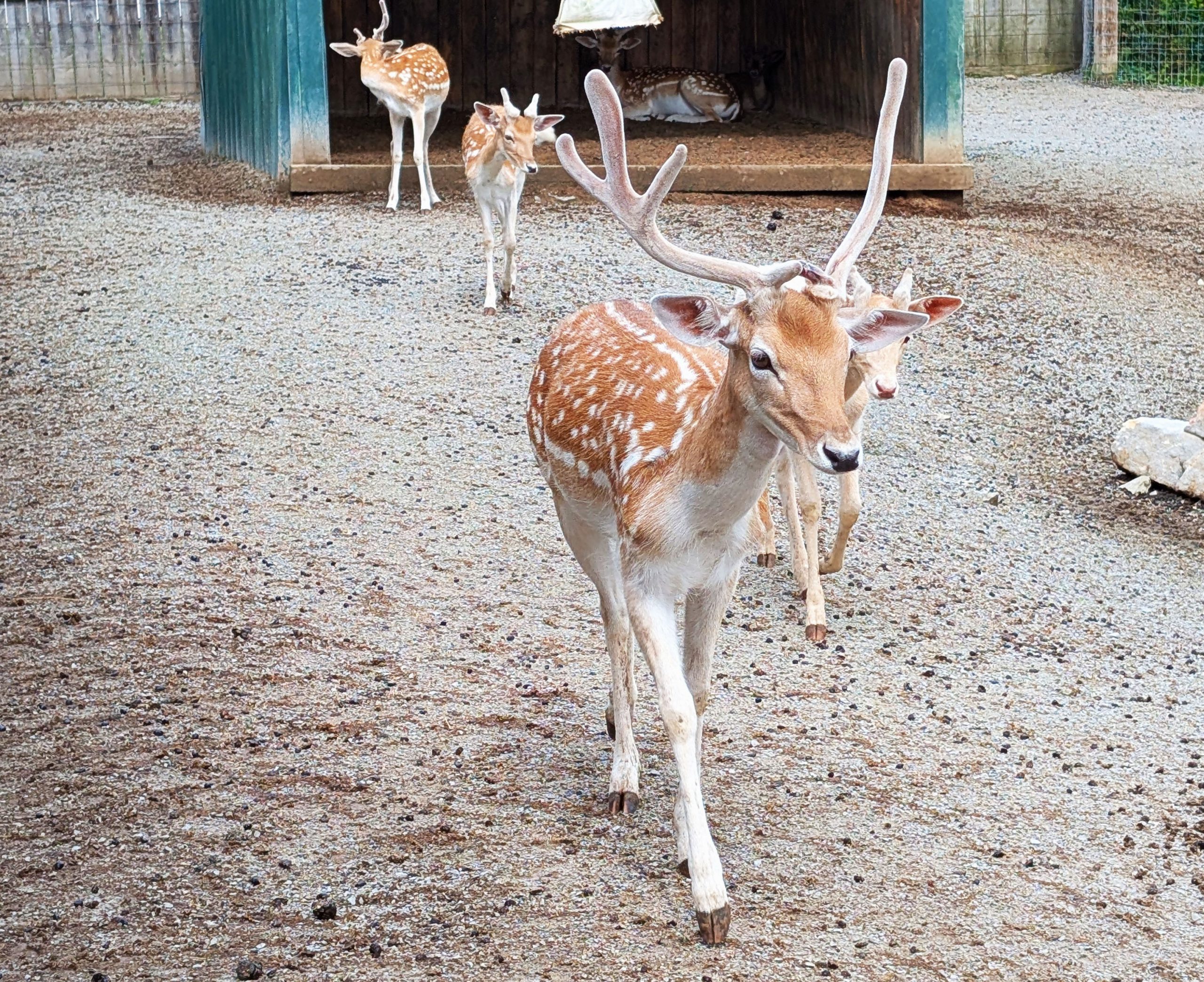
The Fallow Deer is a medium-sized cervid distinguished by its spotted coat and the mature male’s broad, palmate antlers. Coat coloration varies seasonally and genetically but most commonly appears tan to reddish-brown with white spots in summer, transitioning to a duller gray-brown in winter.
A white rump patch bordered in black is typical. The tail is relatively long compared to many deer species and features a dark stripe.
Mature males (bucks) develop distinctive palmate antlers—broad and flattened toward the top, resembling a shovel or open hand. Younger males may show simpler, more branched antlers before the full palm develops.
In your photograph, the leading buck appears to be in velvet, meaning the antlers are still growing and covered in vascularized skin. Velvet antlers indicate active growth and typically precede the autumn rut.
Originally native to parts of the Mediterranean and western Asia, the Fallow Deer has been widely introduced and naturalized throughout:
In many regions, populations exist in managed estates, parks, and semi-wild enclosures.
Fallow Deer prefer:
They are highly adaptable and tolerate a range of climates if food and shelter are available.
Diet consists primarily of:
They are mixed feeders, grazing and browsing depending on seasonal availability.
The breeding season (rut) occurs in autumn.
Natural predators (where present) include large carnivores such as wolves and big cats.
Fallow Deer have been associated with human-managed landscapes for thousands of years. They were transported across Europe during the Roman period and later widely distributed by medieval nobility for hunting estates.
Their long association with human culture makes them one of the most globally established deer species outside their original native range.
In managed landscapes:
In wild or semi-wild systems, maintaining predator balance or active management is essential to prevent ecological imbalance.
All content on the Cernunnos Foundation website, including this profile, is provided free for educational and artistic use. Attribution is appreciated but not required. Knowledge grows when it is shared.