
Kingdom: Plantae
Clade: Tracheophytes
Clade: Angiosperms
Clade: Eudicots
Clade: Asterids
Order: Asterales
Family: Asteraceae
Genus: Silphium
Species: Silphium laciniatum L.
Compass plant is a long-lived native prairie perennial capable of reaching 6–12 feet in height when in bloom. The flowering stalk rises dramatically above surrounding grasses, giving it a sentinel-like presence in open landscapes.
The basal leaves are the defining feature:
The leaf orientation phenomenon gives rise to the common name. In open prairie, the large vertical blades tend to align edge-on to the midday sun, reducing heat stress and water loss.
The flowering stalk is thick, rigid, and covered in fine bristles. When cut, it exudes a resinous sap — hence the name “rosinweed.”
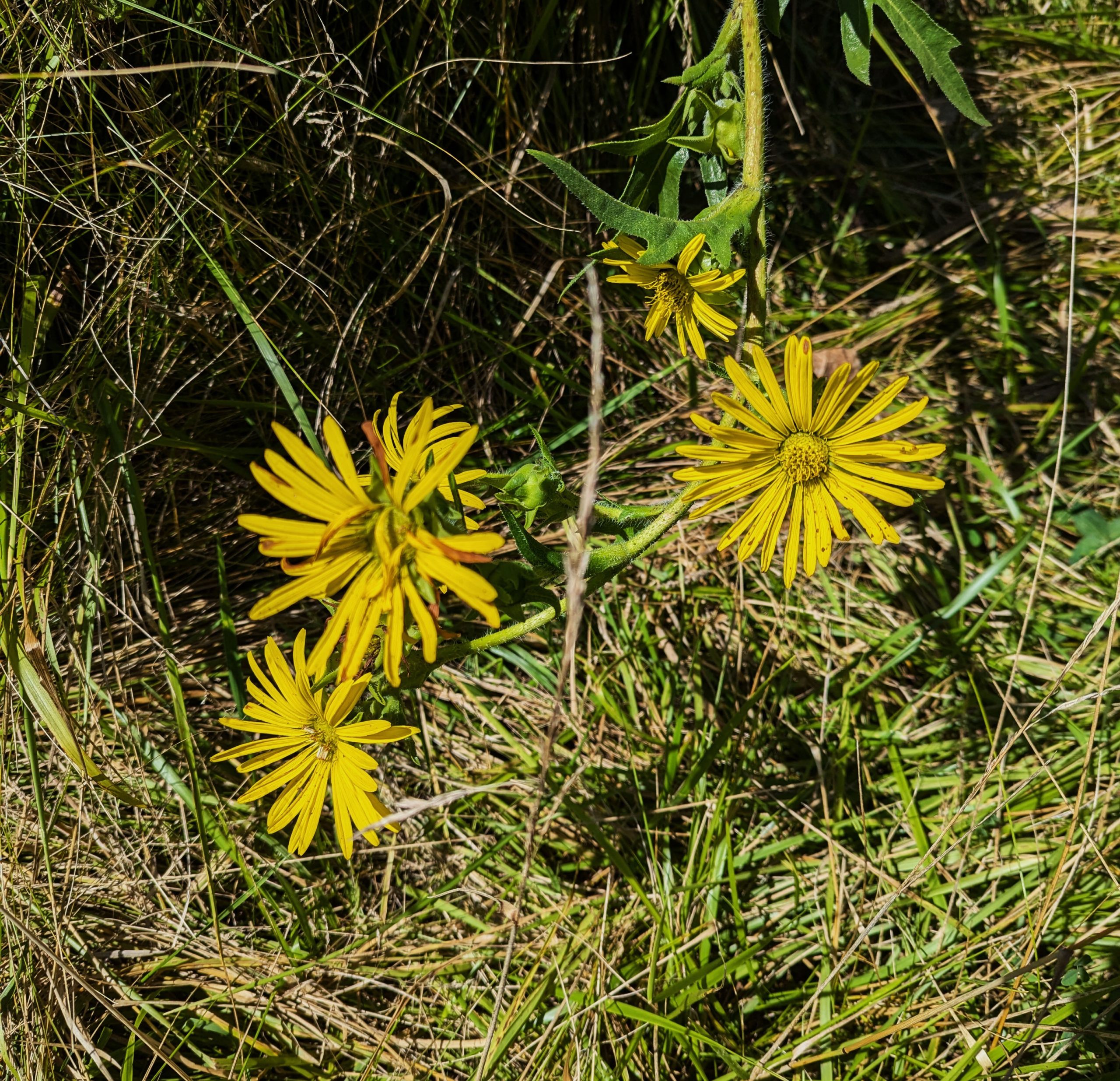
Bright yellow composite flower heads resemble small sunflowers.
Multiple flower heads form along the upper stalk rather than a single terminal bloom.
Native to central North America, especially:
It thrives in tallgrass prairie ecosystems and remnant prairie restorations.
Compass plant prefers:
It develops an exceptionally deep taproot — often exceeding 10–15 feet — allowing survival in drought conditions typical of continental prairie climates.
Ecological roles include:
Its deep root system contributes significantly to soil carbon storage and prairie resilience.
Due to its deep taproot, transplanting mature plants is difficult and often unsuccessful.
Generally robust once established.
Potential issues include:
The primary threat historically has been prairie destruction.
For restoration or native landscaping:
Prescribed burning in prairie systems supports long-term vigor.
Compass plant is not just a species — it is a structural marker of intact prairie ecosystems. When you see one, you are likely standing on land that still remembers what it was.
When encountered in remnant prairie, the plant often towers above surrounding grasses like big bluestem (Andropogon gerardii) and Indian grass (Sorghastrum nutans). The leaf blades feel abrasive to the touch. On hot days, their vertical stance is strikingly visible across a prairie slope.
Standing beside one, you immediately understand how the tallgrass prairie once felt — vertical, alive, engineered by wind and fire.
All original text and educational materials on this site are released for free educational and artistic use. Share, teach, remix, illustrate, and build upon this work. Attribution appreciated. Knowledge grows when it moves.