
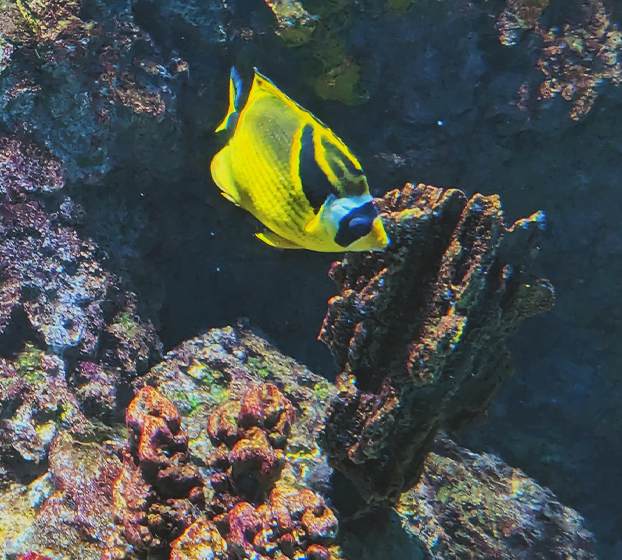
The raccoon butterflyfish is a medium-sized reef fish easily recognized by its bold facial “mask” — a black band running through the eye, bordered by white, and set against a bright yellow body. A contrasting black patch at the rear of the dorsal fin further breaks up its outline, while fine diagonal lines add subtle texture across the flanks.
Adults typically reach 18–20 cm (7–8 inches) in length. The body is laterally compressed and disk-shaped, optimized for maneuvering through reef structures. The elongated snout houses fine, brush-like teeth adapted for picking invertebrates from crevices.
At night, the species undergoes a noticeable color shift, dulling and darkening its yellow tones — a form of nocturnal camouflage that reduces visibility to predators while resting.
The raccoon butterflyfish favors structurally complex reefs where coral heads, rubble, and overhangs provide both feeding opportunities and shelter.
In the wild, Chaetodon lunula occupies reefs with moderate coral cover and abundant invertebrate life. It is most active during daylight hours, cruising methodically along reef faces and flats in search of food.
Unlike many butterflyfish, it is less coral-dependent, allowing it to tolerate degraded reefs better than strictly corallivorous species. At night, individuals wedge themselves into crevices or under ledges for protection.
In captivity, it requires:
Breeding occurs via broadcast spawning, typically around dusk. Pairs or small groups release eggs and sperm into the water column, where fertilization occurs externally.
Larvae are planktonic, drifting with ocean currents before settling onto reefs and undergoing metamorphosis into juveniles. There is no parental care after spawning.
The raccoon butterflyfish is an omnivore, feeding on a mix of:
Its adaptability makes it one of the more resilient butterflyfish species in changing reef environments, though it still depends on overall reef health.
No direct management is required in the wild. Conservation priorities focus on:
Sustainable reef management benefits this species indirectly through ecosystem stability.
The raccoon butterflyfish survives not by specialization alone, but by flexibility. It reads the reef — its gaps, its rhythms, its cycles of light and dark — and adjusts accordingly.
In complex systems, resilience often belongs to those that can change their behavior without losing their identity. The raccoon butterflyfish does not demand a perfect reef. It learns how to live within the one it has.
Chaetodon lunula
Often admired for its bold mask and bright colors, the raccoon butterflyfish is more than ornament. It is a quiet navigator of edges and transitions, active by day, hidden by night, and constantly interpreting the living geometry of the reef.
Where coral structures create both opportunity and danger, it moves deliberately — not rushing, not lingering, but reading the space between. In a world built of light, shadow, and motion, it survives by understanding when to be seen, and when to disappear.