
Kingdom: Plantae
Clade: Tracheophytes
Clade: Angiosperms
Clade: Eudicots
Order: Asterales
Family: Asteraceae
Genus: Coreopsis
Species: Coreopsis verticillata
Threadleaf Coreopsis
Whorled Coreopsis
Tickseed
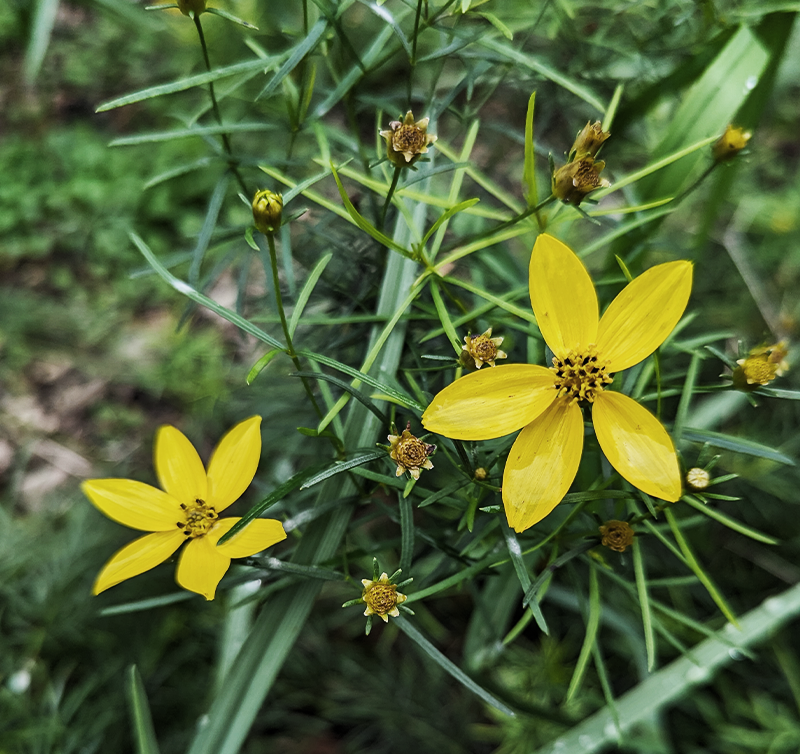
Threadleaf Coreopsis is a delicate perennial wildflower recognized for its bright yellow daisy-like blooms and extremely fine, thread-like foliage. The plant forms airy clumps that sway easily in the breeze, giving it a soft, feathery appearance even when growing in dense patches.
The flowers consist of bright yellow ray florets surrounding a small yellow central disk. Each bloom typically measures 2–4 cm across and appears singly on slender stems above the foliage. The petals are usually slightly notched at the tip.
Flowering often occurs from late spring through mid-summer, and in favorable conditions plants may rebloom later in the season.
The defining feature of this species is its foliage. Leaves are very narrow and thread-like, usually appearing in opposite pairs or small whorls along the stem. The foliage creates a soft, fern-like texture that distinguishes it from many other members of the sunflower family.
Plants typically grow 45–90 cm (18–36 inches) tall, forming clumps that slowly expand over time.
Threadleaf Coreopsis is native to eastern and southeastern North America. Its natural range includes much of the eastern United States, where it grows in open landscapes with good sunlight.
Because of its attractive flowers and durable nature, it has also been widely planted in gardens and naturalized in many regions beyond its native range.
This species thrives in:
It prefers well-drained soils and full sun, though it tolerates a variety of soil conditions once established.
Threadleaf Coreopsis is an excellent pollinator plant, attracting:
Because it blooms during the warm season when pollinator activity is high, it plays a useful role in supporting local insect populations.
Seeds are also eaten by small birds.
The plant reproduces through both:
Seeds are small and develop in the central disk after flowering. In natural conditions they disperse by wind or gravity.
Garden populations are often propagated by division.
Threadleaf Coreopsis is generally hardy and resistant to most pests. Occasional issues may include:
These rarely threaten established plants.
The genus name Coreopsis comes from Greek words meaning “bug-like appearance,” referring to the small seed shape that resembles ticks. This is why many species in the genus share the common name tickseed.
Despite the name, the plant has no relation to actual ticks.
Threadleaf Coreopsis is widely valued in native plant gardens and prairie restorations because of its drought tolerance, long blooming season, and ability to support pollinators.
For cultivated or restoration settings:
The species requires relatively little care once established.