
I need to tell you the real story. Not the technical version — you can read that in the 18-document series we published earlier this year. The story behind the story. Why any of this exists at all. Why there’s a foundation, a media group, and a consulting business all pointed at the same target.
It started with a redfish.
I’m serious. I like redfish. A lot. I like standing in warm water watching them push through grass flats in the Gulf. And at some point, I started learning about what was happening to the water they live in — the Gulf of Mexico Dead Zone, a seasonal oxygen desert measured in thousands of square miles, fed by nutrient pollution from the entire Mississippi River Basin.
Nobody designed this disaster. It’s structural. Nitrogen and phosphorus leak from every stage of American agriculture, urban life, and stormwater management, flow downstream, pile up in the Gulf, and starve everything beneath the surface of oxygen.
Fish kills from algal blooms. Ecosystem collapse. And it has been getting worse for decades.
I already knew the nitrogen cycle. Not from a textbook — from running aquaponic systems. I was part of the early aquaponics movement, working alongside some of the pioneers who figured out how to grow food on fish water before universities took it seriously. I built systems. I tested configurations. I watched biology do what biology does when you give it the right conditions and stay out of its way. That hands-on experience is what made the next question feel obvious rather than theoretical: if the problem is excess nutrients in the water, and greenhouses need nutrients to grow plants, why doesn’t someone just build a greenhouse that drinks from the river?
That question became the Cernunnos Foundation.
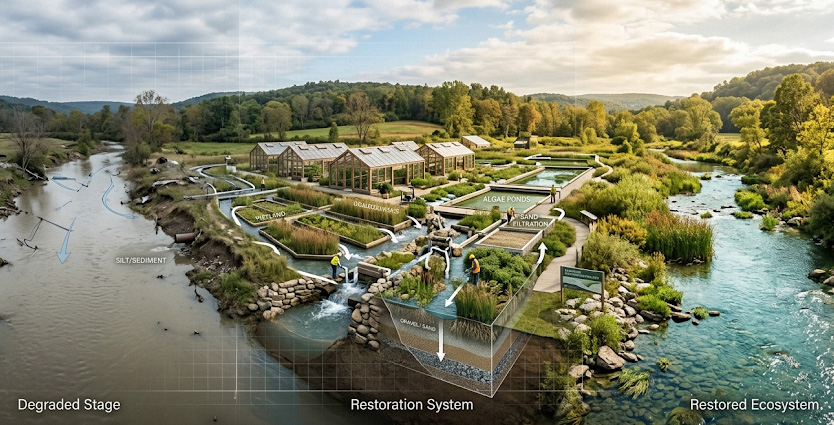
The Cernunnos Foundation website was built with two purposes. The first was to post nature pictures — because I like doing that and I think people should look at the natural world more often. The second was to host an idea that I could not get out of my head: a system to clean up the Dead Zone in the Gulf of Mexico by turning polluted river water into an industrial feedstock.
That idea became the River Refugium Project.
I didn’t have a complete picture at the time. I just knew the ecological impact of reducing that Dead Zone would be life-saving — not just for redfish and shrimp, but for the entire Gulf ecosystem, the fishing communities that depend on it, and ultimately the broader planetary systems that take their cues from how we treat major waterways. I believed then and I believe now that if you can prove this works on the Mississippi, you can export the model to every nutrient-choked river on Earth. The Danube. The Ganges. The Mekong. The Yangtze. All of them.
Is that arrogant? Maybe. Call it white savior syndrome if you want. I call it a guy from the rust belt who keeps an aquarium, spent years inside the aquaponics community learning how biological systems actually perform when real people build them with real water, and realized the nitrogen cycle works the same way whether the tank is five gallons or five million acres.
The Cernunnos Foundation published the first version of the RRP framework in 2025. It was downloaded approximately 400 times. It sparked conversations with engineers, farmers, researchers, policy people, and independent builders across the country. And it forced me to get serious about the framework behind the idea.
Blue Ribbon Team started as a megaphone.
That’s it. The RRP needed attention, and I needed a platform beyond the Foundation website to generate it. So I built one — a publication space where I could write about the project alongside my other interests and see what stuck.
What stuck was everything.
Blue Ribbon Team grew into its own operation. It developed its own editorial voice, its own audience, its own publications. I’m proud of what it has become and the impact it’s having — which is the best kind of problem to have. Something you built to support one project becomes a project worth supporting on its own.
But it never stopped pointing at the river. The RRP runs through everything Blue Ribbon Team publishes, because the river is the thread that connects all of it — ecology, agriculture, energy, economic development, community resilience. The river is the supply chain.
Bright Meadow Group is my favorite part, even though it’s still a baby.
This is the consulting business I built to help people implement these systems — or to help them find the repairs that will make their existing systems better. Fish farms. Aquaculture ponds. Municipal water operations. Regenerative agriculture projects. Educational facilities. Anyone running water through a biological system and trying to make it productive.
BMG operates under a simple model: observe, design, intervene. Come look at the system. Understand what’s happening. Build a plan that fits the operator, not a catalog.
The RRP framework is the flagship design, but it’s not the only thing BMG does. The same principles — closed-loop nutrient management, biological process control, greenhouse integration, thermochemical conversion — apply at every scale from a backyard fish pond to a 100-acre river node. The difference is scope. The logic is identical.
Bright Meadow Group exists because I realized that knowing how to design these systems is only useful if someone can help people build them. Publishing whitepapers doesn’t clean rivers. Helping an operator in Arkansas figure out how to route waste water through a greenhouse — that cleans a river.
Earlier this year we published Version 2.0 of the River Refugium Project — an 18-document engineering package covering every layer of the system, from water intake to clean-water return, from crop architecture to thermochemical processing, from financial modeling to national deployment strategy. The full document table and download links are available in the original release post.
Today’s update is about what we’ve built since that release — because publishing a framework is not the same as putting tools in people’s hands.
Version 2.0 gave you the theory. These new documents give you the implementation layer.
This is the mental model you need before you turn anything on. Not a technical manual — the thinking behind the system, written for the person who will actually stand next to it and make decisions. It covers operational context, system architecture, deployment phasing, site selection, performance metrics, failure modes, leverage points, and the strategic end-state. If you are evaluating whether to build, fund, or operate an RRP node, this is where you start.
Download: [LINK]
Undocumented results are anecdotes. Documented results are data.
The Field Documentation Kit gives any operator — farmer, pond owner, university lab, DNR shop, backyard tinkerer — the minimum structure needed to generate data that is comparable across test sites. Three standardized forms: System Configuration Record (Form A), Water Quality Monitoring Log (Form B), and Biomass Harvest & Disposition Record (Form C). Use them as printed. Adapt them to your tools. The format is less important than the consistency of what you measure and the honesty of what you record.
If you run a test, document it, and want it included in the aggregated dataset: send us what you have. If you run a test and prove us wrong: send us that too. Wrong in which direction matters enormously. Either way, the dataset gets better.
Download: [LINK]
Since the v2.0 release, we’ve received serious technical, financial, and operational questions from readers. This document addresses twelve of them — directly, with no hedging. Topics include the evaporation greenhouse mechanism and what we don’t yet know about it, the 55% clean-water return figure and its implications for water rights, thermal self-sufficiency claims that were too strong and will be revised, the nitrogen credit market dependency in the financial model, HTC/HTL reactor sizing and feedstock uncertainty, crop selection as literature review versus planting plan, end-of-mission economics, heavy metals and emerging contaminants including PFAS, regulatory permitting complexity, why anyone should trust projections built on provisional data, independent technical review status, and whether a small organization can actually build this.
Where answers are definitive, they are stated as such. Where answers depend on pilot data not yet collected, that is stated plainly. Honest questions deserve honest answers.
Download: [LINK]
Alongside the operator tools, BMG has published three new articles that extend the RRP framework into specific applications. These are not academic abstractions — they are written for the people standing next to the water.
A call to farmers, pond owners, tinkerers, DNR shops, and university labs to stop waiting for permission and start running tests. The RRP framework is the hypothesis. Your pond, your lagoon, your creek is the test environment. Your water quality data is the evidence. This article explains what we’re asking people to do, why we’re asking the DIY community first, and how their documented results feed the open-access dataset that moves the entire project forward.
Read: [LINK]
Lake Erie’s western basin produces a massive algal bloom every summer. We call it a crisis. It’s actually inventory. This article applies RRP logic to a Great Lakes deployment — Toledo, Cleveland, Erie, Buffalo — retrofitting dormant Rust Belt industrial capacity to process algal biomass through HTC/HTL reactors. The bloom is the feedstock. The factories are the infrastructure. The question is whether we keep paying to suppress it or start building systems that use it.
Read: [LINK]
That green retention pond behind your subdivision is not an algae problem. It’s a nutrient accumulation system doing exactly what it was designed to do — with no one directing it. This article walks HOAs, property managers, and municipal planners through two practical deployment paths: edge-based greenhouse systems and mobile “mechanical swamp” treatment units. Same RRP logic. Neighborhood scale. Your landscaper becomes the operator of a small biological production system instead of the person who loses the same fight every summer.
Read: [LINK]
Everything I just described — the Foundation, Blue Ribbon Team, Bright Meadow Group, the 18-document series, the financial model, the deployment maps, the operator tools, the field kit, the Q&A — all of it exists because a normal guy wanted to clean up the Gulf of Mexico so he could keep catching redfish.
That’s not a marketing line. That’s the origin story.
I built the Cernunnos Foundation because the idea needed a home. I built Blue Ribbon Team because the idea needed a voice. I built Bright Meadow Group because the idea needed hands.
The RRP sits at the intersection of ecology, engineering, and economic opportunity. It addresses nutrient pollution, agricultural production, biomass energy, and community resilience in a single integrated system. Every piece of it is open. Every assumption is flagged. Every number is waiting to be tested.
I believe this can work. But belief is not the point — measurement is. That’s what the pilot is for. And now, with the Field Documentation Kit, that’s what you can contribute to — on whatever water body is in front of you, at whatever scale you can manage, with whatever tools you have.
The next practical step for the full-scale system remains a 10-acre pilot site, operated for a full growing season, producing real data across every axis — nutrient reduction, agricultural throughput, water quality, labor requirements, crop economics, greenhouse performance. The Lower Mississippi corridor from Memphis to New Orleans scores highest on every metric we track.
But the field testing campaign starts now. Anywhere. Any scale. Any dirty water. The Field Documentation Kit and the Prove the Fix article are the invitation.
Until that full-scale pilot is funded and operational, I am continuing to refine the framework, expand the modeling, and support anyone evaluating the concept through Bright Meadow Group.
I welcome conversation with environmental organizations, agricultural groups, investors, universities, coastal and river-basin planners, nonprofit partners, municipalities, regenerative agriculture practitioners, tribal nations, and independent builders.
Whether you want to understand the system, critique the model, run a field test, or explore a pilot site — I’m available.
Robert Smith
robert@brightmeadowgroup.com
Founder, Cernunnos Foundation
Systems Analysis & Solutions Consulting — Bright Meadow Group
The dare from last time still stands.
If you can build this faster, bigger, or cleaner than I can — take it and run. The entire framework is open. No patents. No proprietary claims. No gatekeeping.
Every river system on Earth that’s choking on nutrient overload is a candidate. Mississippi. Danube. Ganges. Mekong. Murray-Darling. Congo. Yangtze. All of them.
The problems are real. The problems are urgent. And there is room for everyone who wants to get to work.
Godspeed.