
Kingdom: Plantae
Clade: Tracheophytes
Clade: Angiosperms
Clade: Eudicots
Clade: Rosids
Order: Malpighiales
Family: Euphorbiaceae
Genus: Jatropha
Species: Jatropha integerrima
An evergreen to semi-evergreen tropical shrub or small tree, typically 6–15 feet tall in landscape settings, though capable of greater height in frost-free climates. Growth habit is upright, loosely branched, and somewhat airy.
Simple, glossy green leaves with smooth margins (the species name integerrima refers to “entire” leaf edges). Leaf shape varies from ovate to slightly lobed depending on cultivar and growing conditions.
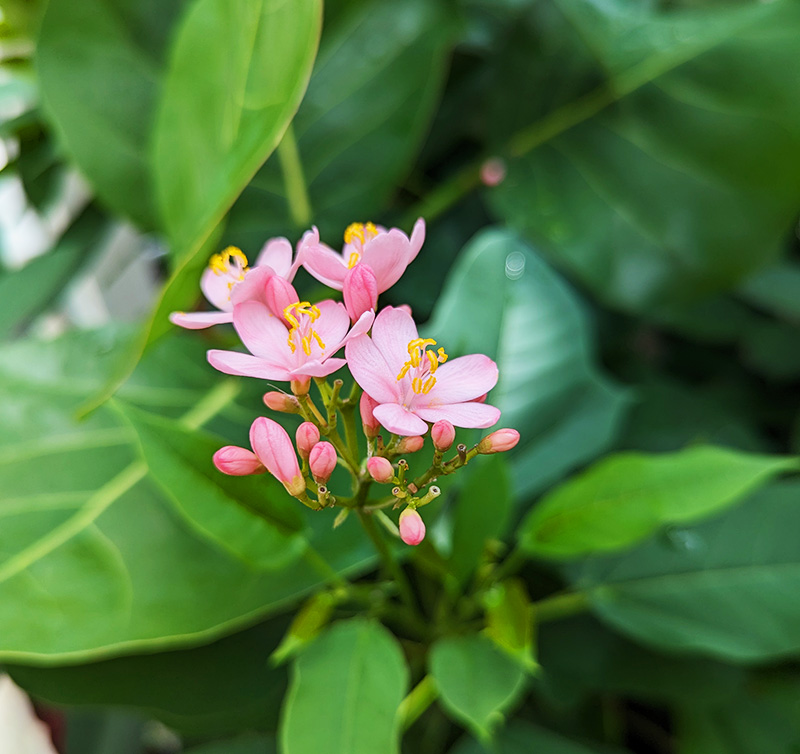
Clusters (cymes) of bright pink to coral-red flowers borne at branch tips nearly year-round in warm climates. Each flower has five rounded petals and prominent yellow stamens that arch upward, creating high visual contrast.
The attached photograph captures a fresh inflorescence with unopened buds beneath open blooms — a classic display stage where the plant shows both continuity and momentum.
Produces small capsule fruits typical of Euphorbiaceae, though ornamental cultivars are primarily grown for flower production rather than fruit display.
Native Range: Cuba and the West Indies.
Cultivated Range:
Widely grown in subtropical and tropical regions, especially:
Hardy in USDA Zones 9b–11. Frost sensitive.
Prefers:
Highly tolerant of heat, humidity, and coastal conditions. Performs well in sandy soils and urban landscapes.
Cuttings root readily in warm, humid conditions.
Peregrina occupies a specific niche in ornamental horticulture: it bridges the gap between tropical show plant and durable landscape shrub. Its extended bloom cycle gives it disproportionate aesthetic value compared to many seasonal flowering species.
The bright pink clusters function as signal beacons against dense green foliage — a structural and chromatic contrast that explains its persistent popularity in warm-climate gardens.
Best used as:
Avoid heavy shade placement if bloom production is a priority.
This profile is provided under the Cernunnos Foundation open-knowledge framework.
All text and descriptive structure may be freely used for educational, artistic, and reference purposes. Botanical information is shared to support ecological literacy and creative interpretation.
Artistic renderings, photographs, and derivative works inspired by this profile are encouraged for educational and non-restrictive use. Knowledge grows when it is circulated.