
Kingdom: Animalia
Phylum: Chordata
Class: Mammalia
Order: Rodentia
Family: Caviidae
Genus: Dolichotis
Species: Dolichotis patagonum
Patagonian Mara — international / scientific use
Patagonian Cavy — zoological contexts
Patagonian Hare — informal name used in parts of Argentina (though it is not a true hare)
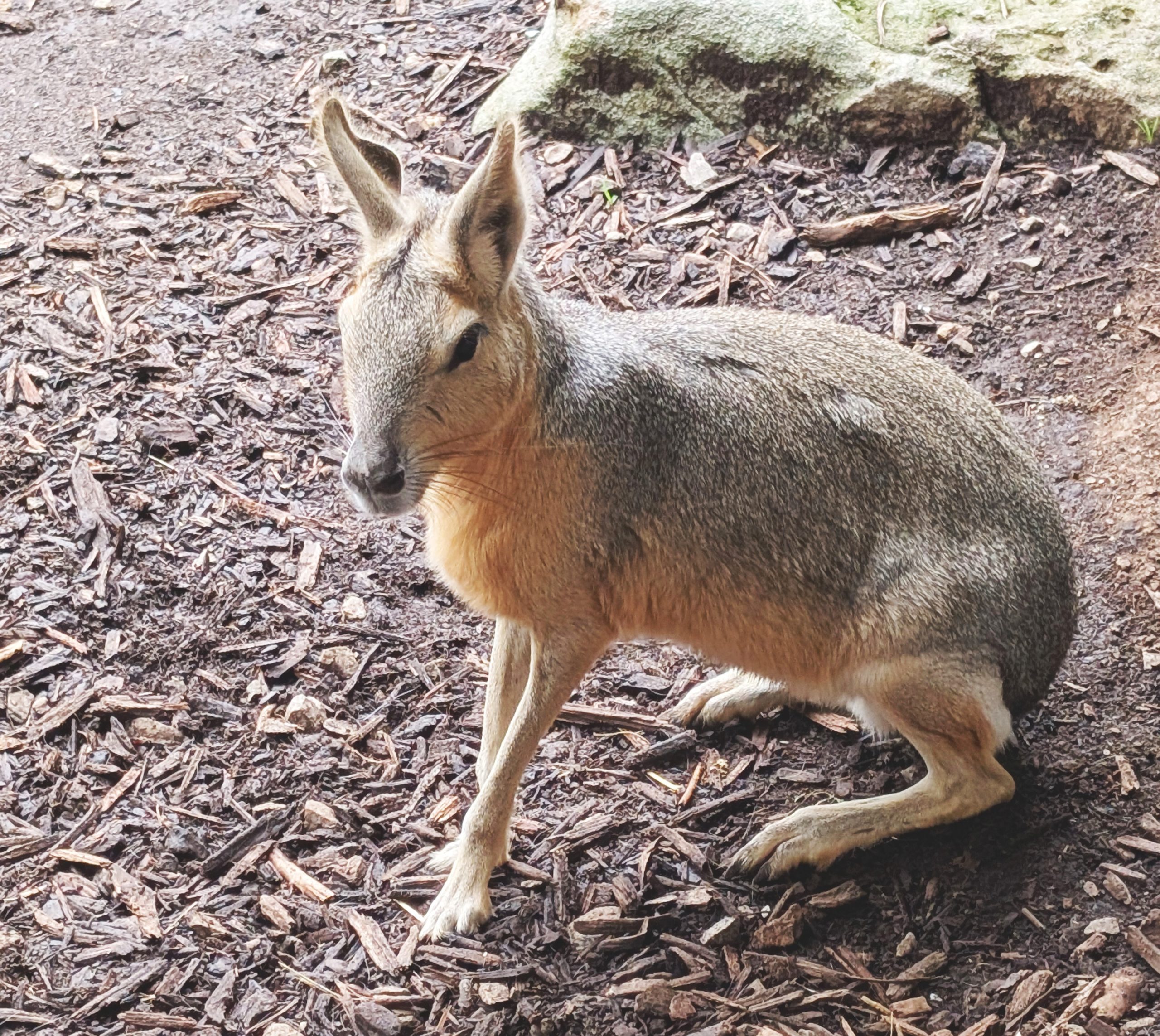
The Patagonian mara is one of the most unusual-looking rodents in the world. At first glance it appears to be a cross between a rabbit, a small deer, and a kangaroo, but it is in fact closely related to guinea pigs and capybaras.
Adults typically stand 45–50 cm (18–20 in) tall at the shoulder and can weigh between 8–16 kg (18–35 lb). Their bodies are built for speed and endurance across open landscapes.
The head is narrow and elongated with a rodent-like muzzle. Large upright ears give the animal a rabbit-like appearance and provide acute hearing, an important defense against predators in open terrain.
The coat is generally gray-brown or grizzled brown on the back with lighter buff or tan coloration along the sides and underside. The fur is short and dense, helping protect the animal from the temperature extremes of its native grasslands.
Mara legs are adapted for rapid running. The hind legs are long and powerful while the forelegs are shorter and more delicate. This gives them a distinctive sitting posture resembling a rabbit or small kangaroo.
The Patagonian mara is native to Argentina, particularly the dry plains and shrublands of Patagonia and central Argentina. Their natural habitat consists of open grasslands, scrublands, and semi-arid steppe environments where visibility is high and running speed is essential for survival.
Outside their native range they are found primarily in zoos, wildlife parks, and conservation collections.
In the wild, maras prefer wide open areas with scattered vegetation. They rely on clear sight lines to detect predators such as foxes, pumas, and birds of prey.
They are diurnal animals, most active during daylight hours. Maras typically live in pairs, forming strong long-term bonds. Groups may occasionally gather in areas where food is abundant.
Their diet consists mainly of:
Like many rodents, they practice coprophagy (re-ingesting certain droppings) to extract maximum nutritional value from plant material.
Patagonian maras are notable among rodents for their monogamous pair bonds.
Breeding pairs often remain together for life. Females give birth to litters of 1–3 young after a gestation period of roughly 90–100 days.
In the wild, several pairs may use a shared nursery burrow where young from different families are raised in proximity while adults guard the area.
Young maras are relatively well-developed at birth and begin grazing within a few weeks.
Primary threats to wild populations include:
The species is currently listed as Near Threatened by the IUCN due to gradual population declines in portions of its natural range.
The Patagonian mara represents a fascinating example of convergent evolution. Although it resembles rabbits and small ungulates in posture and locomotion, it evolved these traits independently as a grazing rodent adapted to life on open plains.
Their unusual appearance often surprises observers encountering them for the first time.
This profile and associated imagery are released by the Cernunnos Foundation as part of its open knowledge initiative. Text and images may be used freely for educational, research, artistic, and reference purposes, with attribution appreciated but not required.
The goal of this archive is to expand public access to accurate natural history information and to support artists, educators, and students in exploring the remarkable diversity of life on Earth.