
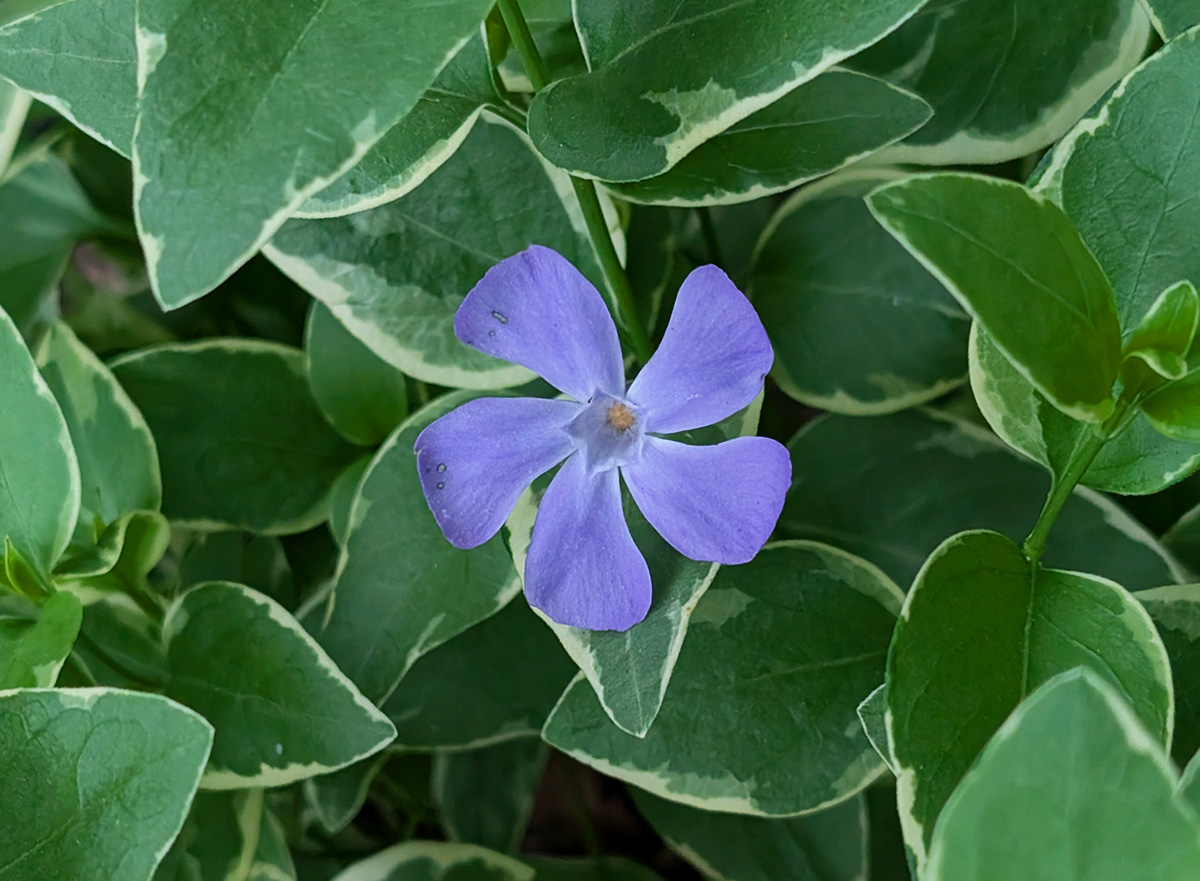
Vinca minor ‘Argenteovariegata’ is a low, trailing evergreen subshrub that spreads along the ground by rooting at stem nodes, forming dense, interlocking mats typically 10–20 cm tall. It spreads indefinitely outward over time, making it one of the more persistent and reliable groundcovers in cultivation. Individual stems may extend considerably in a single season. The variegated cultivar is somewhat less vigorous than the straight species, which makes it marginally easier to manage in garden settings.
Leaves are opposite, elliptic to oblong, 2–4.5 cm long and 1–2.5 cm wide, with a rounded to slightly wedge-shaped base and smooth, entire margins. The upper surface is a deep sea green with a leathery, slightly glossy texture. Each leaf is edged with a clean, irregular band of creamy white to ivory, giving the foliage a strongly variegated appearance even when the plant is not in flower. The midrib is pale and distinct. Petioles are short and exude a milky latex when broken, a characteristic of the Apocynaceae family.
Flowers are solitary, borne in the leaf axils on short pedicels. Each bloom is approximately 2–3 cm across with five asymmetrically twisted, fan-shaped petals in a soft violet-blue to periwinkle purple, joined at the base into a narrow tube. The center is pale, with a small, compact structure of fused stamens. The pinwheel arrangement of the petals is characteristic of the genus. Bloom is heaviest from early spring through early summer, with intermittent flowering continuing into autumn under favorable conditions. The flowers attract early bumblebees and other pollinators.
Fruit consists of paired, slender follicles that split to release seeds. Seed set is relatively uncommon in cultivated settings and particularly reduced in variegated forms. The plant spreads primarily by vegetative means rather than seed in gardens.
Vinca minor is native to central and southern Europe, ranging from Portugal and France north to the Netherlands and the Baltic states, east through central Europe to the Caucasus, and into southwestern Asia in Turkey. It is associated with shaded woodland floors, hedgerows, and forest margins in its native habitat.
Widely cultivated across temperate regions of North America, Europe, Australia, and New Zealand. It has naturalized extensively in the eastern United States and parts of Canada, where it escapes cultivation into woodland margins and disturbed forest understory. It is listed as invasive in several US states due to its ability to form dense colonies that displace native spring ephemerals and understory plants. The ‘Argenteovariegata’ cultivar is less aggressive than the straight species but should be planted with awareness of its spreading potential.
Light: Part shade to full shade; tolerates deep shade but blooms best with some indirect light Soil: Moderately fertile, well-drained to moist; tolerates a range of soil types including clay Moisture: Moderate; established plants are reasonably drought tolerant in shade USDA Zones: 4–9 Typical Habitat: Woodland edges, shaded slopes, north-facing banks, and garden margins; naturally found under deciduous canopy where it completes its growth cycle before full leaf-out
Vinca minor propagates most readily by division or stem cuttings. Rooted sections of stem can be separated from the parent mat and transplanted directly. Stem tip cuttings root easily in moist medium in spring or summer. Seed propagation is possible but uncommon in cultivation, particularly for the variegated cultivar. Plants establish quickly once rooted and begin spreading in the first season. Division of established mats is the most practical method for expansion or containment.
Generally very resistant to pests and disease outside its native range. Occasional issues include stem blight caused by Phoma exigua, which can cause die-back in dense mats during prolonged wet conditions. Vinca canker (Phytophthora) may occur in poorly drained soils. Deer will occasionally browse young growth. The primary ecological concern is invasive spread into native woodland habitats in North America, where dense mats can outcompete and eventually eliminate native spring wildflowers, ferns, and tree seedlings.
Established mats require very little care. Shearing or mowing back in early spring before new growth emerges refreshes the planting and encourages denser coverage. Runners extending beyond desired bounds can be pulled up easily — rooting is shallow and the plant does not produce a deep tap root. Division every few years keeps the mat from becoming overly dense. In garden settings adjacent to natural areas, physical edging or regular perimeter trimming is advisable to prevent escape into woodland. The variegated form is generally slower spreading than the species and somewhat easier to keep in bounds.
The genus name Vinca derives from the Latin vincire, meaning to bind or to fetter — a reference to the long pliable stems used in antiquity to weave garlands and crowns. The Italian common name fiore di morte, flower of death, reflects a grimmer historical use: in the Middle Ages, garlands of periwinkle were placed on the heads of condemned prisoners being led to execution, and the plant became associated with mortality and the passage between worlds. It appears in the writings of Jean-Jacques Rousseau, who described the intense pleasure of encountering it unexpectedly on a walk — one of the earliest recorded instances of plant-triggered involuntary memory. The alkaloid vincamine, derived from Vinca minor, has been studied for its effects on cerebral blood flow and is the basis for the semisynthetic drug vinpocetine, used in some countries as a cognitive support supplement.
Photographed in May 2025, a single violet-blue flower open at the center of a dense mat of variegated foliage. The cream-edged leaves were in excellent condition — clean margins, deep color, no pest damage visible. The plant was clearly well established, the mat thick and interlocking. The lone flower at center frame has the quality of something deliberate, as if the plant had placed it precisely there to be noticed. Identification confirmed by the opposite variegated leaves with entire margins and non-cordate base, the five-petaled pinwheel flower form, and the overall trailing mat habit consistent with Vinca minor ‘Argenteovariegata’.
All images and written content published on this site are provided freely for educational and artistic use. Attribution appreciated but not required. Knowledge grows when shared.