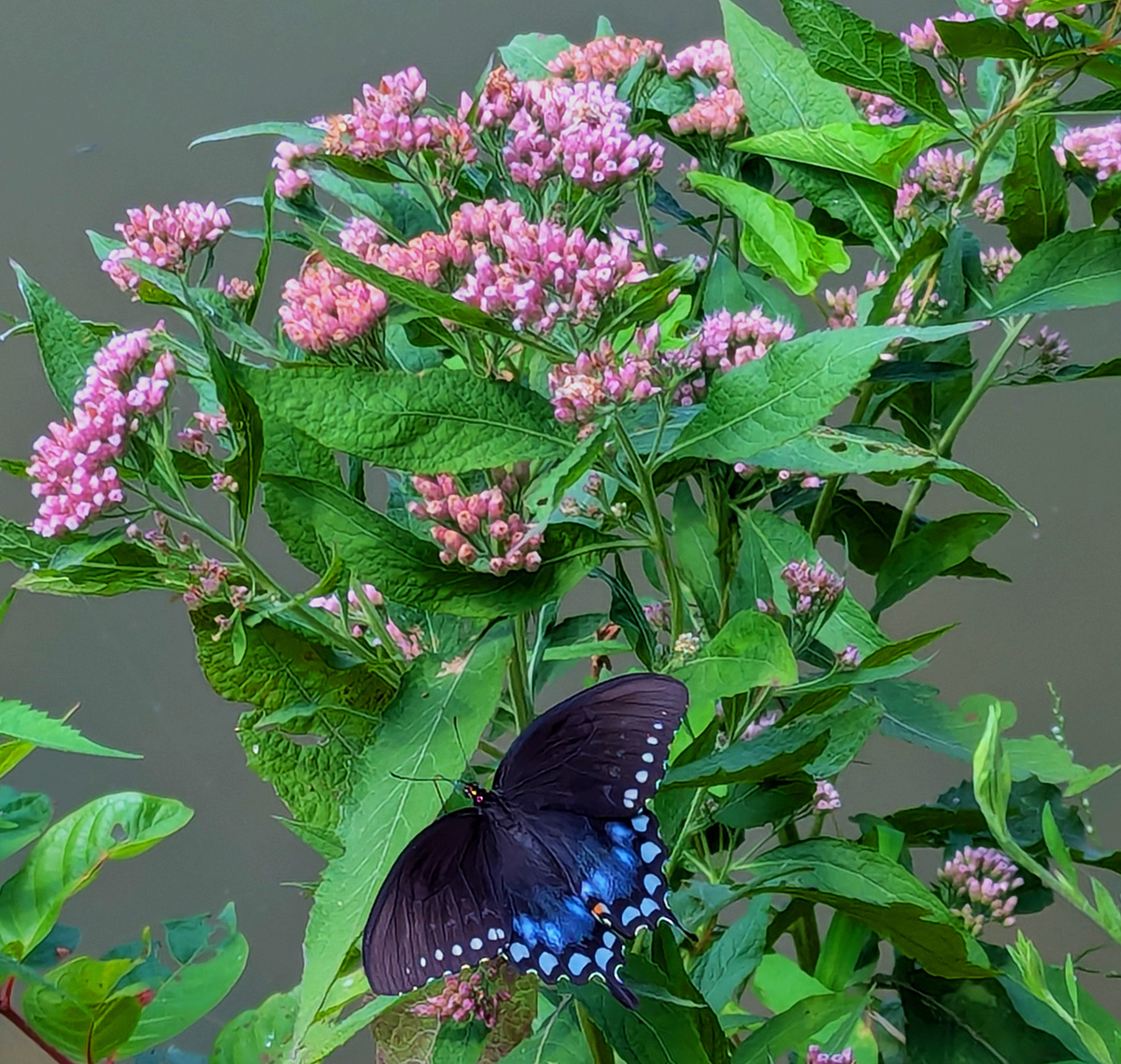
Papilio troilus
Taxonomy
Domain: Eukaryota
Kingdom: Animalia
Phylum: Arthropoda
Subphylum: Hexapoda
Class: Insecta
Order: Lepidoptera
Superfamily: Papilionoidea
Family: Papilionidae
Subfamily: Papilioninae
Genus: Papilio
Species: Papilio troilus
Common Names by Region
- United States / Canada: Spicebush swallowtail; “green-clouded swallowtail” in older references
- Regional / vernacular: Occasionally just “spicebush” among gardeners who grow the host
Description
Quick ID
- Size: Large, roughly 3.5–4.5 inch wingspan; tailed hindwings.
- Ground color: Brownish-black above.
- Hindwing wash: Broad iridescent cloud filling much of the hindwing — blue in females, blue-green/teal in males. The bright blue here points female.
- Marginal spots: A row of pale ivory-to-blue crescents along the wing edges. On the forewing they read as small light spots near the margin.
- Underside tell (if visible): Two arcs of orange spots on the hindwing, with one spot in the inner arc replaced by a blue-green patch — the classic “missing spot.”
- Separates from black swallowtail: No paired rows of clean yellow forewing spots, and no centered orange-and-black bull’s-eye at the anal angle.
Flight Season
- Spring through early fall in Pennsylvania, typically two to three broods (roughly May into September).
Look-alikes
- Black swallowtail (Papilio polyxenes): Yellow spot rows on the forewing and a bull’s-eye anal spot; less extensive hindwing blue.
- Red-spotted purple (Limenitis arthemis): No tails, and iridescent blue covers more of both wings; a mimic of the toxic model below.
- Pipevine swallowtail (Battus philenor): The toxic model this species mimics — more uniform blue-green sheen, single arc of orange spots beneath.
Known Range
- Native: Eastern North America, from southern Ontario and New England south to Florida and west to the Great Plains. Common and widespread across Pennsylvania, including the Conemaugh corridor.
Habitat & Host Plants
Habitat
- Woodland edges, streamsides, wet meadows, and gardens — anywhere its larval hosts grow near nectar.
Larval Host Plants
- Spicebush (Lindera benzoin) and sassafras (Sassafras albidum) are the primary hosts, with occasional use of other laurel-family plants. The butterfly’s common name comes straight from the host.
Adult Nectar
- Joe-Pye weed, milkweeds, thistles, jewelweed, and other summer wetland and meadow flowers — the streamside nectaring in this frame is textbook behavior.
Life Cycle / Reproduction
- Egg to adult through the familiar swallowtail sequence. Eggs are laid singly on host foliage.
- Caterpillar: One of the more remarkable in the region — green with two large false eyespots that give it a snake-like look, curling a leaf into a shelter and changing color (green to yellow-orange) before pupating.
- Overwinters as a chrysalis.
Pests / Threats
- Habitat loss where host shrubs are cleared; roadside mortality; parasitoid wasps and flies on larvae.
- Broadly stable across its range where spicebush and sassafras persist.
Additional Notes
Ecology & Mimicry
- A Batesian mimic of the toxic pipevine swallowtail, gaining protection by resembling a butterfly predators learn to avoid.
- An effective pollinator on its nectar rounds and a strong indicator that host laurels are present nearby.
Field Note
- Worth photographing the underside when you can — the “missing spot” pattern is the cleanest confirmation and settles any troilus-vs-polyxenes question at a glance.
Open Reference / Educational Use (CF Standard)
This profile is provided for open educational reference, field identification support, and art/illustration reference in the spirit of the Cernunnos Foundation field guide project. Reuse is encouraged with attribution to CF and your on-site page as the source.
Spotted Joe-Pye Weed
(image: same frame — the pink host of nectar beneath the swallowtail)
Eutrochium maculatum
Taxonomy
Domain: Eukaryota
Kingdom: Plantae
Subkingdom: Tracheobionta
Superdivision: Spermatophyta
Division: Magnoliophyta
Class: Magnoliopsida
Clade: Eudicots
Clade: Asterids
Order: Asterales
Family: Asteraceae
Genus: Eutrochium (formerly Eupatorium)
Species: Eutrochium maculatum
Common Names by Region
- United States / Canada: Spotted Joe-Pye weed, spotted trumpetweed
- Historical / vernacular: “Joe-Pye weed” broadly (after the folk-medicine namesake); “queen of the meadow” in some older texts
Description
Quick ID
- Growth form: Tall, upright, clump-forming perennial (commonly 3–6+ feet), often mistaken for a shrub. Stems frequently show purple spotting or a purplish cast.
- Flowers: Small, fuzzy, rose-pink to mauve florets packed into broad flat-topped clusters — the flat top separates it from the domed clusters of its Joe-Pye cousins.
- Buds: Plump and darker pink, giving the cluster a beaded, lacy texture before opening.
- Leaves: Lanceolate, coarsely toothed, rough-surfaced, in whorls of 4–5 at each node (the confirming character).
Blooming
- Mid- to late summer (roughly July into September), a prime late-season nectar source.
Look-alikes
- Hollow Joe-Pye / trumpetweed (Eutrochium fistulosum): Domed clusters and a hollow stem.
- Sweet Joe-Pye (Eutrochium purpureum): Domed clusters, vanilla scent, drier woodland edges.
- Swamp milkweed (Asclepias incarnata): Rounded umbels of crown-structured flowers and opposite, smooth-margined leaves — the alternative to rule out if leaves here are paired rather than whorled.
Known Range
- Native: Across much of northern and eastern North America, including all of Pennsylvania. Common along the wet ground of stream and pond margins throughout the region.
Care / Habitat
Light
Soil
- Rich, consistently moist to wet soil; tolerates heavy and mucky ground.
Water
- Moisture-loving. Happiest with wet feet — streambanks, ditches, pond edges, wet meadows.
Typical Habitat (when naturalized / wild)
- Riparian edges, wet meadows, marsh borders, and seeps — exactly the water’s-edge setting in this frame.
Propagation / Reproduction
- Perennial, spreading by seed and by slowly expanding root crowns.
- Seed: Wind-dispersed with a pappus; self-sows on open moist ground.
- Division: Easily divided in spring for garden or restoration use.
Pests / Diseases / Threats
- Generally robust. Occasional powdery mildew or leaf spot in crowded, humid stands; leaf miners now and then.
- No significant threats where wetland habitat persists; a strong candidate for rain gardens and streambank plantings.
Additional Notes
Ecology & Use
- A heavyweight pollinator plant — butterflies (including the swallowtail above), native bees, and other insects work it hard through late summer when few other nectar sources bloom.
- The Joe-Pye name traces to folk-medicine tradition; the genus was long filed under Eupatorium before the segregate genus Eutrochium took the whorled-leaf species.
- Excellent structural anchor for a native wet-meadow or riparian planting.
Management
- Leave standing through winter for seed and stem habitat; cut back in early spring.
- Divide crowns to propagate or to hold a clump in bounds.
Open Reference / Educational Use
This profile is provided for open educational reference, field identification support, and art/illustration reference in the spirit of the Cernunnos Foundation field guide project. Reuse is encouraged with attribution to CF and your on-site page as the source.
Post Views: 66