
Kingdom: Animalia
Phylum: Chordata
Class: Amphibia
Order: Caudata (Urodela)
Family: Plethodontidae (Lungless Salamanders)
Genus: Desmognathus
Species: Desmognathus fuscus (Rafinesque, 1820)
General: Dusky Salamander, Northern Dusky Salamander
Canada: Northern Dusky Salamander (common in parts of the east; noted as widespread in Canada within its range)
United States (regional guides): Northern Dusky Salamander
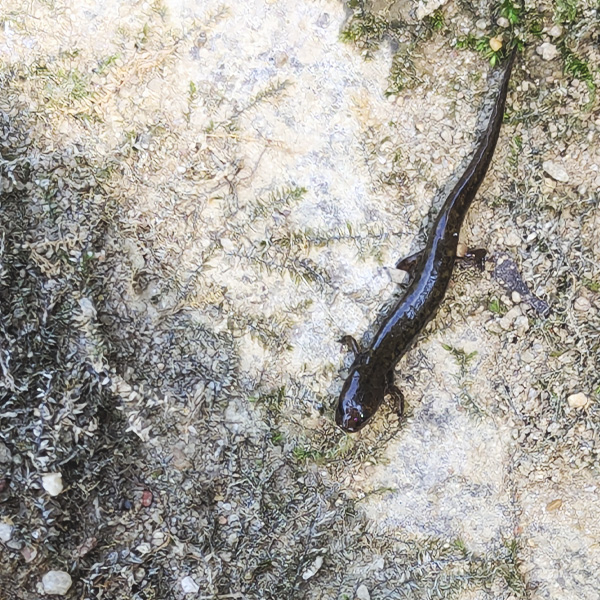
The Northern Dusky Salamander is a small, sturdy streamside salamander built for life at the edge of water—typically found in saturated soil, seepage zones, springs, and along small headwater streams.
Coloration is variable (brown, gray, olive, or darker tones), often with mottling along the sides and a lighter underside that may be mottled as well. Many individuals show a pale line extending from the eye toward the jaw—one of the more consistent field marks across the “dusky” lookalikes.
A key structural cue is the laterally compressed tail with a distinct dorsal keel—a “knife-like” profile that reads clearly when you see the animal from above or the side.
This species is typically encountered under rocks, logs, leaf litter, moss, and streambank cover—often very close to water, because it is highly vulnerable to drying out.
Eastern North America, with records spanning from parts of eastern Canada (e.g., New Brunswick / Quebec noted in range summaries) southward through the eastern United States, and westward into portions of the Midwest within its broader distribution. Range limits and “dusky” IDs can be confusing because closely related species overlap or replace one another regionally.
CF generally discourages casual captivity for native amphibians. If temporary holding is required for research/rehab contexts, the critical needs are cool temperatures, constant humidity, clean water, and abundant hides—and strict attention to legal/ethical handling rules in your area. (For most readers: observe, photograph, and release.)
Females typically lay eggs in concealed, moist microhabitats near streams (e.g., under logs, rocks, moss, or within bank cavities). Larvae are aquatic and remain associated with stream substrate spaces until metamorphosis.
Conservation note: Listed as Least Concern on IUCN-based summaries for the species, though local status can vary by region and habitat condition.
This is a lungless salamander (Plethodontidae): respiration is largely through skin and mouth tissues, which is one reason moisture and clean microhabitat conditions are so non-negotiable for long-term survival.
Dusky salamanders are excellent “watershed truth-tellers.” If the seep dries, the canopy opens, the banks silt in, or pollutants creep in, they often disappear quietly—long before people notice the system has shifted.
If you want dusky salamanders, manage for headwaters:
The Dusky Salamander is not flashy. That’s the point.
It lives where systems are honest:
where water moves slowly through stone and roots,
where shade holds the temperature,
where the ground stays damp enough for skin to breathe.
In a world that loves big signals—charts, dashboards, declarations—this animal is a small, living measurement:
If the headwaters are cared for, it remains.
If they’re neglected, it vanishes.
Not as a protest.
As a fact.
Unless otherwise noted, Cernunnos Foundation content is shared to support education and artistic reference. You may quote, adapt, or build from this material for educational and creative work with attribution.