
Kheow (Thailand)
Clouded Leopard
Mint Leopard
Tree Tiger
Rimau Dahan (Malay — “branch tiger”)
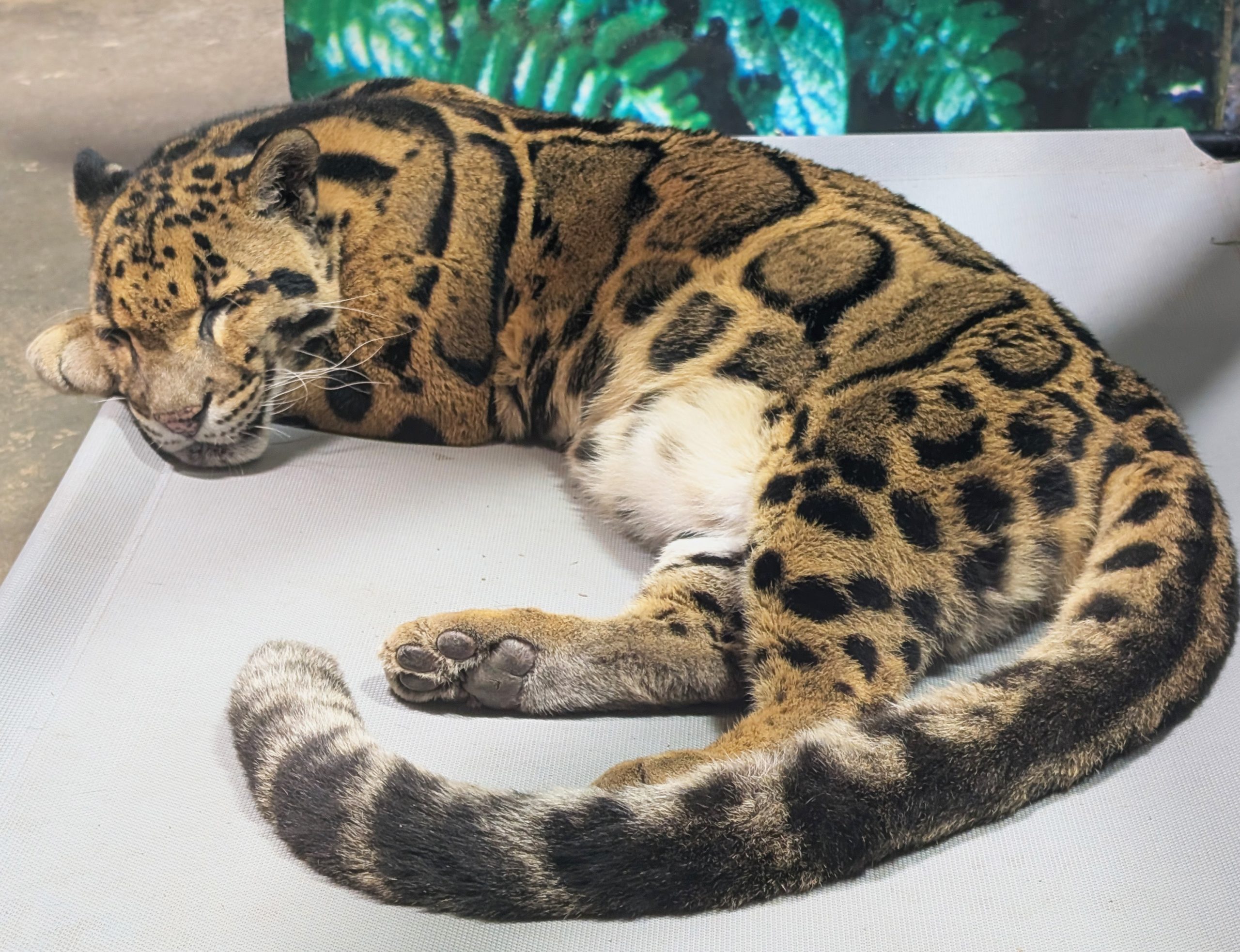
The clouded leopard is a medium-sized wild cat immediately recognizable by its extraordinary coat — large, irregular dark-bordered blotches called “clouds” set against a warm tawny background, the largest such markings relative to body size of any living felid. The body is long and low-slung, built for an arboreal life, with short powerful legs, disproportionately large rounded paws, and a remarkably long tail that may equal the body in length and serves as a balance organ in the trees.
The head is elongated and heavy-jowled, housing canine teeth that are proportionally the longest of any living cat — so extreme in their development that clouded leopards are sometimes described as the closest living analog to the saber-toothed cats of the Pleistocene.
Length: 60–110 cm body; tail adds an additional 55–90 cm Weight: 11–23 kg
Males are substantially larger than females and may approach twice their weight. This is pronounced sexual dimorphism even by felid standards.
The base coat ranges from tawny to pale yellow-brown. Each “cloud” rosette has a thick, irregular dark border enclosing a center slightly darker than the background coat, creating the layered pattern the species is named for. Underparts are white to pale cream. The legs and tail carry solid black spots. Two dark stripes run from the inner corners of the eyes toward the nape, and the ears are black-backed with a pale central spot.
Melanistic (all-black) individuals are rare but documented, particularly in Borneo — though the Bornean population is now recognized as a separate species, the Sunda Clouded Leopard (Neofelis diardi). Each individual’s cloud pattern is unique, functioning somewhat like a fingerprint.
Cubs are born with lighter, less defined patterning that gradually darkens and sharpens through the first months of life. The characteristic cloud markings become distinct by around six months. Full adult coloration is largely achieved by one year.
The clouded leopard ranges from the eastern Himalayan foothills through Southeast Asia — including Nepal, northeastern India, Bhutan, southern China, Myanmar, Thailand, Vietnam, Laos, Cambodia, and the Malay Peninsula. It has been historically recorded in Taiwan but is considered extinct there. It is absent from Borneo and Sumatra, where the closely related Sunda Clouded Leopard takes its ecological place.
The species occurs from sea level up to approximately 2,500 m elevation in montane forest, making it one of the more elevation-tolerant felids in its range.
Habitat: Tropical and subtropical evergreen forest; also found in secondary forest, grassland edges, and mangroves Activity: Primarily crepuscular and nocturnal; some daytime activity recorded Social: Solitary; pairs form only briefly during mating
The clouded leopard is among the most skilled arboreal climbers of all cats. It can hang upside-down from branches by its hind feet, rotate its ankles nearly 180 degrees, and descend trees headfirst with ease — capabilities shared with few other felids. Despite this, it hunts primarily on the ground.
The species is secretive and rarely observed in the wild even within its range. Most population data comes from camera traps and studies of captive individuals. Home range size is poorly documented but estimated at 23–44 km² for males in some study areas. Territory is maintained through cheek rubbing, urine spraying, and scratch marking.
Diet Type: Carnivore
Primary prey includes deer (particularly muntjac and sambar), wild pigs, and monkeys. Secondary prey includes porcupines, civets, birds, and smaller mammals. Near forest edges, clouded leopards occasionally take livestock, which is the primary driver of human conflict and retaliatory killing across much of the range.
Breeding Season: No strict seasonality; breeding occurs year-round in captivity Gestation: Approximately 85–93 days Litter Size: 1–5 cubs; typically 2–3 Parental Care: Female only; cubs remain with the mother for 9–10 months
The clouded leopard is one of the most difficult felids to breed in captivity, largely due to high rates of male aggression toward females during introduction. Captive breeding programs have found that raising potential pairs together from a young age significantly improves reproductive success. Cubs are altricial — largely helpless at birth — and develop rapidly, opening their eyes at 10–12 days and exploring their environment by five to six weeks. Sexual maturity is reached at approximately 24–30 months.
Conservation Status: IUCN Vulnerable (assessed 2015)
Clouded leopards are protected under CITES Appendix I, and hunting is legally prohibited across all range countries, though enforcement varies considerably. Forest protection and wildlife corridor connectivity are identified as the highest conservation priorities for wild populations.
In captivity, the species requires large, complex enclosures with extensive vertical climbing structures, visual cover, and environmental enrichment. The species is highly sensitive to stress — low-traffic housing and visual barriers are standard management tools. Diet typically consists of whole prey or raw meat supplemented with bones to support dental health. Captive populations are managed under Species Survival Plan (SSP) programs in North America and equivalent Endangered Species Programs (EEP) in Europe.
The clouded leopard occupies a phylogenetically unique position within Felidae. It is the oldest diverging lineage within the subfamily Pantherinae, splitting from the ancestor of lions, tigers, leopards, and jaguars approximately 6 million years ago — making it a genuinely ancient lineage rather than simply a mid-sized member of a familiar group.
Its canine teeth are not merely unusual in proportion — they represent a convergent evolution with true saber-toothed cats of the Pleistocene, making the clouded leopard of significant interest to paleontologists and evolutionary biologists alike.
Vocally, the species produces a repertoire unlike either small or large cats — it cannot roar (lacking the fully ossified hyoid of the Panthera lineage) but does not purr continuously on both inhale and exhale as small cats do. Instead it purrs only on exhale, and its calls include prusten (the chuffing greeting shared with tigers), moaning, hissing, and a distinctive meow not found in any large cat.
Photographed at a zoological facility, March 25, 2026. The subject was curled and resting on an elevated platform in an indoor enclosure with a tropical rainforest mural backdrop — a common setup for clouded leopards, which are highly stress-sensitive and rarely put themselves on display for visitors. What struck me first was the sheer scale of the paws and the tail: the tail wrapped nearly full-circle around the body, and the feet were enormous relative to the frame — you could really understand the arboreal design in a glance. The cloud rosettes were more dramatic in person than any photo communicates — thick, irregular dark borders with slightly darker centers against warm tawny fur.
Identification confirmed by the combination of cloud patterning, elongated jowl structure, oversized paws, and tail length. A genuinely rare sight even in captivity. These cats spend most of their time hidden, and a relaxed, visible animal is something to stop and appreciate.
This profile is part of the Cernunnos Foundation Open Knowledge Archive.
All text may be freely used, quoted, reproduced, or expanded for educational and research purposes. The goal of this archive is to provide clear, accessible natural history information without restriction.
Knowledge grows when it is shared. Copy it. Improve it. Build on it.