
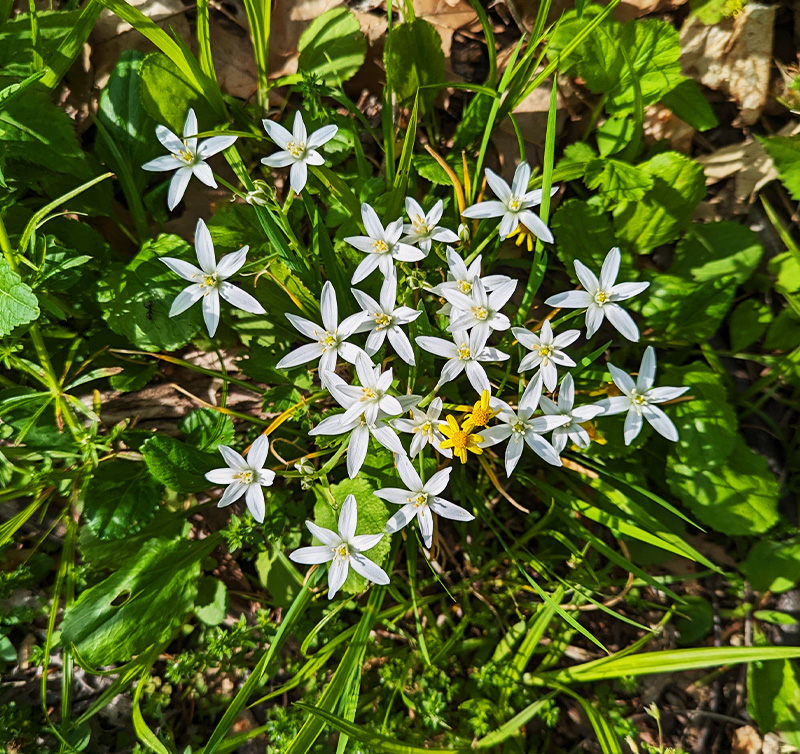
Ornithogalum divergens is a small bulbous perennial growing from a white, tunicate bulb. Plants typically reach 15–30 cm in height and spread gradually into loose colonies through a combination of offset bulb production and self-seeding. Foliage dies back after flowering and the plant enters summer dormancy, a pattern typical of Mediterranean geophytes naturalized into temperate landscapes.
Leaves are basal, linear, and grass-like, 10–30 cm long and 3–7 mm wide, with a distinctive pale white midrib stripe running the full length of the upper surface. Texture is smooth and slightly succulent. They emerge in early spring and begin yellowing as the plant approaches and passes peak bloom.
Flowers are borne in a loose, spreading raceme on a slender scape. Each bloom has six white tepals with a green stripe on the outer surface, surrounding yellow-green stamens with distinctively broadened, flattened filament bases. Individual flowers are star-shaped and roughly 2–3 cm across. The inflorescence is notably divergent rather than tightly upright — the primary trait separating this species from close relatives. Bloom period runs April through June depending on latitude and local conditions.
Fruit is a small three-lobed capsule containing angular black seeds that ripen in summer and disperse locally when the capsule splits. The plant also spreads vegetatively through daughter bulbs that gradually separate from the parent.
Native to central and western Europe, with a core distribution across France, the Iberian Peninsula, and into central Europe including Germany, Switzerland, and the Low Countries. It is associated with traditionally managed grasslands, open woodlands, and vineyard margins. The species has naturalized broadly in the northeastern United States and parts of Canada, spreading readily in disturbed ground, roadsides, lawns, and garden margins. In parts of North America it is considered a minor invasive.
Light: Full sun to part shade Soil: Well-drained, moderately fertile; tolerates poor and rocky soils Moisture: Drought tolerant once established; prefers dry conditions during summer dormancy USDA Zones: 4–9 Typical Habitat: Open grasslands, meadow edges, woodland margins, roadsides, and disturbed ground; commonly found in thin soils and semi-shaded garden settings
Ornithogalum divergens spreads readily by both seed and vegetative offset. Seeds germinate in spring without requiring cold stratification. Bulb offsets can be divided and replanted in late summer or fall during dormancy at a depth of approximately 5–8 cm. Once established, colonies expand on their own with minimal intervention.
Generally pest-resistant; deer and rabbit browsing is uncommon due to mild toxicity. Bulb rot can occur in heavy or poorly drained soils during wet winters. All parts of the plant contain cardiac glycosides and are toxic to humans, dogs, cats, and horses if ingested — a trait shared across the genus. The species carries some invasive potential in disturbed North American habitats where it can outcompete native spring ephemerals.
Once established, O. divergens requires very little attention. Deadheading after bloom limits seed spread and is advisable where naturalization is not desired. Allow foliage to yellow and die back naturally before cutting, as the leaves continue feeding the bulb after bloom. Dividing crowded clumps every few years maintains vigor and controls spread. Where containment is a priority, physical root barriers or container planting will prevent offset migration.
Ornithogalum divergens is one of several similar white-flowered species frequently grouped or confused under the shared common name Star-of-Bethlehem. Taxonomic treatment of this group has shifted over time, and O. divergens is sometimes treated as a variety within the broader O. umbellatum aggregate, though it is now generally accepted as a distinct species based on its spreading inflorescence architecture and chromosome count. The genus name Ornithogalum derives from the Greek for “bird’s milk,” a classical expression for something wonderfully improbable — a fitting name for flowers that appear almost luminous against early spring ground cover. Ecologically, the blooms provide an early nectar and pollen resource for small native bees and hoverflies.
Photographed in Geistown, Pennsylvania in early spring, growing in a semi-shaded garden margin alongside creeping Charlie and lesser celandine. The colony had clearly naturalized from a prior planting, spreading outward across disturbed ground near a stone foundation. Flowers were fully open in morning light, the white tepals bright against the surrounding green. A single lesser celandine bloom visible at center frame served as an unplanned but useful scale reference. Identification confirmed by the divergent raceme, green abaxial tepal stripe, broadened stamen filaments, and pale midrib on the basal leaves.
All images and written content published on this site are provided freely for educational and artistic use. Attribution appreciated but not required. Knowledge grows when shared.