
Kingdom: Plantae
Clade: Angiosperms
Clade: Eudicots
Order: Boraginales
Family: Boraginaceae
Genus: Myosotis
Species: Myosotis scorpioides L.
General: Water Forget-me-not, True Forget-me-not
Europe: Water Forget-me-not, Marsh Forget-me-not
North America (naturalized): Water Forget-me-not
Traditional / Historical: Scorpion grass (referring to coiled flower stems)
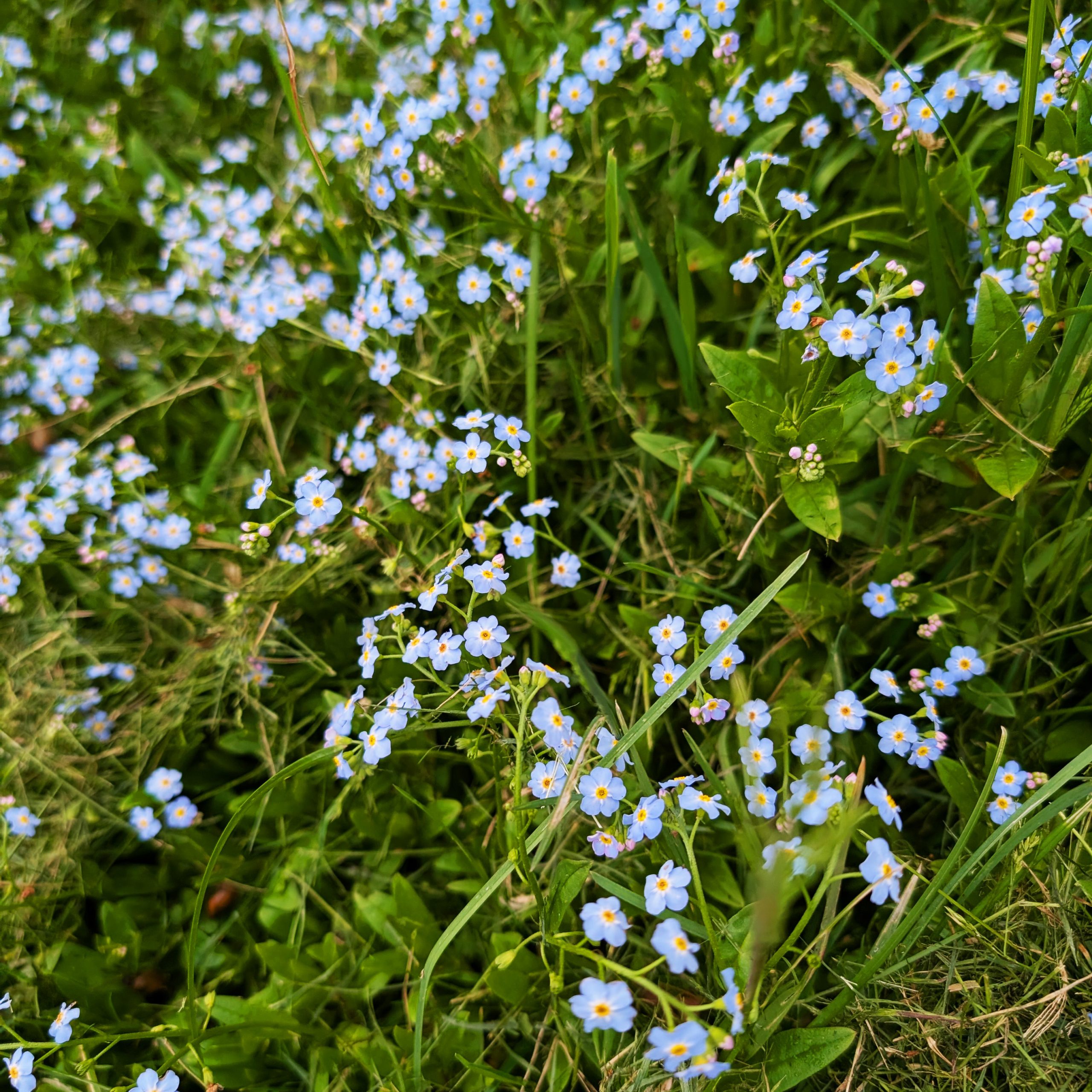
Myosotis scorpioides is a low, rhizomatous perennial adapted to wet environments. Stems are soft, slightly hairy, and often trail or lean into surrounding vegetation, rooting where they contact moist ground.
Leaves are narrow, oblong, and lightly textured, arranged alternately along the stem. The plant forms loose colonies rather than rigid clumps, creating soft mats along water edges.
Flowers are small and intensely recognizable: bright sky-blue petals surrounding a yellow eye, often opening from pinkish buds. Flowers are arranged in curved clusters that unfurl gradually — a scorpion-tail shape that gives the species its name. Blooms typically appear from late spring through summer and may continue into autumn in consistently moist conditions.
The overall impression is gentle and understated — a plant that reads more as atmosphere than structure.
Native to: Europe and parts of temperate Asia
Widely naturalized in: North America and other temperate regions
Myosotis scorpioides frequently escapes cultivation and establishes in wetlands, stream margins, and ponds, where moisture remains consistent throughout the growing season. It may become locally abundant in suitable habitats.
This species is designed for transition zones between land and water and struggles in dry or heavily drained environments.
Colonies slowly expand over time, especially where water levels fluctuate.
Monitoring spread is advised near sensitive wetlands.
Water Forget-me-not succeeds not through dominance, but through persistence and adaptability.
Forget-me-nots thrive at the edge.
They live where land blurs into water, where certainty gives way to change. They do not demand attention through size or spectacle — they earn notice through repetition, color, and presence.
A single flower is easy to overlook.
A thousand quietly reshape the shoreline.
In ecological terms, Myosotis scorpioides demonstrates a quiet principle: resilience comes from flexibility, not force.
It reminds us that memory in nature is rarely a monument. More often, it is a small blue thing that returns every year where water lingers.
Content and images published by the Cernunnos Foundation are provided freely for educational, artistic, and reference use unless otherwise noted. Sharing and adaptation for learning or creative work is encouraged.